Life and resiliency in a rowing shell
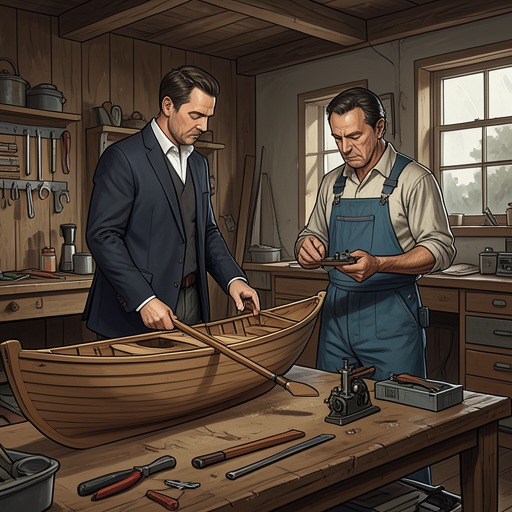
The Boys in the BoatLife and resiliency in a rowing shell is the material responsiveness that George Yeoman Pocock designed into his cedar boats and the meaning he drew from their behavior on the water. A shell was not merely a rigid platform for rowers: its flexible skin, compressed against a resistant frame, could store tension and spring forward with the oars. For Pocock, that capacity to respond and recover made the boat a participant in the crew’s movement, and gave technical construction a human significance.
The Material Basis of Resilience
Pocock’s idea depended on cedar’s particular qualities. Its low density made it easy to shape and light enough to favor speed; its even grain made it strong yet flexible, less inclined to twist or warp than many alternatives. These properties allowed a thin cedar skin to bend around the shell’s frame while remaining durable. The result was a boat whose responsiveness was not added as a mechanism separate from its materials, but emerged from how those materials behaved together.
The process drew on cedar’s ability to take and retain a bend. Pocock strapped thin sheets of wood over the shell’s frame, covered the assembly with blankets, and directed steam from the shell house’s heating system underneath. After three days, the relaxed cedar had conformed to the frame’s shape. Once dry, the sheets could be glued in place. The method echoed the Coast Salish peoples’ longstanding use of bent cedar to make boxes, while allowing Pocock to produce a sleek shell without nailing each plank separately to the ribs. The boat’s efficiency and appearance thus came from a controlled accommodation: the wood yielded to a form, then held it.
Camber and Stored Tension
The shells acquired another, initially puzzling characteristic after they had spent time in the water. People called them “banana boats” because the bow and stern curved slightly upward. Pocock eventually understood that the change arose from the different responses of cedar and ash. Cedar does not swell across its grain when wet, but it can expand along the grain; in a sixty-foot shell, that lengthwise expansion could amount to as much as an inch. The cedar skin had been dry when fastened to the frame. In regular use, it became wet and tried to lengthen, while the ash frame remained dry and rigid, preventing it from doing so.
That resistance compressed the cedar skin and lifted the ends of the shell into a subtle curve known as camber. The important effect was not simply the boat’s altered outline. Because the skin remained compressed against a frame that would not give way, the whole shell carried a continuing tension, compared in the account to a drawn bow awaiting release. On the catch of the oars, that tension gave the boat a springing liveliness: it tended to move forward in a way Pocock believed no other design or material could duplicate. Resilience, in this account, is not softness or mere flexibility. It is the stored capacity to answer resistance with renewed motion.
A Living Shell and a Moving Crew
Pocock’s description of the good shell joined its material behavior to the coordination of the rowers. He wrote, “A good shell has to have life and resiliency to get in harmony with the swing of the crew.” The shell’s spring was valuable because it could work with the crew’s collective rhythm, rather than merely carry eight separate efforts. Its life depended on the meeting of wood, water, and coordinated human movement: the material gave back at the point when the oars engaged, while the crew supplied the shared motion that made that response useful.
This relationship also shaped Pocock’s insistence that the boat be allowed to move freely. He described the shell as sensitive and argued that if it was not let go free, it would not work for the crew. The principle makes the boat’s responsiveness conditional. A resilient shell does not produce a crew’s harmony by itself; it can support that harmony only when it is not constrained from responding. Its construction and its handling therefore belong to the same idea: the shell must be built to yield and rebound, and then allowed to do so in motion.
Craftsmanship and Meaning
Pocock treated resilience as the distinctive value hidden inside the cedar’s behavior: its readiness to bounce back, keep coming, and persist against resistance. He considered that quality the shell’s life, and a shell without such life unworthy of the young men who gave their hearts to moving it through the water. The judgment reaches beyond a claim about speed. The boat’s worth is measured by whether its qualities answer the sustained effort of the people who use it.
The concept consequently holds engineering and interpretation together without making them identical. Camber and compression describe physical effects; life and resilience name the responsiveness Pocock believed those effects produced. His account does not turn the shell into a substitute for the crew. Rather, the boat becomes more than passive equipment because its material structure contributes to the shared action: it stores tension, releases it into forward motion, and enters into harmony with the crew’s swing. In this sense, the shell’s resilience is both a feature of its design and an image of persistence made effective through cooperation.