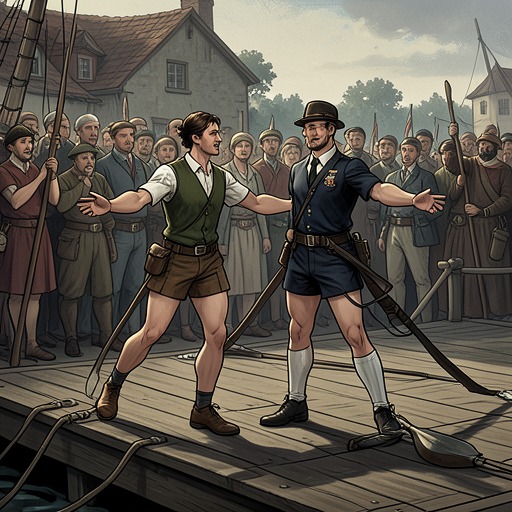
Long Beach Marine Stadium
The Boys in the BoatLong Beach Marine Stadium becomes the stage for a tightly compressed contest with consequences far beyond its finish line. On an arrow-straight saltwater course, the Washington Huskies rowing team and the California crew raced over the Olympic distance of 2,000 meters before a crowd of more than six thousand. California’s half-second victory left Al Ulbrickson without the redemption he had hoped to find there, while reinforcing the question of which western crew could claim the path to Berlin.
Setting and Spectators
Long Beach Marine Stadium is presented through the conditions surrounding the race rather than through architectural description. More than six thousand spectators packed the venue, some in bleachers and others standing on the sand along both sides of the course. The waterway’s straightness gives the contest a visible line of pursuit: the crews can be watched driving down the course, almost locked together, with the finish approaching in full view.
The backdrop is not pastoral. A forest of oil derricks rose behind the spectators, while a thin, acrid smell of petroleum hung over the venue. The air itself was relatively calm, with only a light breeze crossing the course from the Pacific. Those details frame the race in a working, industrial landscape and distinguish its setting from the storied eastern regatta culture associated with Poughkeepsie. Here the western rivalry plays out in a stadium whose large audience and conspicuous surroundings make the contest both a local sporting spectacle and a test watched for its national implications.
A Western Rivalry at Olympic Distance
The stadium’s importance rests on the stakes brought to it by the crews. The national press had recently treated California’s varsity as almost certain to represent the United States at the 1936 Olympics in Berlin. Ulbrickson was determined to challenge that assumption. The Long Beach race offered an immediate chance to change the prevailing view, and rumors in Seattle had made the result personal: a defeat might cost him his job.
The distance made this more than a repeat of the four-mile contest at Poughkeepsie. Two thousand meters was the Olympic distance, and the shorter race demanded a different kind of calculation. Crews still needed a strong start, enough speed through the middle to remain within reach, and a final sprint; at this distance, however, each phase arrived faster, and positioning and timing became more urgent. The venue thus hosts a contest over both strength and judgment, with the crews required to manage a short, intense race rather than simply reproduce their performance over a longer course.
The Race and Its Result
Washington and California bounded ahead of the rest of the field and then raced nearly level for most of the course, both boats moving in full-sprint mode. With 200 meters remaining, California edged ahead by inches. At 100 meters, its lead had grown to a quarter of a length. The narrowing distance turned the final stretch into a visible reversal-in-progress: Washington had to close the gap while California tried to hold it.
Bobby Moch suddenly shouted something to his crew. He had recently added a chant to his calls and noted it in his scrapbook as an obscene reference to California coach Ky Ebright, but he never said whether that was what he yelled at Long Beach. Whatever the words were, Washington surged forward in the final 50 meters and rapidly closed on California. The comeback stopped short. Ebright’s crew finished in 6:15.6, half a second ahead of Washington.
Consequences and Narrative Significance
The finish made Long Beach Marine Stadium the setting of a missed opportunity rather than a clean redemption. Ulbrickson had sought a result that could upset the press’s expectations about Olympic selection and perhaps secure his position; instead, he returned home with another defeat, possibly his last. The stadium’s close contest therefore registers as a consequential setback even though Washington nearly erased California’s lead in the closing meters.
The race also gives physical form to a larger struggle for recognition. Collegiate crew drew substantial press attention and crowds in the period, but western programs had long competed for standing against an eastern center of influence. Within the longstanding rivalry between the University of Washington and the University of California, Berkeley, Long Beach Marine Stadium becomes a site where that regional contest is judged at the Olympic distance. Its packed banks, industrial horizon, and near-tie finish bring together public spectacle, coaching pressure, and the uncertain selection of a national representative.