Olympic ideal
The Boys in the BoatThe Olympic ideal holds that athletes of different nations and races should meet and compete on equal terms. In the book, it is more than an abstract sporting principle: its clash with Nazi racial doctrine, and its uneasy coexistence with class privilege and unequal resources, make the 1936 Games a test of what equality in sport could mean in practice.
A principle in conflict with Nazi doctrine
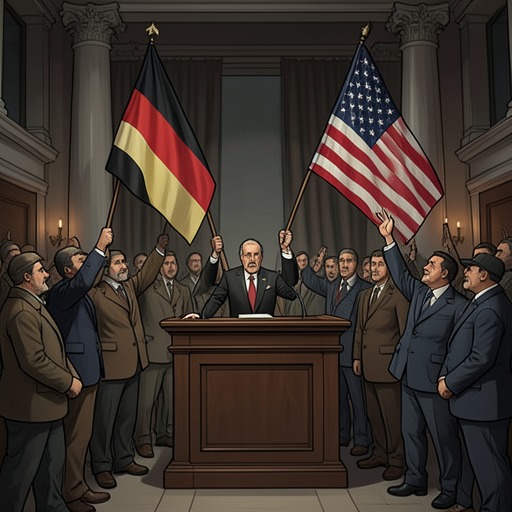
The ideal’s defining premise—that athletes of all nations and races could mingle and compete as equals—directly opposed the National Socialist Party’s belief in Aryan superiority. Adolf Hitler had condemned the Games as an invention of Jews and Freemasons and objected to the prospect of Jews, Black people, and other visitors entering Germany. His later change of position did not erase that ideological conflict. Rather, the preparations for the 1936 Olympics brought the universal promise of international sport into the setting of a regime whose racial hierarchy denied that promise.
Joseph Goebbels, the minister of public enlightenment and propaganda, was instrumental in Hitler’s change of mind. The contrast matters: an event founded on international athletic fellowship could also be useful to a government seeking political advantage. The ideal therefore appears not as a guarantee that sport stands apart from politics, but as a principle whose meaning and public presentation could be contested by the regime hosting the Games.
International sport and the struggle for recognition
The ideal also took shape in the widening reach of collegiate rowing. During the 1920s and 1930s, crew drew large crowds and extensive press coverage, and leading oarsmen received national attention. Eastern colleges, which modeled their rowing traditions on elite British institutions such as Eton College, sent their crews into prominent universities including Harvard University, Yale University, and Princeton University. This history gave rowing prestige, but it also tied that prestige to established institutions and social standing.
On the West Coast, the University of Washington and the University of California, Berkeley had competed in an annual rivalry since 1903. Their regattas could draw tens of thousands, and western crews had begun to challenge eastern dominance. Yet their programs had long struggled for funding and recognition, while western coaches were paid far less than their eastern counterparts and neither school had money for recruitment or wealthy patrons. The center of collegiate rowing’s influence still lay among eastern universities. The Olympic ideal’s language of equal competition thus sat alongside a sporting landscape in which reputation, resources, and access were unevenly distributed.
The cost of crossing that divide was tangible. Western teams faced expensive journeys east with fragile racing shells, and their athletes encountered condescension as well as curiosity. Washington’s 1913 appearance at the Poughkeepsie regatta produced a surprising third place, but the western crews returned only occasionally over the following decade because the expense was difficult to justify. Their later successes challenged assumptions about who belonged among the country’s leading crews without immediately dissolving the inequalities that had shaped those assumptions.
Class boundaries within rowing
The contrast between rowing’s public reach and its social boundaries is especially clear at the Henley Royal Regatta. Its rules barred anyone who had earned wages as a mechanic, artisan, or labourer from competing. When the Australian crew, made up of policemen, was excluded because policemen were treated as labourers, its members left for Berlin determined to race there instead. The episode shows how a celebrated rowing tradition could define athletic eligibility through occupation, reserving competition for men deemed socially suitable.
That exclusion does not by itself define the Olympic ideal, but it sharpens the question the ideal raises: who is allowed to compete as an equal? The contrast is pointed. At Henley, paid work could disqualify an athlete; in the American college system, working-class crews had to contend with a scarcity of patrons and the cost of travel. The ideal of national and racial fellowship did not automatically remove such class barriers.
The price of participation
The tension became immediate after the Washington crew won its place at the Games. At the Princeton banquet, the boys found the customary purple necktie and five-dollar bill at each setting, but rumors of a different kind were spreading. Henry Penn Burke told Al Ulbrickson, George Pocock, and Ray Eckman that Washington would have to pay its own way to Berlin. He demanded $5,000 by the end of the week and warned that the second-place University of Pennsylvania could take Washington’s place.
The demand exposed how a formal invitation to compete could still depend on a team’s ability to meet the costs. The American Olympic Committee lacked funds, but the Washington athletes could not pay their own fares. They were working-class Americans, not heirs to industrial fortunes, and the university had already scraped together money to send them east for the regattas. In this case, equal standing on the water did not mean equal capacity to reach the starting line.
The response came from a broad community campaign. Volunteers sold fifty-cent tags; donations arrived from businesses, individuals, and the boys’ hometowns. The gifts included $75 from Joe Rantz’s Sequim and $299.25 from Don Hume’s Olympia. By the end of the first day, tag sales had brought in $1,523; on the second, a $5,000 certified check was sent to Ulbrickson. The crew could proceed to Berlin because support gathered the resources its athletes could not supply themselves. Their passage makes the ideal’s material condition visible: the opportunity to compete depended not only on sporting merit, but also on who could finance participation and on who was willing to help.