Pocock western red cedar racing shell
The Boys in the BoatThe Pocock western red cedar racing shell was George Pocock’s synthesis of speed, structural ingenuity, and hand craftsmanship. Developed in 1927, it replaced brittle, costly imported planking with local cedar shaped by steam; the resulting hull was lighter, faster, and subtly resilient. Its significance lay not only in how efficiently it moved over water, but in Pocock’s conviction that a shell should possess a living responsiveness worthy of the rowers who moved it.
A machine made as a work of art
A racing shell had a practical purpose: to carry a crew across water as quickly and efficiently as possible. Pocock also understood it as an expression of human aspiration toward beauty, purity, and grace. His achievement was to make the boat answer to both definitions—to function as a finely engineered machine while bearing the marks of a maker who treated the work as art.
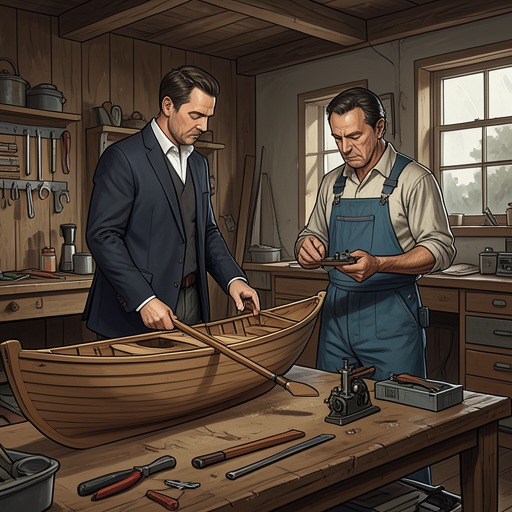
That approach was visible in his methods. Even as power tools became available in the 1930s, Pocock relied largely on saws, hammers, chisels, planes, and sanding blocks. Hand tools gave him control over detail and, he believed, a closer contact with the wood. Quiet mattered too: craftsmanship required thought, and thought required an environment without the noise of machinery. His traditional methods were therefore not simply a refusal of new tools; they expressed a desire to feel the material and put care into the finished shell.
The change to western red cedar
Before 1927, Pocock followed the construction methods his father had taught him in England. On a perfectly straight I-beam more than sixty feet long, he built a delicate framework of spruce and northern ash, then fitted Spanish cedar strips to the ribs. Thousands of brass nails and screws had to be filed down by hand before the hull could be varnished. Each plank demanded laborious, careful fitting, and a misplaced chisel or careless hammer blow could undo days of work.
The change began when George Pocock experimented with western red cedar, following an idea previously suggested by Ed Leader. Spanish cedar was expensive because it had to be imported from South America, and it was brittle enough to require frequent repairs to the school’s fleet. Pocock had also noticed the lightness and durability of old cedar canoes on Puget Sound. Western red cedar offered a striking combination of qualities: its low density made it easy to shape; its open-cell structure made it light and buoyant; and its even grain gave it strength and flexibility without a tendency to twist, warp, or cup. Natural preservatives in its fibers resisted rot, while the wood took a smooth, lustrous finish.
Pocock searched the Northwest for suitable timber, traveling to sawmills on the Olympic Peninsula and into the forests of British Columbia. Around Lake Cowichan on Vancouver Island, he found massive, ancient trees yielding long, straight, tightly grained stock. From these he could mill planks more than twenty inches wide and sixty feet long, then shave matching pairs only five-thirty-seconds of an inch thick. Placing the book-matched sheets on either side of the keel gave the boat a symmetrical appearance and performance.
A new way to form the hull
The thin cedar sheets made it possible to abandon the repeated nailing of individual planks to the frame. Pocock strapped the sheets over the shell’s frame, covered the assembly with heavy blankets, and directed steam from the shell house’s heating system beneath them. After three days, the cedar had relaxed into the frame’s shape. Once dried, the sheets could be glued in place. The method resembled the Coast Salish practice of bending a single cedar plank to make a box, adapting a long-established way of working wood to racing-shell construction.
The cedar hull was only one part of a carefully composed boat. Pocock used sugar pine for keels, ash for frames, Sitka spruce for gunnels and hand-carved seats, and Alaska yellow cedar for washboards. He valued the latter wood partly for the way its color matured from old ivory to honey, complementing the burnished red hull. At bow and stern, varnished silk formed translucent yellow decking. He then rubbed the hull with pumice and rottenstone, applied thin coats of marine varnish, and repeated the finishing process until the surface gleamed. Four gallons of varnish went into the finish he wanted. The shell was ready only when its smoothness and sheen seemed to promise speed.
The performance justified the experiment. The sleek cedar shells were faster than the Spanish cedar boats, and Harvard University, after ordering one as a trial, reported that it had cut several full seconds from its crew’s best times. The improvement was therefore more than an aesthetic one: the light, smooth hull translated the properties of its material into a measurable gain on the water.
Camber, spring, and the shell’s life
Cedar revealed another quality only after the first shells had been used. Their bows and sterns rose slightly when the boats were exposed to water, prompting the nickname banana boats. Pocock traced the effect to the way the wood changed length. Cedar did not appreciably swell across its grain, but it did expand along it; over a sixty-foot shell, the increase could reach an inch. The cedar had been attached to the frame while dry, and, once wet, wanted to lengthen. The ash frame stayed dry and rigid, preventing that expansion.
The resulting compression pushed the ends of the hull upward, giving it camber. Rather than regarding the curve as a defect, Pocock recognized that the compressed cedar skin held the boat under continuous, subtle tension, like a drawn bow. On the catch of the oars, that tension gave the shell a springing liveliness that he believed no other design or material could reproduce.
For Pocock, this resilience was the cedar shell’s defining quality: its capacity to rebound, persist, and keep coming against resistance. He saw that responsiveness as more than a technical advantage. A shell without life, in his view, was unworthy of young men who gave their hearts to driving it through the water. The boat thus joined material behavior to an ideal of collective effort: its hidden tension became forward motion, while its hand-finished surface made speed visible.