Poughkeepsie
The Boys in the BoatPoughkeepsie became one of the defining stages of American collegiate rowing: the Hudson River city hosted the Intercollegiate Rowing Association regatta, where eastern dominance was tested, western programs sought national recognition, and Washington’s crews made history. Its importance lay not only in the races themselves but in the public spectacle surrounding them, which turned a river competition into a national measure of rowing prestige.
The Regatta and Its National Audience
The Intercollegiate Rowing Association regatta had deep roots in American rowing. The sport’s early landmarks included an 1824 New York Harbor race between American watermen and British sailors, and the first collegiate crew race, between Harvard and Yale on Lake Winnipesaukee in 1852. Those contests helped establish rowing as a prominent public sport; by the early twentieth century, Poughkeepsie had become its great annual collegiate gathering.
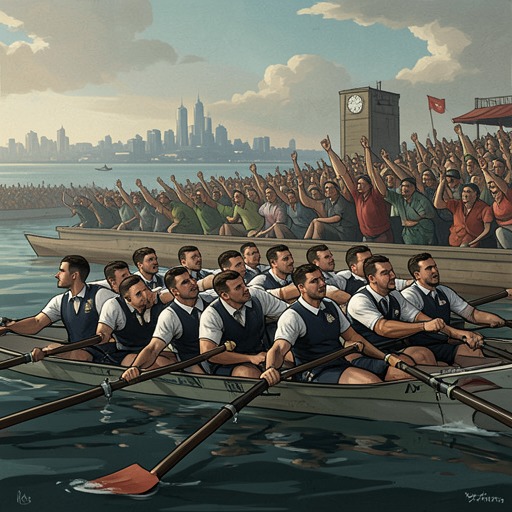
The regatta’s reach extended well beyond the riverbanks. Tens of thousands of spectators traveled to Poughkeepsie, with attendance reaching as many as 125,000 in 1929, while millions more followed the radio coverage. The event came to rival the Kentucky Derby, the Rose Bowl, and the World Series as a major national sporting occasion. For colleges, the competition carried the weight of a national championship, and a crew’s standing at Poughkeepsie could bring attention to its school far beyond its home region.
Eastern Dominance and the Western Challenge
For much of the regatta’s early history, eastern colleges dominated. Stanford became the first western school to compete, in 1912, and finished sixth. The following year, Hiram Conibear brought a Washington varsity crew east for the first time. Washington did not win, but its third-place finish surprised eastern fans and journalists accustomed to seeing elite eastern institutions at the front of the field.
Western crews returned only occasionally during the next decade. Sending athletes and delicate racing shells across the country was expensive, and the visitors encountered a mixture of curiosity, condescension, and derision. The social contrast was visible in the competitors themselves: eastern spectators expected the sons of prominent political and industrial families, while western crews included farmers, fishermen, and lumberjacks. Poughkeepsie thus exposed the gap between eastern rowing’s established status and the western programs’ struggle for resources and respect.
That imbalance made Washington’s 1923 victory especially consequential. Under head coach Russell Callow, the varsity crew entered the home stretch nearly level with Navy. In the noise of the crowd, coxswain Don Grant raised a red flag cut from a Cornell banner to signal the decisive effort. Washington pulled ahead to secure the West’s first Intercollegiate Rowing Association victory. The win turned the crew into a focus of national curiosity: spectators and reporters asked where Seattle was and whether the rowers were lumberjacks. The boys answered that attention with smiles and miniature totem poles, while the victory gave the western challenge a result that could no longer be dismissed as a novelty.
The 1936 Regatta Setting
Poughkeepsie again became a national stage in June 1936, when Washington arrived for the regatta in a summer thunderstorm. The crew unloaded its racing shells from a baggage car and carried them to the river. Its accommodation had changed markedly from the rickety shack used in earlier years: Al Ulbrickson arranged for the team to occupy Cornell’s former house on the river’s east side, next door to the California quarters. The building offered hot showers, exercise facilities, electric lights, a spacious dormitory with extra-long beds, and a screened porch where the rowers could sleep in hot weather. A radio connected them to broadcasts ranging from baseball to the New York Philharmonic. Nearby, a cookhouse only twenty-five feet from the front door served the crew, with Evanda May Calimar in charge of the kitchen.
The setting also shaped how the race was experienced. The varsity contest was scheduled for after 8:00 p.m., after sundown, and the field remained uncertain: eastern coverage treated California and Cornell as the boats to beat, while Seattle papers gave Washington a narrow edge. Bookmakers in Poughkeepsie placed Washington and California at even money, with Cornell behind them. Before the varsity race, Washington’s junior varsity won in the number five lane. Four miles upriver, Joe Rantz heard the five bombs signaling that result and silently raised his fist with Shorty Hunt and Roger Morris.
As the varsity boats gathered near the starting line below Krum Elbow, twilight settled over the river. The Washington crew’s race plan called for a deliberately restrained pace before a late drive, making the contest a test of timing as well as strength. The crew’s eventual come-from-behind victory made Washington the national champion and completed its sweep of the Hudson. Contemporary sportswriters described the win as historic, spectacular, and brilliant; Royal Brougham characterized the crew’s execution as cold-blooded. Poughkeepsie was therefore both the physical course on which Washington won and the public arena in which that performance became a national story.
Lasting Significance
Poughkeepsie’s significance in the narrative rests on the way its regatta joined place, competition, and recognition. The Hudson course concentrated rival programs and a vast audience in one setting, while the cost and difficulty of reaching it made participation itself a measure of unequal resources. Washington’s 1923 breakthrough challenged the assumption that collegiate rowing belonged to the East; its 1936 championship confirmed that a western crew could command the center of the sport. In both moments, success on the river altered how the country regarded the program and the region it represented.