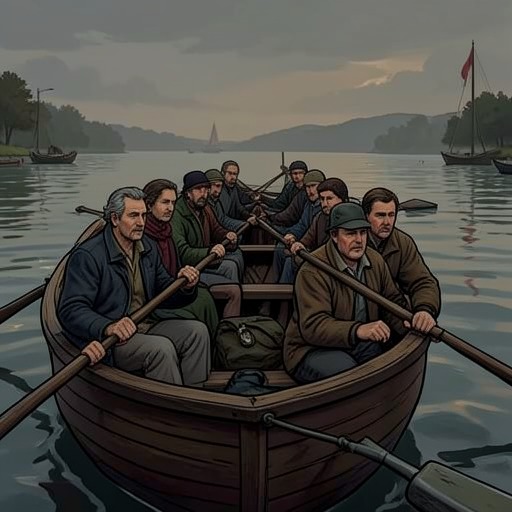
Pulling together
The Boys in the BoatPulling together is both a practical condition of rowing and a larger social ideal in the book. In a racing shell, the strength of individual oarsmen is not enough: their movements must become a coordinated whole. That physical interdependence gives the crew’s shared effort a meaning beyond competition, while the histories of collegiate rowing and the Washington team show how cooperation can challenge, but does not automatically erase, the unequal conditions in which sport is organized.
The crew as an interdependent whole
A crew can be brought down by one member’s slump. Unlike a baseball or basketball team, where others may compensate for an off day, rowers depend on each crewmate to perform almost flawlessly with every pull. One person’s mistake can disturb the stroke’s tempo and the boat’s balance, undermining the work of everyone else. The book identifies concentration as a frequent source of such failures: individual attention must be directed toward the shared task, not allowed to drift away from the boat.
The ideal is more demanding than merely pulling at the same time. In an eight, arms, knees, bodies, backs, and even the small movements of the wrists have to work in precise relation. When the crew achieves this unison, the shell runs fluidly between strokes and can seem to move on its own. The book describes the resulting experience as a kind of language and poetry: effort does not disappear, but pain gives way to a shared exultation. The crew’s achievement lies in the way each person’s action answers and completes the others’.
This unity also has a concrete competitive effect. A well-coordinated crew can conserve power, maintain a lower stroke rate, and still move efficiently—sometimes faster than a less efficient crew rowing at a higher rate. Conserved energy becomes a reserve for the final, punishing sprint. Maintaining coordination becomes harder as the rate rises, because every separate movement must happen at shorter intervals. The boat’s collective rhythm is therefore not a decorative ideal added to athletic performance; it is one means by which effort becomes more effective.
Individual skill and the limits of correction
The Washington freshmen’s early struggles reveal the tension between individual technique and collective performance. When their form deteriorated, their coxswain, George Morry, repeatedly chanted M-I-B, meaning mind in boat. The reminder called on each oarsman to concentrate on the person ahead and on the coxswain’s commands, shutting out distractions beyond the shell. Yet chanting the principle did not restore the freshmen’s speed, and their coach, Tom Bolles, turned to the boat’s mechanics. The episode distinguishes the need for shared attention from the separate technical work required to make a crew move well.
Later, Al Ulbrickson’s trials exposed a similar problem at the level of team selection. He moved Joe Rantz and other rowers among boats, seeking a lineup that would clearly outperform the rest. Two crews emerged as leading contenders, but neither decisively beat the other. Ulbrickson recorded technical faults: some rowers broke their arms at the wrong point, while others caught the water too early or too late. He understood, however, that the deeper difficulty was not simply a list of errors. Although the squad contained more strong individuals than any he had coached, they too often rowed as boatfuls of individuals, retreating into separate and sometimes defiant worlds. Scolding isolated technical faults while preaching teamwork could deepen that separation rather than resolve it. Individual excellence mattered, but could not substitute for a functioning crew.
A sport shaped by status and access
The ideal of shared labor stands against the class structure of collegiate rowing. In the 1920s and 1930s, college crews drew crowds and extensive press attention, and outstanding oarsmen could become national sporting figures. In the East, private schools modeled on institutions such as Eton taught rowing as a gentleman’s sport and sent their oarsmen to prestigious universities. The sport’s public glamour therefore coexisted with a narrow social tradition about who belonged in a shell.
Western universities gained enthusiastic audiences of their own, particularly through the rivalry between the University of Washington and the University of California, Berkeley. Their annual April races could draw tens of thousands of students, alumni, and local spectators. Yet western programs had fewer resources: their coaches earned a fraction of eastern coaches’ salaries, the schools had no money for recruitment, and they lacked wealthy patrons. Travel to Poughkeepsie was expensive, and western crews encountered condescension as well as curiosity. Eastern spectators were accustomed to seeing the sons of powerful families in racing shells, not farmers, fishermen, and lumberjacks. Even a western victory did not immediately remove that social distance.
The exclusion of working rowers at the Henley Royal Regatta made the boundary explicit. Its rules barred people who had worked for wages as mechanics, artisans, or laborers; the Australian policemen were classified as laborers and consequently could not compete. The rule treated paid work as an unfair advantage over men in sedentary occupations. Meanwhile, the British Olympic crew came from the Leander Club, and its members represented a tradition in which elite education, dress, and rowing culture reinforced one another. The contrast makes an important qualification to the book’s ideal: rowing depends on mutual effort within the boat, but access to the sport and its most prestigious stages remained governed by class distinctions.
From shared labor to public support
The book connects the boat’s interdependence to a broader possibility: people facing circumstances they could not change alone might still act together. That possibility becomes especially tangible when Washington’s crew faces the prospect of being unable to afford Berlin. At the Princeton Inn, Henry Penn Burke told Ulbrickson and the Washington representatives that the crew would have to pay its own way or surrender its place to Penn. The American Olympic Committee was short of funds, and other teams were also being asked to finance some or all of their travel. For Washington, the demand was particularly severe: its rowers were working-class men who could not simply contribute the fare themselves.
The response came from a wide circle of supporters. Students sold fifty-cent tags, radio announcers appealed for donations, and a statewide campaign reached alumni, businesses, towns, and civic organizations. Contributions ranged from five dollars from the Hide-Away Beer Parlor to five hundred from the Seattle Times; the hometowns of the rowers also sent money, including $75 from Joe Rantz’s Sequim. Volunteers sold $1,523 worth of tags on the first day, and by the second, a $5,000 certified check had been sent to Ulbrickson. The sums and sources make collective effort visible as practical action: many separate contributions carried the crew past a barrier none of its members could meet alone.
Meaning and limits of the ideal
Pulling together is not presented as a claim that individual ability is irrelevant. The boat requires each rower’s precise, repeated work, and the crew’s performance depends on that work being done well. Its central distinction is between individual effort that remains isolated and individual effort coordinated with others. The former can leave a team stranded in competing private worlds; the latter can transform a set of bodies into a boat that runs smoothly and preserves strength for the finish.
The idea also holds together two different scales of cooperation without equating them. Inside the shell, interdependence is a technical fact of every stroke. Outside it, the fundraising drive shows a community responding collectively to an unequal allocation of Olympic resources. Neither form of cooperation abolishes the class barriers built into rowing, as the treatment of working Australians at Henley makes clear. But together they give the Washington crew’s story its larger contrast: men from backgrounds often treated as out of place in elite sport become a team through coordinated labor, while a broad public helps make their participation possible. The shared effort is not merely a virtue attributed to the crew; it is the means by which the boat moves and, at a decisive moment, the means by which it gets to the starting line.