Roger Morris
The Boys in the BoatRoger Morris is a tall, reticent oarsman whose place in the story extends well beyond his years in the boat: he is one of Joe Rantz’s earliest crew friends, a dependable teammate through the trials of college rowing, and a companion whose bond with Joe endures into old age. His career joins physical stamina to an understated kind of loyalty, expressed less through grand declarations than through presence, shared effort, and the comfort of silence.
Identity and Early Experience
Morris arrives at the University of Washington as a six-foot-three freshman, lanky and loose-built, with dark, tousled hair and heavy eyebrows that make him appear to be glowering. His reserve is part of his first impression, but his history sets him apart from most of the other freshmen: he is the only one in the incoming group who has rowed before.
Before the Great Depression, his family kept a rustic cabin on the western side of Bainbridge Island. As a boy, Morris spent summers rowing around Manzanita Bay. At twelve, with a toothache and eager to get back to his family’s home in Fremont, he undertook a much longer trip in a small rowboat. He went north through Agate Passage, crossed six miles of relatively open Puget Sound among freighters and ferries, and continued east through the Ballard Locks. The account establishes the distance and route as evidence of his stamina and determination, though not the conclusion of the journey.
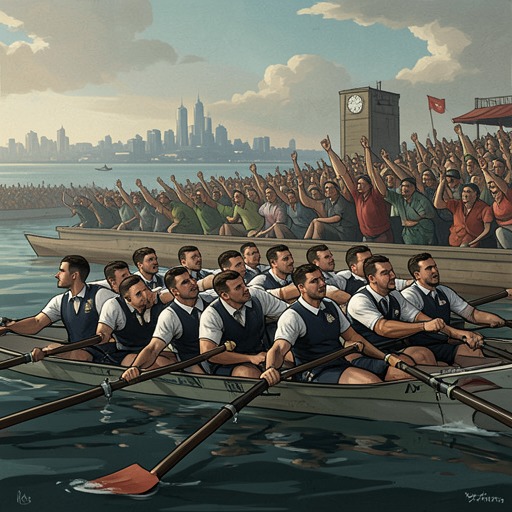
Morris enters a sport with a long-established hierarchy. Collegiate crew in the 1920s and 1930s drew major press coverage and large crowds, while eastern institutions modeled rowing on elite British traditions. On the West Coast, the University of Washington and the University of California, Berkeley had built a heated rivalry dating to 1903. The programs had struggled for funding and recognition, and their annual races became major public contests. Morris’s rowing therefore belongs both to a demanding college team and to a broader effort by western crews to establish themselves against eastern prestige.
A Place in the Washington Crews
Morris and Joe Rantz enter college together, but their temperaments differ. Joe is powerfully built and draws attention; Morris is gangly, taciturn, and gruff. When Tom Bolles announces the freshman first-boat assignments, Morris is named in the bow seat and Joe at number three. Joe gives a small, restrained fist pump at his selection; beside him, Morris exhales softly. Their shared place in the boat begins as a practical pairing, but it develops into a friendship that becomes central to both men’s rowing lives.
The freshmen’s first race against California takes place after five and a half months of training. Morris rows at number seven, with Joe at number three, as the crew heads into a stiff north breeze on Lake Washington. The race demands more than three hundred strokes from each oarsman. The details of the event make visible the discipline beneath the spectacle: months of preparation are tested in minutes, with the rowers’ individual exertion bound together by the boat’s pace and coordination.
After the freshman crew’s victory over California, Morris and Joe join their teammates in watching the varsity race against Ky Ebright’s crew. Morris’s rowing career also becomes part of the Washington program’s growing record in eastern competition. The Intercollegiate Rowing Association regatta at Poughkeepsie had long been dominated by eastern colleges; Washington’s first eastern varsity appearance, under Hiram Conibear in 1913, startled eastern observers by placing third. Against that history, the later success of Washington crews represents a challenge to assumptions about where the country’s strongest rowers could come from.
Friendship, Friction, and Team Loyalty
Morris’s closest early crew friendship is with Shorty Hunt. The two have been buddies from the first day: Shorty is talkative, Morris reserved, an unlikely combination that works. Their friendship gives Joe a place within a small circle of support. As older rowers tease him, Shorty and Morris increasingly come to his side. Shorty, rowing directly behind Joe, puts an arm over his shoulder and reassures him, “Don’t worry, Joe. I’ve got your back.” Morris’s role is quieter, but Joe later remembers their easy, largely wordless comradeship as something he had not understood how much he valued until it was gone.
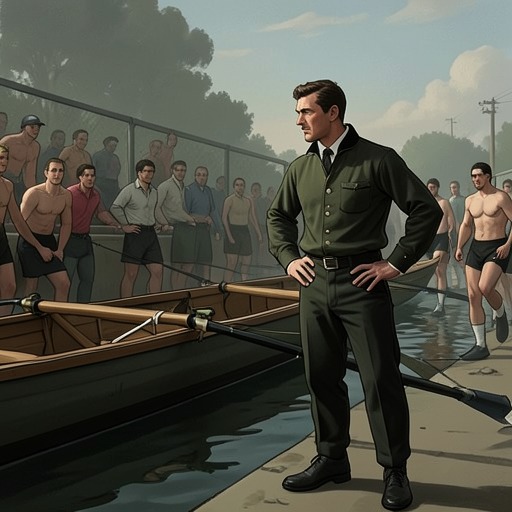
That loyalty is not simply a matter of affection; the crew’s relationships are shaped by strict discipline and the pressure to perform. After a meeting with Al Ulbrickson, Morris, Shorty, and Joe walk up the hill from the shell house, angry and uncertain whether they may have committed a training infraction. Ulbrickson’s established rule is severe: one infraction means a drop of two shells, and a second means expulsion from the squad. The three boys privately complain that he is unfair and cold, and that he demands more without offering encouragement. Their conversation shows how the same discipline that organizes the team can also strain the trust between coach and rowers.
When the sophomore crew struggles against the junior varsity, Ulbrickson calls Morris, Joe, and several teammates into his office. The setback tests the confidence built by earlier victories. Morris is among those the coach believes are struggling, but the years spent rowing together remain important to Joe even when the lineup changes. Later, Joe feels the loss of the old sophomore camaraderie particularly through the absence of Morris and Shorty from his boat. His realization gives Morris’s friendship a consequence beyond nostalgia: the boat’s changing composition alters Joe’s sense of belonging.
The Olympic Crew and the Berlin Races
When Joe joins the boat preparing for the Olympic trials, Morris is in the bow. He welcomes Joe aboard alongside other crewmates, and their old friendship resumes within the new lineup. As Joe settles into the shell, Morris waves from the front and calls, “Hey, Joe, I see you finally found the right boat!” Shorty again offers his quiet assurance, while the other rowers make room for Joe. The scene makes the crew’s unity concrete: a place in the boat is also an invitation back into a circle of trust.
The shell is christened Husky Clipper before the trials. George Pocock pours a jar of fluid over its bow and names Berlin as a destination; the fluid is sauerkraut juice, chosen to get the boat used to Germany. The joke links the local Washington crew to the international contest awaiting them without displacing the work required to reach it. Morris is part of a group whose success depends on both preparation and the ability to row as one.
In the heat before the elimination races, the oppressive East Coast weather unsettles the team. On the night of July 3, Morris and Joe sit up after lights-out, joking and telling stories in the dark as they try to steady themselves. Their conversation takes place against the crew’s anxiety and the coach’s own unease. The small private scene recalls the intimacy of their early friendship at a moment when the stakes have risen from college races to Olympic competition.
In Berlin, the Washington rowers share facilities with twenty-four international teams. Morris and his teammates become friendly with the Australian police crew and the Swiss rowers, while the British Leander Club crew is regarded as a leading opponent. The broader setting is shaped by class as well as competition: at Henley, the Australians had been barred under a rule excluding men who worked for wages as mechanics, artisans, or laborers, a category that included policemen. Their arrival in Berlin after leaving Britain exposes the social boundaries built into rowing’s traditions, even as the Olympic regatta brings crews from different countries into direct contest.
The Washington crew’s days in Germany include both competition and ordinary diversions. During the heat, Morris and Joe joke together in the dark; later, the Americans visit New York City before continuing to Germany, touring landmarks and watching events aboard their ship. In Köpenick, the team’s public attention grows tiring. The rowers sometimes rent boats in the evenings and circle the castle in the rain, keeping company with the swans to escape the crowds. Morris also records his displeasure with one of the town’s entertainments, describing the orchestra as out of tune. These brief episodes show him away from the racing shell but still within the crew’s shared routines and humor.
Final Race and Lasting Bond
At the Olympic regatta, the conditions can make simply holding a shell in position a struggle. Before the final, the Husky Clipper is backed against the gangway on the exposed Langer See, where wind pushes at the bow and choppy waves slap the port side. Morris and Gordy Adam labor on the starboard side, rowing in place to lever the boat back against the wind and keep its bow pointed down the lane. The moment reduces the scale of the contest to immediate, collective work: before the race begins, each rower must help keep the boat where it belongs.
After the final, the American boat drifts beyond the grandstands into quieter water. The rowers lean over their oars, gasping and visibly spent. When Shorty cannot get his eyes to track and someone asks who won, Morris answers, “Well . . . we did . . . I think.” His uncertain, exhausted response is a human-scale ending to a race watched by crowds: the result reaches the crew through bodies pushed to their limits, not through ceremony alone.
The Poughkeepsie regatta is the last race for Morris, Shorty, and Joe. By Royal Brougham’s calculation on a bar napkin, each had rowed about 4,344 miles over four years, while the three had raced only 28 miles in college; together, they had never been defeated. The contrast between thousands of training miles and a few dozen competitive ones gives their record its particular measure. The work is immense, the official racing brief, and the bond formed through it lasts longer than the season or the boat.
Morris remains the first of Joe’s crew friends and, by the account’s description, the last man standing. He dies on July 22, 2009. At his memorial, Judy recalls that in their final years Morris and Joe often met in person or spoke by phone and did almost nothing, hardly speaking, content simply to sit in one another’s company. That quiet companionship completes the pattern established in the boat: their friendship did not depend on constant conversation or renewed competition. It endured as the same wordless trust Joe had once recognized only after he feared losing it.