Rowing “Swing”
The Boys in the BoatRowing “Swing” names the moment when a crew’s separate bodies and efforts resolve into a single, fluid rhythm. In the Washington crew’s story, it is not simply a high stroke rate or a polished technique: it is the condition in which each oarsman moves in relation to the others so completely that the boat seems to propel itself. The book makes this shared rhythm visible in the blades entering the water together, and audible in the near-silence of a night row. Its importance is at once athletic and social: speed depends on coordination, while coordination depends on trust.
What Swing Means
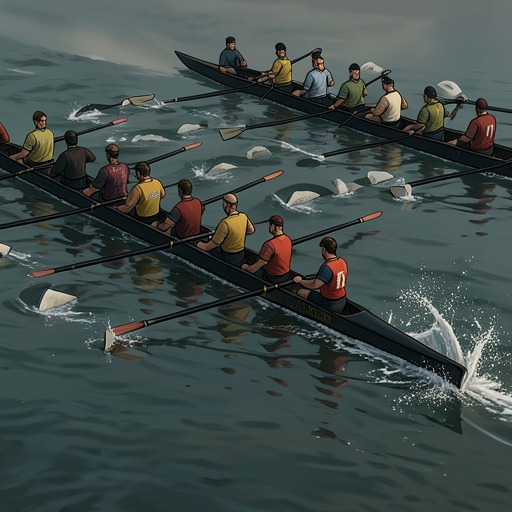
The distinction between rate and swing is clearest when Washington rows slowly. On Lake Carnegie, Don Hume and Joe Rantz set the pace at thirty-four strokes per minute, and their long, slow strokes draw the rest of the crew into exact alignment. From the bank, the eight men, their oars, and the Husky Clipper appear like one thing, coiling and uncoiling over the water. The blades enter the lake at the same instant and leave scarcely a splash; the shell glides forward without a check. The passage defines swing through its observable effects: a lower rate need not mean a lack of power when each stroke travels farther and the crew applies its effort together.
That unity does not erase individual roles. Hume’s stroke establishes the pace, Rantz rows beside him, and the other six follow the movement. But the effectiveness of the arrangement lies in how little it looks like a series of commands and responses. The whole boat seems to act continuously. The image of eight backs swinging in unison makes a technical achievement legible as a relationship: the crew’s motion is powerful because no one’s movement breaks the common rhythm.
The Night Row and the Crew’s Shared Rhythm
During a late-night return from the final time trial, Bobby Moch set the varsity at a leisurely twenty-two or twenty-three strokes per minute. The boys initially chatted with rowers in the freshman and junior-varsity boats beside them. Pulling softly and steadily, they began to move ahead without intending to. As the other boats fell away, their voices disappeared; before long, the only sound the varsity could hear was the gentle dip and lift of its own blades. Under the bridges, with their lights behind them and the water black around them, the crew rowed alone together.
The moment matters because swing arrives not as a shouted order or a burst of force but as a shared condition. Years afterward, Moch remembered that the blades made only a soft sound and that the oarlocks did not rattle on the release. The crew rowed fluidly and almost without conscious effort, in the black void among the stars that George Pocock had described. Silence becomes the scene’s measure of coordination: stray noise has vanished along with the other boats, leaving a rhythm so settled that it seems to require no correction.
The same state appears under race pressure, though there the soundscape is different. With the Washington boat still behind at Poughkeepsie, the rowers are detached from themselves but acutely aware of one another’s minute movements. Moch’s calls, the oars in their locks, their breathing, and their pounding pulses occupy the middle of the river. In the number-five seat, Stub McMillin realizes that after three miles he is still breathing through his nose. Near the finish, Shorty Hunt keeps his eyes on the back of Rantz’s neck and pulls with his whole heart, while Rantz’s attention narrows to the crew’s repeated M-I-B mantra. Swing binds these different experiences together: the quiet of practice and the strain of racing both depend on attention held inside the boat.
Finding It Again in Berlin
Before the Olympic races, the crew’s confidence is uncertain. Rantz believes he is the weak link, having joined the boat last and still tending to row erratically. He does not yet know that every other boy shares the fear of failing his crewmates. In the last days before competition, they draw closer: they huddle on the dock, put their arms over one another’s shoulders, and talk through how to improve each row. Rantz and Roger Morris walk beside the Langer See and skip stones; Johnny White lies in the sun and thinks through his rowing; Shorty Hunt writes long letters home. These separate ways of calming themselves accompany the work of restoring the crew’s common rhythm.
The boat begins to come alive again as the boys row twice a day. With Hume back at stroke, the tentativeness and awkwardness that had appeared when Ulbrickson removed him disappear. Pocock sees the difference, and the crew again finds its swing. The return of that rhythm is presented as a practical change in the boat and a reassurance among its members: the crew does not become effective through confidence alone, but confidence follows when the men can feel their movements fitting together.
Swing Under the Pressure of Competition
In the race against Great Britain, Washington is still behind with 150 meters remaining. The boys hold their swing as pain burns through their muscles and connective tissue; they keep rowing in harmony as the rate approaches forty. In the final twenty strokes, especially the final twelve, they pass the British shell and cross the line twenty feet ahead. Don Hume collapses forward across his oar. The victory has a measurable consequence as well as a dramatic one: the time of 6:00.8 sets new course, world, and Olympic records. Swing here is not ease in the sense of comfort. It is the crew’s capacity to preserve coordinated movement when effort has become painful and the result is still undecided.
The term also acquires meaning against the wider culture of rowing. In the 1920s and 1930s, collegiate crew drew national attention, but the sport’s prestige was closely associated with Eastern private schools and elite universities. Western programs such as Washington faced condescension as well as the expense of competing at Poughkeepsie. At the Henley Royal Regatta, rules excluded people who had worked for wages as mechanics, artisans, or laborers; Australian policemen were classified as laborers and barred from competing. Against that background, the Washington crew’s collective performance carries a significance beyond its technique. Swing is achieved through interdependence rather than social rank: eight men must make one boat move, and the boat’s unity cannot be supplied by any single oarsman alone.