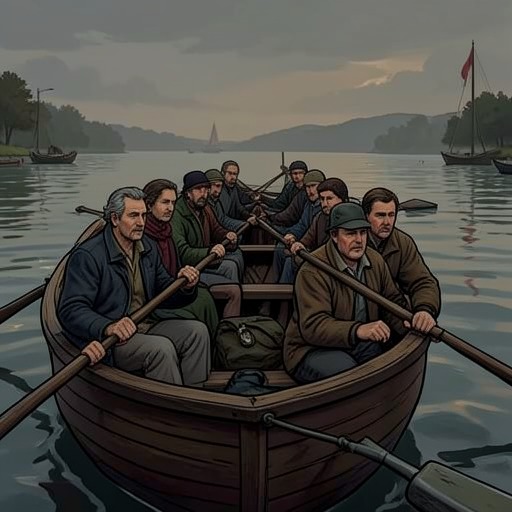
Rowing as art
The Boys in the BoatRowing as art is presented as a union of disciplined technique, material craftsmanship, and collective movement. It is neither a frantic contest of strength nor beauty detached from practical purpose: the shell must move efficiently, while the crew must bring thought and action into exact accord. The ideal consequently belongs both to the boatbuilder’s hands and to the rowers’ coordinated bodies.
Beyond a contest of force
The book states the distinction directly in an epigraph attributed to George Yeoman Pocock: “Rowing a race is an art, not a frantic scramble. It must be rowed with head power as well as hand power.” The contrast is not between physical effort and its absence. Instead, it opposes ungoverned exertion to strength directed by judgment. Rowing well requires the hands, but also a mind that can choose what to attend to and keep that attention steady under the pressure of a race.
Pocock’s advice makes this mental discipline part of the art. Rowers should block out thoughts of the opposing crew from the first stroke and direct their attention to themselves and their own boat, keeping their thoughts positive. The race is thus approached not as a series of reactions to an opponent, but as a task of maintaining the boat’s own work. The instruction gives artistic form a competitive consequence: concentration helps prevent a crew’s effort from becoming a scramble.
The shell as machine and artwork
Pocock’s boatbuilding gives the idea a second, material form. A racing shell can be understood as a machine, designed for the narrowly defined task of moving a crew across water as quickly and efficiently as possible. Yet it can also be understood as an artwork expressing a human desire for beauty, purity, and grace. The achievement, as the book frames it, is not to choose between these descriptions. Pocock excels as both maker of an effective machine and artist.
That double purpose is visible in his manner of working. Though modern power tools became available during the 1930s, Pocock continued to rely largely on hand tools: saws, hammers, chisels, planes, and sanding blocks. The choice answered several commitments. He valued traditional methods, believed hand tools gave him finer control, and disliked the noise of power tools. Most deeply, he wanted physical intimacy with the wood: to feel its life under his hands and put something of his own life, pride, and care into the shell. In this account, craftsmanship is not merely the finishing of an object. Attention to material becomes one way of making the boat carry human intention.
The labor involved made that attention consequential. Before 1927, Pocock followed the method his father had taught him in England, building on a straight I-beam more than sixty feet long. He assembled a light framework of spruce and northern ash, joined Spanish cedar strips to its ribs, and used thousands of brass nails and screws. Their heads had to be filed down by hand before the hull could receive marine varnish. A slipped chisel or careless hammer blow could ruin days of work. The shell’s grace therefore rests on painstaking decisions and vulnerable stages of construction, not on an abstract idea of beauty alone.
Rowing as a shared language
The crew supplies a bodily counterpart to the craft of the boatbuilder. The book calls the rare coordination sought by a crew “swing”: not simply oars entering the water together, but a whole sequence of actions occurring in unison. Sixteen arms pull; sixteen knees fold and unfold; eight bodies slide forward and back; eight backs bend and straighten. Even subtle turns of the wrists must be mirrored along the boat. The description slows attention down from the visible sweep of the oars to the many small movements that make collective motion possible.
When the movements coincide, the boat continues to run fluidly between strokes, without being checked by one rower’s mistimed action. It can then feel as if the boat has become part of the crew and moves of its own accord. The book describes the result as a perfect language, and Pocock’s compact judgment is: “Poetry, that’s what a good swing feels like.” The comparison makes the crew’s art something enacted rather than merely observed: meaning arises through coordinated action, with no single movement sufficient on its own.
Effort, economy, and the ideal
The account does not equate this harmony with effortless speed. A good swing does not necessarily make a crew faster in itself. Its practical value is that a boat whose motion is not interrupted can make more effective use of each stroke. That efficiency allows rowers to conserve power, maintain a lower stroke rate, and preserve energy for a punishing sprint at the end of a race. The aesthetic ideal and the physical demands of competition remain joined, but the connection is specific: coordination can make effort count more fully.
The difficulty increases as the rate rises. Every separate action must occur at shorter intervals, making it harder to preserve the same exact unity at speed. The standard is therefore not simply synchrony at an easy tempo, but the approach toward sustaining it even as the crew presses harder. In the book’s formulation, crews that come closest to this demanding balance approach the plane on which champions row. Rowing as art names that pursuit: technical control and collective discipline turning strenuous motion into a coherent whole.