Seattle
The Boys in the BoatSeattle is both a city in crisis and the setting in which Joe Rantz’s prospects begin to change. Its waterfront, university, and Lake Washington hold sharply different worlds: unemployment and labor violence, collegiate privilege and competition, and the discipline of rowing. The city eventually becomes the place where a family divided by abandonment gathers around the news of an Olympic victory, and where Joe returns to build a life beside the water.
A city in hard times
On October 9, 1933, Seattle first appears under gray skies, amid the material signs of the Great Depression. Seaplanes crossed Puget Sound toward Bremerton, ferries left Colman Dock, and the Smith Tower rose over streets where men in worn clothes pushed carts of fruit and gum. On Yesler Way, people waited for soup kitchens to open. Newspapers carried news of federal relief, while the city’s everyday movement continued around people struggling to get by. The opening cityscape makes economic hardship visible not as an abstraction but in shoes, carts, sidewalks, and queues.
The weather and mood then shift. By late morning, the cloud cover opened, and Lake Washington changed from gray to green and blue. On the University of Washington campus, students ate and talked on the grass beneath the library’s neo-Gothic towers. Their conversation turned to classes, football, and the recent World Series, while newspapers and cigarette advertising belonged to the ordinary rhythms of campus life. Seattle’s contrast is built into these adjacent scenes: a city of people waiting for relief and a university community able, at least for an afternoon, to lounge in the sun.
A route toward a possible future
Seattle becomes a destination in Joe’s life before it becomes home. In the summer of 1931, his brother Fred Rantz, then a chemistry teacher at Roosevelt High School, invited him to move to the city and finish his senior year there. Fred argued that a diploma from a respected school might help Joe enter the University of Washington. Joe was wary of Fred’s tendency to direct his life, and the move would mean leaving Joyce Simdars behind. But Seattle offered educational possibilities that his life in Sequim could not, and Joe began to imagine a future that included university and a family of his own.
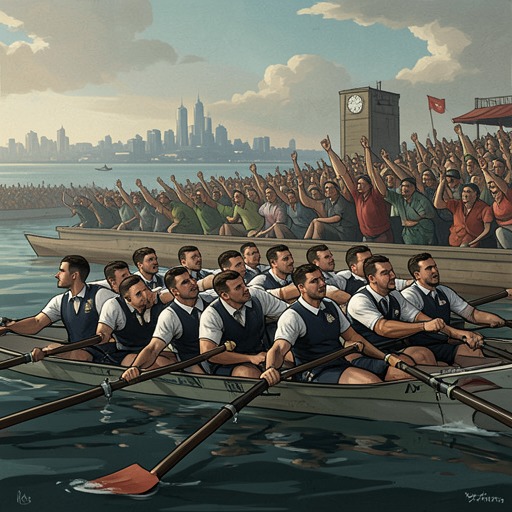
The city’s rowing world gave that future a demanding form. At the University of Washington, the shell house and Lake Washington became the setting for Joe’s training and for his relationship with Joyce, who watched him race from a student ferry on a spring race day. She had taken a rare afternoon away from her live-in job to support him; the outcome mattered to both of them because Joe’s prospects in crew were bound up with their hopes for a shared life. Seattle’s water was not merely scenery: it was where ambition had to be tested in public, against other crews and under the pressure of a race.
Waterfront conflict and rowing seasons
The city’s waterfront could also become a site of direct conflict. When Joe arrived back in Seattle in the summer of 1934, a dispute between nearly thirty-five thousand members of the International Longshoremen’s Association and steamship companies had escalated across West Coast ports. The wider conflict would claim eight lives. In Seattle, it reached a climax on July 18, when twelve hundred union members broke through police lines and shut down cargo unloading by strikebreakers, including University of Washington fraternity boys and football players. Fighting continued around Smith Cove and nearby waterfront streets. Strikers charged police with two-by-fours; mounted officers used batons. The mayor ordered machine-gun emplacements at Pier 91, but the police chief refused and resigned. The city’s labor conflict thus placed university men on opposing sides of a struggle over work and power.
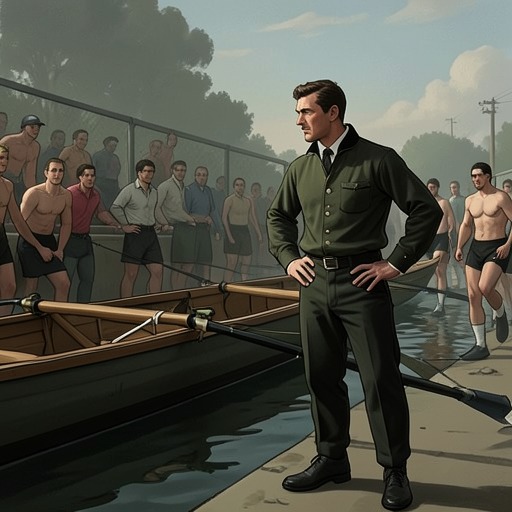
Rowing seasons brought their own changes to the city’s relationship with the lake. When Joe returned to the shell house for fall turnout in October 1934, a long drought had lowered Lake Washington enough to expose brown banks and leave the floating dock stranded above the water. The crews had to carry their shells down the bank and wade in to launch them. The landscape imposed practical conditions on the sport, even as the former freshmen arrived with the confidence of national champions. Under Al Ulbrickson, that confidence met a harder training regime and a demotion that unsettled the sophomores. For Joe, the pressures of rowing coincided with poverty and uncertainty about his family, making the city’s promise of opportunity feel precarious rather than assured.
Family, victory, and return
Seattle also holds the revelation that Joe’s father, Harry Rantz, and his family had been living in the city since the night they left Joe behind in Sequim in 1929. Their first home there was a two-room shed on the waterfront near Seattle Hooverville. One room served as both kitchen and bathroom; the other was a combined living room and bedroom for six people. Trucks passed close to the door, rats moved through the rooms, and Harry could not find the job that had brought the family to Seattle. The city that had represented a possible future for Joe had also been the place where his family endured severe poverty without him.
When the American crew’s victory at the 1936 Summer Olympics was announced, the family’s Seattle home became the scene of a reunion in feeling, if not yet in circumstance. Joe’s half siblings cheered and tossed cushions; Harry stood among them applauding. Joyce cried, then turned off the radio, returned a clover to her book, embraced Harry for the first time, and made sandwiches. The victory connected the young men racing in Berlin to the people listening at home, and changed the emotional meaning of the family’s shared city.
By the middle of September, Joe was back in Seattle, living in the new house on Lake Washington. His father had built Joe a bedroom beside his own. Joe brought the oak sapling awarded to the crew in Berlin to the university, where a groundskeeper planted it near the shell house, then began looking for work before school resumed. The return joins the book’s athletic achievement to practical needs—housing, work, and education. Seattle remains a place of hardship and unresolved history, but it is also where Joe can finally live near his father, return to the water, and make a future rather than merely imagine one.