Swing (rowing)
The Boys in the BoatSwing (rowing) is the condition in which eight oarsmen move with such exact coordination that the boat continues smoothly between strokes. More than a racing technique, it joins minute physical actions into a shared rhythm: a fleeting achievement that can conserve strength, shape a crew’s performance, and remain vivid in memory after it has passed.
Definition and Physical Pattern
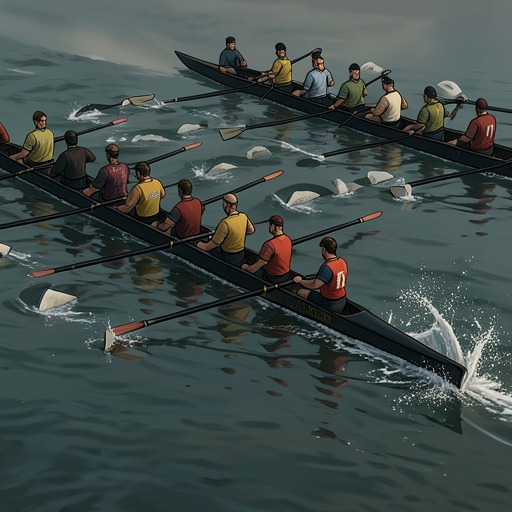
Swing is difficult both to achieve and to define. Many crews never find it, including crews that win; others find it but cannot keep it. Its standard is not merely that all eight oars enter and leave the water at the same instant. The motion must be coordinated throughout the stroke: sixteen arms begin pulling together, sixteen knees fold and unfold together, and eight bodies slide forward and backward in time. Even the small turn of each wrist must match the movements of the other rowers.
That precision matters because one mismatched action can interrupt the boat’s run. When each movement is mirrored across the shell, the boat travels fluidly between pulls rather than being checked by the next stroke. The book describes the resulting experience as one in which the boat seems to move almost of its own accord, while also feeling like a part of each person in it. The effect is collective without erasing the individual actions that make it possible: each rower contributes a separate movement, but its full value depends on all the others.
Efficiency, Effort, and the Limits of Speed
Swing is not presented as a simple guarantee of greater speed. A well-synchronized crew does not necessarily go faster merely because its rowing is more beautiful or more exact. Its practical advantage is that when no rower checks the boat’s run, each stroke produces more useful movement. The crew can conserve power, row at a lower rate, and still travel efficiently—sometimes faster than a less coordinated crew rowing at a higher rate.
That conserved effort matters over the course of a race. A crew that has made its strokes more efficient can retain energy for the punishing sprint at the end. Swing therefore links technical control to pacing: it is not just a quality of movement but a way of managing the work required to finish strongly. The advantage remains conditional, however. As the stroke rate rises, the many separate actions have to occur at shorter intervals. Keeping them aligned becomes increasingly difficult, and maintaining swing at a high rate approaches the limits of what a crew can do. The ideal is to raise the rate without losing the coordination that makes each stroke count.
A Found and Recalled Achievement
For Joe Rantz and his crewmates, swing was not only an abstract rowing ideal. They found it as freshmen on the day they won at Poughkeepsie. Al Ulbrickson remembered how they finished that race: the closing performance had been so striking that he could not get its image out of his mind. He believed the quality the freshmen had discovered was still present in them, even after they had moved beyond that triumphant moment.
The later difficulty of holding swing gives the memory its force. As the Pacific Coast Regatta approached in early April, the sophomore crew repeatedly seemed to find and then lose its coordination. They beat the junior varsity on Monday, lost badly on Tuesday, won again on Wednesday, and fell apart on Thursday. When they won, they did so decisively; when they lost, the collapse was complete. The contrast makes swing seem neither a permanent gift nor a reliable possession. A crew’s earlier mastery could remain compelling to its coach while proving elusive in the present.
Technical Ideal and Narrative Meaning
The book’s account makes swing both physical and expressive. It depends on observable actions—the timing of arms, knees, backs, bodies, and wrists—but its significance exceeds a checklist of synchronized movements. At its best, rowing becomes a shared language, and the description turns from mechanics toward poetry. That shift does not make swing mystical or detach it from training: the beauty arises from exact, repeated coordination and from the boat’s uninterrupted motion.
Swing also gives a concrete form to the crew’s interdependence. No rower’s action is sufficient by itself; each movement must fit the others, and the boat’s run reveals whether the eight have achieved that fit. Yet the coordination remains vulnerable to tempo: greater speed compresses the intervals in which each action must happen, threatening the very harmony the crew needs. The ideal consequently lies not in power alone or in synchronization as spectacle, but in sustaining precise movement while increasing effort. For Ulbrickson, the remembered freshman finish offered evidence that his rowers had once reached that ideal; their uneven later performances left open the harder question of whether they could find it again.