The development of the Conibear stroke
The Boys in the BoatThe development of the Conibear stroke transformed an improvised rowing program into a technical innovator. The stroke was not the product of one coach working alone: Hiram Conibear’s drive to make Washington competitive met George Pocock’s practical knowledge of rowing mechanics, and their discussions produced a method that soon brought the University of Washington its first significant victories and drew notice from Eastern schools.
A Western program seeking recognition
In the 1920s and 1930s, collegiate rowing drew crowds and press coverage on a scale comparable to baseball and football. Its prestige, however, remained concentrated in the East, where private schools modeled on Eton College prepared oarsmen for universities such as Harvard, Yale, and Princeton. The University of California, Berkeley and the University of Washington had built a heated rivalry dating to 1903, and both attracted tens of thousands of students, alumni, and local spectators to their annual April races. Yet Western programs had little funding, no recruitment budgets, and few wealthy patrons; their coaches earned far less than their Eastern counterparts. California crews had won Olympic gold twice, but the national center of collegiate rowing had not shifted west.
The Intercollegiate Rowing Association regatta at Poughkeepsie represented a measure of that hierarchy. Eastern colleges dominated it for much of the early twentieth century. When Washington first brought a varsity crew east in 1913, the team finished third, surprising Eastern fans and the press; Western crews nevertheless faced condescension as well as the expense of transporting athletes and delicate racing shells across the country. Washington’s narrow 1923 victory at Poughkeepsie showed that a Western crew could win on that stage. The earlier search for faster shells and more effective technique had begun against this wider struggle for recognition.
Conibear meets the Pococks
Conibear arrived at the University of Washington in 1907 as a track coach and football trainer, with only four weeks of rowing experience. He took charge of the crew in 1908 largely because no one else was available. Before that, he had been a professional bicycle rider and an athletic trainer, including for the world champion Chicago White Sox. His lack of a conventional rowing background did not limit his ambition: he wanted to replace Washington’s tubby, sometimes fragile home-built boats with long, sleek, fast shells like those made in England.
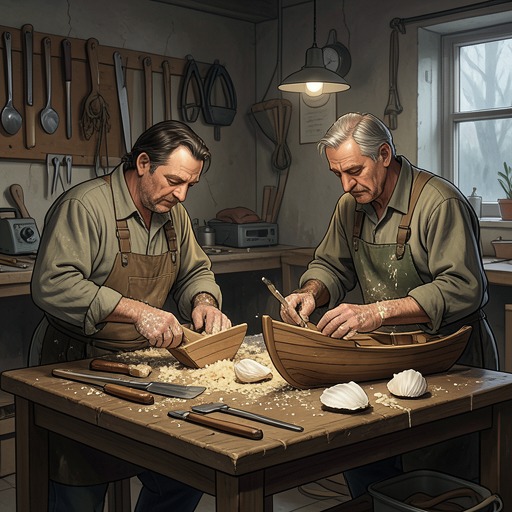
That ambition brought him to the Pococks’ floating workshop in Coal Harbour, Vancouver. On a blustery day, George Pocock saw Conibear rowing awkwardly toward the shop, all elbows and knees. The brothers mistook his ineffective effort for drunkenness, snagged his boat with a boathook, and helped him aboard. Conibear introduced himself as the University of Washington rowing coach and proposed a fleet of as many as fifty, or at least twelve, eight-oared shells. He wanted the brothers to move to the university campus and build them in a dry workshop. The prospect persuaded George and Dick Pocock to summon their father from England; only after he was on his way did they learn that Conibear had funds for just one shell. The reduced order brought the Pococks to Washington nonetheless, where the collaboration that shaped the stroke could begin.
From observation to a new stroke
Conibear tried to make rowing instruction scientific. He studied anatomy and physics, then borrowed a human skeleton from the biology lab, seated it as a rower, wired its hands to a broom handle, and watched student assistants manipulate it through different strokes. The model helped him investigate movement, but it could not by itself identify the faults in Washington’s actual rowing. George Pocock, who had learned from Thames watermen in his youth and taught boys at Eton, saw inefficiencies in the oarsmen’s technique that no further adjustment of the skeleton could resolve.
Pocock initially held back rather than volunteer advice. When Conibear asked for his opinion, however, he began to explain what he knew. Conibear listened and learned quickly; the method that came to be called the Conibear stroke took shape through their exchanges. Its shorter layback and quicker catch led into a shorter, more powerful pull. At the finish, the oarsmen sat more upright, ready to slide forward and begin the next stroke with less delay. The approach differed conspicuously from the Eastern style, with its exaggerated layback and long recovery. It was not simply a change in posture: it joined the end of one stroke more directly to the beginning of the next, making a quicker continuation possible.
Results and legacy
The new stroke soon accompanied Washington’s first significant victories. Its success unsettled expectations about what an effective rowing style should look like; Eastern schools began studying the method and asking how so unorthodox a technique could work so well. The shift in attention gave the Washington program a technical distinction at a time when Western crews were still trying to gain respect in a sport shaped by Eastern institutions and traditions.
Conibear died in 1917 after climbing too far out on a limb while reaching for a plum in his backyard. By then, Washington had become a serious West Coast contender against Stanford, California, and British Columbia, although it had not yet reached Conibear’s ambition of becoming the Cornell of the Pacific. His legacy in the stroke was therefore both practical and collective: his restless experimentation and Pocock’s knowledge of rowing mechanics met in a technique that outlasted its originator and forced rival programs to take Washington seriously.