U.S. Olympic Committee
The Boys in the BoatThe U.S. Olympic Committee was the American organization charged with preparing and sending athletes to the Olympic Games, and its president, Avery Brundage, became a central figure in the fight over participation in the 1936 Summer Olympics. Its position carried consequences beyond formal policy: it helped determine whether American athletes would compete in Nazi Germany, and its financial shortfall left even a successful Olympic rowing crew dependent on public fundraising to reach Berlin.
Role and Place in American Sport
The Committee operated within a sporting world in which Olympic selection and participation depended on a network of athletic organizations, coaches, colleges, clubs, and donors. Brundage held the presidency of both the U.S. Olympic Committee and the Amateur Athletic Union, but the two bodies were not interchangeable: the Amateur Athletic Union conducted the December 1935 vote on an investigation of conditions in Germany, while Brundage and his allies on the U.S. Olympic Committee fought against a boycott.
The Committee’s work also depended on resources that were unevenly distributed. American collegiate rowing drew large audiences and extensive press coverage, yet western programs had little recruitment money and few wealthy patrons. Moving a crew and its delicate racing shells across the country was expensive; sending athletes across the Atlantic added another burden. Those constraints would become immediate when the Washington crew, despite winning its way toward Olympic selection, was told that it might have to finance its own passage.
The Boycott Dispute
The Committee’s most consequential political role in the account emerged during the campaign to keep the United States out of the Berlin Games. Brundage argued that politics should not determine who received the chance to compete internationally and presented participation as a matter of fairness to American athletes. In September 1934 he toured German athletic facilities on a brief, closely supervised visit. His hosts assured him that Jewish athletes were being treated fairly, and he returned to the United States dismissing Jewish concerns as exaggerated.
The narrative sets those assurances against Brundage’s own public record and arguments. His views appear to have been shaped by antisemitic prejudice: he had written in 1929 about the prospect of a physically strong, mentally alert, morally sound “master race.” During the boycott dispute, he pointed to the exclusion of Jews from clubs he belonged to, repeatedly associated Jews with communists, and described boycott supporters in ways that blurred the distinction between critics of Nazi policy and political subversives. His language also treated Jews as separate from Americans, rather than as Americans speaking about persecution abroad.
Charles H. Sherrill, a prominent ally, reinforced that position. A former United States ambassador to Turkey, he had attended the 1935 Nuremberg Rally as Adolf Hitler’s personal guest and returned from Germany with assurances similar to Brundage’s. Although Sherrill described himself as a friend to American Jews, he warned that Olympic protest might provoke antisemitism in the United States. Brundage likewise recast opposition to participation as the importation of foreign hatreds into American sport. The account marks a consequential shift: by late 1935, Brundage had moved, deliberately or otherwise, from accepting deception to helping sustain it.
The Vote and Its Consequences
The final formal defeat of the boycott effort came through an Amateur Athletic Union vote, not a vote by the U.S. Olympic Committee. On December 8, 1935, delegates at the Commodore Hotel in New York rejected a proposal to send a three-person committee to Germany to investigate claims of Nazi mistreatment of Jews. The resolution failed by 58.25 votes to 55.75. The close result ended the last serious American effort to boycott the Games, and the United States proceeded toward Berlin.
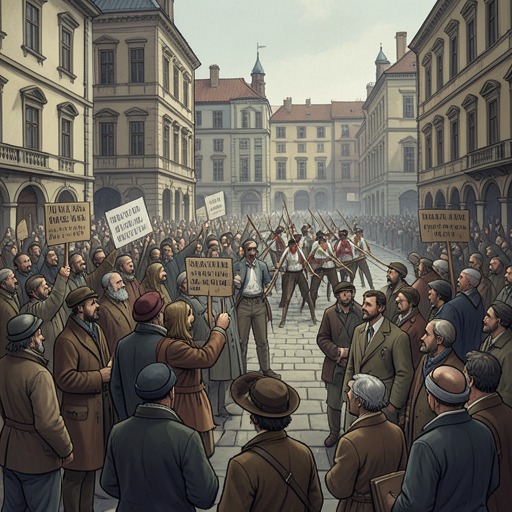
The result was preceded by a public demonstration on November 21, when ten thousand people marched through New York under police escort. Jews, labor leaders, university professors, and Catholics gathered in Madison Square Park after proceeding along Eighth Avenue and Twenty-Third Street. Speakers described Nazi persecution, the concealment of conditions in Germany, and the moral cost of American participation. The contrast between that organized protest and the eventual institutional decision reveals the limits of the Committee’s claim that sport could be insulated from politics: the choice to participate was itself made amid dispute over persecution and the use of Olympic competition.
Money, Selection, and Participation
With the boycott question settled, the remaining task was to choose the athletes who would represent the United States. Yet the Committee’s ability to send them was constrained by money. In the summer of 1936, officials disclosed that the winning Washington rowing crew would have to pay its own way to Berlin or risk being replaced by the second-place Pennsylvania team. The U.S. Olympic Committee had come up short of funds, and swimmers, fencers, and other teams were also being asked to cover some or all of their travel costs.
For Washington, the demand collided with the circumstances of the athletes. The university and Seattle residents had already scraped together money to send the crew east for the regattas at Poughkeepsie and Princeton; the rowers themselves were working-class young men, not heirs able to pay for an ocean voyage. The ultimatum required five thousand dollars by the end of the week. The response came from a broad local campaign: students sold fifty-cent tags, volunteers solicited donors, and contributions arrived from businesses and the rowers’ hometowns. By the end of the first day, tag sales had raised $1,523. On the second day, the Seattle Chamber of Commerce chairman sent a certified check for five thousand dollars to Al Ulbrickson.
The crew then traveled as the officially designated U.S. eight-oared Olympic rowing team. Its departure aboard the SS Manhattan, before more than ten thousand spectators at Pier 60, made the national character of Olympic representation visible in flags, crowds, and ceremony. But the route to that public send-off had exposed the dependence of American participation on local wealth, civic organization, and private giving. The Committee could authorize and represent the team; it could not, in this instance, guarantee that the winning crew’s passage would be paid.
Institutional Significance
The U.S. Olympic Committee’s role in these episodes is defined by the tension between its Olympic ideals and the practical and political choices required to enact them. Brundage’s appeal to keeping politics out of sport coexisted with a decision to compete in a country whose treatment of Jews was at the center of the boycott dispute. At the same time, the Committee’s funding shortage made access to the Games contingent on the ability of athletes and their communities to raise money.
The resulting picture is not of an institution acting alone. Its influence operated through Brundage and his allies, alongside the Amateur Athletic Union, the Olympic Rowing Committee, athletic programs, and private and civic donors. The Committee helped send the American team to Berlin, but the controversy over the boycott and the scramble to finance Washington’s passage show how Olympic participation was shaped by both public argument and unequal access to resources.