United States Olympic rowing team
The Boys in the BoatThe United States Olympic rowing team was the Washington eight-oared crew sent to the 1936 Berlin Games, a transformation that made a regional university boat the United States’ representative in the sport’s most prestigious event. Its selection carried more than athletic significance: it brought working-class rowers into a national contest shaped by money, class, and inherited rowing traditions, and it depended on a citywide campaign to pay their way.
Identity and American Rowing Context
The team emerged from collegiate rowing, a sport that in the 1920s and 1930s could draw crowds and press coverage on a scale comparable to baseball and college football. Major regattas attracted prominent sportswriters, while fans followed crews through training and racing seasons. The sport’s culture, however, was markedly unequal. Eastern private schools modeled rowing on institutions such as Eton College and sent oarsmen to elite universities including Harvard, Yale, and Princeton. National rowing’s center of gravity remained in the East, while western crews received less funding, recognition, and access to patrons.
On the West Coast, the University of Washington and the University of California, Berkeley had contested a rivalry dating to 1903. Their annual April races drew tens of thousands of students, alumni, and local spectators, and California crews had won Olympic gold twice. Yet the western programs had virtually no recruitment money or wealthy backers, and their coaches earned a fraction of eastern coaches’ salaries. The Washington crew’s national role therefore arose within a sport whose public popularity coexisted with a sharp division in institutional resources and social standing.
The regatta at Poughkeepsie embodied that divide. In 1923 Washington won the West’s first Intercollegiate Rowing Association victory, narrowly defeating Navy after its stroke, Dow Walling, raised the pace despite suffering from three enormous boils. The victory drew astonished questions about where Seattle was and whether Washington’s rowers really were lumberjacks. Western crews still made the expensive journey east only occasionally, facing curiosity, condescension, and sometimes open derision. By 1936, the Washington eight’s emergence on the national stage thus carried the memory of earlier contests in which western athletes had to establish not only their speed but their claim to belong.
From Washington Crew to National Representative
At Princeton, after Washington had secured its opportunity to go to Berlin, the crew’s status changed formally: the boys were now the United States eight-oared Olympic rowing team. The change did not erase their origins. They were working-class Americans rather than heirs to industrial fortunes, a distinction that became decisive when officials disclosed that the fare to the Games might not be covered.
The team’s athletic identity was also collective. In Berlin, the Washington rowers included Joe Rantz and Don Hume, with Bobby Moch serving as coxswain; Al Ulbrickson coached the crew, and George Pocock was closely involved in its preparation. Before the final, the boys’ response to Hume’s condition showed how much their performance depended on one another: they agreed that if he had the courage to row, they would not let him down. The team’s public role was national, but its working unit remained the boat and the mutual commitment of the people in it.
The Funding Crisis and Seattle’s Response
At the annual Loyal Shoudy banquet in Princeton, the rowers found the customary purple necktie and five-dollar bill at each place setting. Celebration gave way to alarm when Henry Penn Burke told Ulbrickson, Pocock, and Washington athletic director Ray Eckman that the crew would have to pay its own way to Berlin. The American Olympic Committee was short of funds, and other athletes were also being asked to finance some or all of their travel. But the possibility that the winning rowing crew might not be sent had not been made clear to Washington beforehand.
The demand was five thousand dollars by the end of the week. Burke cited earlier teams that had raised private funds and suggested that Seattle should be able to do the same. Ulbrickson knew the Washington rowers could not supply the money themselves, and the university had already struggled to raise funds for their trip east. He returned to Burke and declared that Washington did have the means to travel, then accepted the New York Athletic Club’s offer of training facilities at Travers Island and left Princeton before questions could arise about how the money had been found.
Seattle mobilized quickly. Students sold fifty-cent lapel tags; radio announcers appealed for contributions; Pacific Telephone and Telegraph general manager I. F. Dix organized a campaign that sent telegrams to chambers of commerce around the state. Donations arrived from businesses, individuals, civic groups, and the rowers’ hometowns. The Seattle Times gave five hundred dollars to start the drive; Bobby Moch’s Montesano contributed fifty dollars, Don Hume’s Olympia sent $299.25, and Sequim sent seventy-five dollars for Joe Rantz. Volunteers sold $1,523 in tags on the first day. At the end of the second, the Seattle Chamber of Commerce chairman sent Ulbrickson a certified check for five thousand dollars. The crew’s passage to Berlin was secured not by a single patron but by a rapid civic effort that drew support from across the state.
Training and Olympic Competition
The team trained at Travers Island, the New York Athletic Club’s extensive facility on Long Island Sound. The club offered access to rowing water as well as a boathouse, gymnasium, and other athletic facilities. For rowers from fields, forests, and small towns, the setting was a striking contrast with home, and it placed them within an elite amateur-sport institution as they prepared to represent the country.
The Olympic rowing format gave each of the fourteen eight-oared crews two opportunities to reach the medal race. Crews winning their preliminary heats on August 12 advanced directly and gained a day of rest; the losers had to win a repechage the next day to qualify. Washington drew France, Japan, Czechoslovakia, and Great Britain, the opponent the crew regarded with particular concern. The British eight came from the venerable Leander Club and had been selected from strong rowing programs at Oxford and Cambridge. The Australians, meanwhile, had been excluded from the Henley Royal Regatta because its rules barred people employed as mechanics, artisans, or laborers; policemen were classified as laborers. Their exclusion made visible the class boundaries that could govern access to rowing even before a race began.
The Team at the Berlin Start
On the day of the eight-oared final, the Washington crew’s worn clothing contrasted with the immaculate uniforms of its rivals. The Italians wore light blue and white bandanas; the German rowers wore white jerseys marked with an eagle and swastika. The Americans, keeping their new uniforms clean, wore mismatched track shorts and old sweatshirts. Bobby Moch tucked Tom Bolles’s lucky fedora beneath his seat in the stern of the Husky Clipper. Ulbrickson reviewed the plan with the rowers, while he, Pocock, and Royal Brougham watched from a balcony with binoculars, judging the team’s chances poor in lane six and with Hume looking gravely ill.
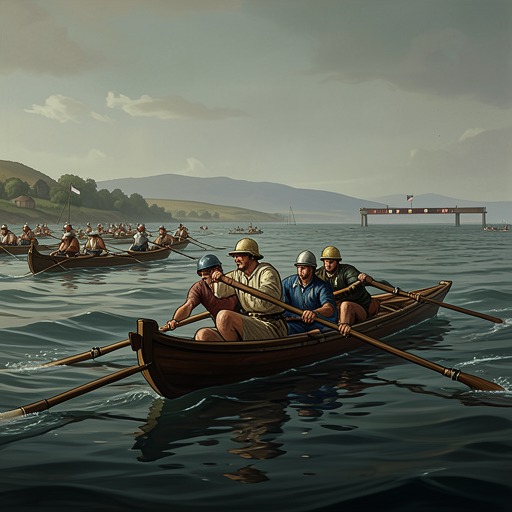
The final’s opening conditions tested the crew before the start. Gusting crosswinds pushed the shell sideways, forcing Roger Morris and Chuck Day to steady it at the bow while Moch worked the tiller ropes. Hume set a measured paddling pace as he conserved strength. Inside the boat, Joe Rantz felt the noise of the crowd recede; the rowers moved together in a slow warm-up, their breathing and motion synchronized. Their anxiety gave way to a tentative calm, anchored in the agreement not to fail Hume. The crew backed the Husky Clipper toward the starting position on the Langer See as the wind continued to buffet the shell. The team’s identity, in that moment, was expressed less by its national designation than by the coordination required to hold one boat on course.