University of California, Berkeley
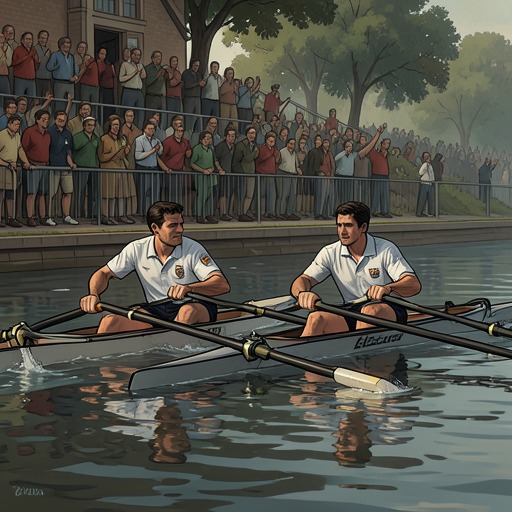
The Boys in the BoatThe University of California, Berkeley’s rowing program turned a threatened West Coast crew into a formidable national competitor, and its rivalry with the University of Washington made the two public universities a counterweight to the eastern schools that had long defined collegiate rowing. Its rise depended not only on Ebright’s coaching but also on the money, equipment, spectators, and social prestige surrounding the sport. By 1936, the Berkeley crew remained dangerous enough to shape expectations for the Olympic trials even as its coach judged the Washington boat the strongest in the country.
A West Coast program and its setting
Rowing at the University of California, Berkeley dated to 1868, making the program one of the oldest in the United States. Its significance grew within a sport that, in the 1920s and 1930s, could command press coverage and crowds on a scale comparable to baseball and college football. Eastern private schools had cultivated rowing as a gentleman’s sport, sending oarsmen into prominent universities and sustaining a powerful network of fans, reporters, and institutions. In that world, western crews were still outsiders: farmers, fishermen, and lumberjacks did not match the familiar image of the eastern collegiate oarsman.
The University of California, Berkeley and the University of Washington had competed annually since 1903. Their April dual regattas drew tens of thousands of students, alumni, and local spectators, making the rivalry a public contest over West Coast supremacy as well as a sporting event. Yet neither western program had recruitment funds or well-heeled patrons, and their coaches earned a fraction of eastern coaches’ salaries. The eastern center of collegiate rowing remained among the major universities and rowing institutions of the Northeast. The University of California, Berkeley therefore competed from a position of regional strength but limited resources, with the possibility that national rowing prominence might shift west—and might settle in California rather than with its northern rival.
Rebuilding under Ky Ebright
The program’s future appeared uncertain when its coach, Ben Wallis, prepared to leave Berkeley after years of disappointing results. The stewards of rowing at the University of Washington worried that, if the University of California, Berkeley abandoned its crew, their own program would lose the serious West Coast rival that helped justify its continuation. The University of California, Berkeley needed an effective coach; Ebright wanted a coaching position; and the University of Washington wanted its rival to survive. In February 1924, Ebright became head coach with the task of rebuilding the Berkeley program. By 1927, the crew had improved enough to contend with the University of Washington for regional supremacy.
Ebright’s appointment also gave the growing rivalry a personal dimension. He had begun rowing as a coxswain at the University of Washington in 1915, remained around its boathouse after graduation, and had sought its head coaching position when it became available in 1923. The University of Washington passed him over. Some there later regarded his move to the University of California, Berkeley as a betrayal; others suspected that resentment over the rejected position drove him to settle a personal score. The account presents those judgments as perceptions rather than established motives, but it makes clear that the rivalry intensified as the Berkeley crew improved. Ebright’s work helped turn a program that had nearly been abandoned into a persistent adversary.
National contests and unequal resources
For western crews, entry into the national contest came at a cost. The Intercollegiate Rowing Association regatta at Poughkeepsie was a major institution in American rowing, drawing as many as 125,000 spectators in 1929 and millions more radio listeners. Eastern crews dominated for much of the early twentieth century. When western programs did make the expensive journey east, they encountered curiosity, condescension, and sometimes open derision; transporting crews and delicate racing shells across the country was difficult to justify when the reception itself could be hostile. The University of California, Berkeley, like the other western programs, returned only occasionally during the decade after the University of Washington’s breakthrough victory there in 1923.
By 1932, the Berkeley crew had become capable of defeating its rival decisively. At the annual race on Lake Washington, more than 100,000 spectators watched the University of Washington boat struggle in rough, wind-whipped water and finish eighteen lengths behind the University of California, Berkeley. In June, Ebright’s varsity defeated the Washington crew by five lengths at Poughkeepsie. The University of Washington then failed to advance beyond a preliminary race at the Olympic trials on Lake Quinsigamond, while Ebright went on to win an Olympic gold medal in Los Angeles in August. The results established the Berkeley program not merely as a regional challenger but as the dominant western crew of that season.
That dominance did not eliminate instability within the program. By the time of a later season, only one member of Ebright’s 1932 Olympic gold-medal crew remained on the Berkeley varsity, whose times were described as indifferent. Ebright said that his rowers had the size and power but that he could not see them winning. The freshmen had begun beating the varsity in both time trials and head-to-head races, exposing a lineup problem despite the program’s recent triumphs. At the same time, Berkeley’s home water, the Oakland Estuary, remained a stage for the larger contest with the University of Washington. On the equipment side, George Pocock’s shop connected the rival programs: seventeen of the eighteen boats on the river at one regatta had come from his workshop, and he serviced Ebright’s boats at the Berkeley boathouse.
The 1936 challenge and the limits of victory
In the run-up to the 1936 Olympic trials, a Berkeley varsity time of 19:31 over four miles became the fastest reported time on the river that year. The University of Washington staged a nighttime trial in rough water several days later. Its coach, Al Ulbrickson, gave reporters a slower figure than the time recorded privately by his assistant, Johnny White, while rumors circulated that Ebright’s crew had produced an even faster performance. The competing times and partial reports turned training into a public contest of reputation as well as speed, with the University of California, Berkeley widely treated as the favorite.
At the Princeton trials, the University of Washington beat the New York Athletic Club by two and a half lengths in its heat. The Berkeley crew then faced Navy and Penn. For the first thousand meters, the three boats contested the lead; Penn moved ahead before the final five hundred, when the University of California, Berkeley surged past both rivals and won by a quarter of a boat length. Its time was 6:07.8, compared with 6:17.8 for Washington’s heat. The result reinforced the belief among many observers that Berkeley was the stronger sprinting crew, even after Washington’s victories in longer races. Ebright, however, told observers that the Washington crew was the best in America and deserved to go to Berlin. His judgment distinguished the danger Berkeley posed from his assessment of the rival boat’s overall strength.
The Olympic place also exposed how financial resources shaped access to international competition. After Washington won the trials, officials told its representatives that the winning crew would have to pay its own fare to Berlin or give way to Penn. Ebright’s program had paid its own way in 1928 and 1932, while Washington’s working-class rowers could not be expected to finance their passage. The ensuing Seattle fundraising campaign raised thousands of dollars, including contributions from towns associated with individual Washington rowers. The episode made visible a disparity that surrounded both western programs: competitive achievement did not itself guarantee the funds required to compete. Berkeley’s ability to finance earlier Olympic trips was part of the institutional advantage it could invoke, not evidence that the wider system was equitable.
Significance
The University of California, Berkeley’s rowing program embodies the mixture of rivalry and dependence that shaped western collegiate crew. Its competition with the University of Washington drove both programs toward national recognition, while their shared scarcity of recruitment money and patronage set them apart from the eastern institutions that held greater prestige and resources. The Berkeley crew’s success could unsettle eastern assumptions about who belonged among the leading oarsmen, but the older hierarchy remained visible in the costs of travel, the status attached to amateur rowing, and the struggle to finance an Olympic campaign. Ebright’s team was therefore both a powerful sporting opponent and part of a larger contest over regional standing, institutional resources, and the social boundaries of the sport.