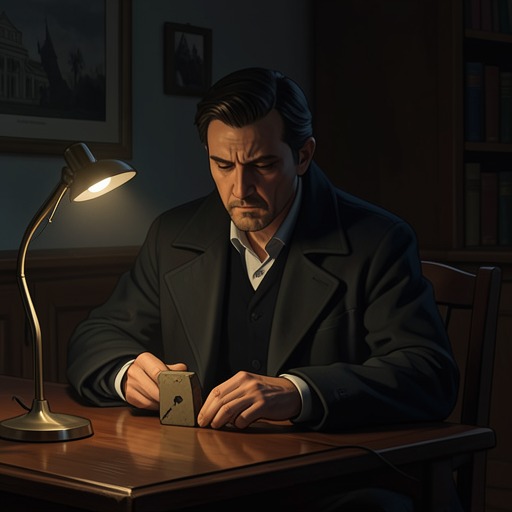
“In a pickle, take the nickel”
The Brass Verdict“In a pickle, take the nickel” is a nursery rhyme that Mickey Haller remembers as his father’s lesson in refusing to incriminate himself. First heard in childhood through the open door of his father’s study, it returns years later when Haller is confronting the possible end of his own legal career, joining a family memory to the question of whether he can continue as a lawyer.
The childhood memory
Haller’s memory centers on an antique glass ball, an heirloom from Mexico passed down through his mother’s family. It had been found broken beneath the Christmas tree, and his mother brought him into the living room to see the damage and give him a chance to confess. Haller was five. His father, already sick and not expected to recover, had moved what remained of his work into a study beside the living room.
Haller does not see his father in the study. He hears him sing the rhyme from beyond the open doorway: “In a pickle, take the nickel …” The broken heirloom and his mother’s questions establish the immediate predicament; his father’s voice supplies a response that is less an explanation than a compact instruction.
A lesson in silence
Haller understands the rhyme as a direction not to answer his mother’s questions. He refuses to confess and, in his recollection, connects that refusal to being his father’s son “in blood and the law.” The moment makes the phrase more than a family saying: it is Haller’s earliest remembered enactment of a lawyer’s protection against self-incrimination, learned before he could practice law.
The memory also places legal identity inside family life. The lesson comes not in a courtroom but through a doorway, amid a child’s damaged heirloom and a mother’s attempt to elicit an explanation. Haller’s father is present through his voice and his remaining work, while the child’s silence becomes the action that joins the two.
The phrase’s return
Years later, during a night of doubt about whether he can continue practicing law, Haller recalls the scene and smiles. He has been tempted to return to pills to dull physical and internal pain; he recognizes that he faces his own jury and expects a guilty verdict, with no more cases afterward. Against that present crisis, the childhood rhyme carries a double resonance: it recalls the lawyer he inherited from his father and the child who knew when not to answer.
The recollection does not resolve Haller’s crisis. After remembering it, he laughs, looks out over Los Angeles, and says to himself that he cannot do this anymore. The rhyme therefore returns not as a simple reassurance but as a measure of the distance between the boy who learned to remain silent and the adult who is struggling to decide whether his life in law can continue.