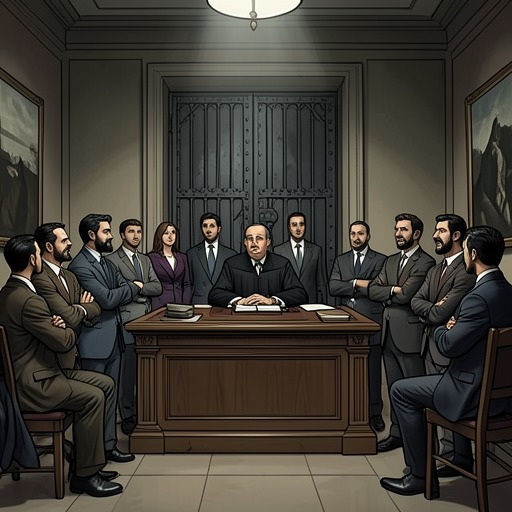
“Take the nickel” and keep silent
The Brass Verdict“Take the nickel” and keep silent is Mickey Haller’s compact rule for criminal defendants: when questions threaten to make a case worse, silence can preserve the ability to fight it. The phrase links a courtroom tactic to Haller’s broader defense ethic, while Walter Elliot’s experience shows how much the timing of that choice can matter.
The Rule and Its Legal Logic
Haller’s advice is to avoid discussing a case, including with people close to the defendant, and to invoke the Fifth Amendment when questioning creates a risk of self-incrimination. In his formulation, silence is not a confession or a way to settle the facts; it is a means of keeping a defendant from supplying investigators with further material and retaining room to contest the prosecution’s account.
The rule is expressed as a form of tactical patience: a defendant may give up the immediate chance to explain, but can live to fight another day. Its force depends on the distinction between what a person may know or have done and what the state can establish through its case. Silence does not make an underlying accusation disappear, and Haller does not present it as a guarantee of release.
A Courtroom Demonstration
During his examination of Ronald Torrance, Haller asks about looting during the riots. After pausing and glancing at his attorney, Torrance invokes the Fifth Amendment. Haller then asks a series of questions designed to leave Torrance choosing between incriminating himself and refusing to answer under the amendment’s protection.
Torrance takes the nickel six times. The repetition makes the legal protection visible in the courtroom, but also wears on the judge, who eventually directs Haller back to the case at hand. Haller reluctantly complies. The exchange demonstrates both the utility and the limits of the tactic: a refusal to answer can protect a witness, but pressing the point has procedural limits and cannot displace the trial’s central business.
Defense Work and the Limits of Silence
Haller’s principle does not require him to confuse a defendant’s interests with a claim of innocence. In Barnett Woodson’s case, Haller believes Woodson killed two Westside boys, though he had never asked him directly. He nevertheless regards testing the state’s case with his full skill as his professional job. After doing so, he has a means to improve Woodson’s position, but does not expect Woodson’s wish to walk away from the killings to come true.
That distinction gives the nickel rule a wider significance in Haller’s practice. Defense is an examination of the state’s proof, not an assurance that the client’s account is true or that silence will secure acquittal. Haller can protect a client’s legal position while remaining clear-eyed about what he believes happened.
Walter Elliot’s Delayed Silence
Walter Elliot initially tells investigators how he says he discovered the bodies at his beach house. He is taken to the Malibu substation while the crime scene is examined, waits for three hours in an unlocked interview room, and then undergoes a videotaped interview that crosses into interrogation. Only after investigators advise him of his rights does Elliot stop answering questions and ask for an attorney.
Haller judges the decision better late than never, but considers Elliot better off had he said nothing to investigators from the start. The sequence makes the rule concrete: Elliot eventually asserts his right to stop, yet only after giving an initial account and sitting through a lengthy wait and interview. Investigators obtain search warrants for the beach house and car and conduct a gunshot-residue test; the account does not make silence a way to undo steps already taken in the investigation.
The Phrase as a Recurring Motif
In Haller’s reflections, a brass plate beneath a mounted fish bears the maxim about wishing one had kept quiet. He treats it as counsel drawn from the pattern of criminal defendants talking themselves into prison, and connects it to the advice he gives clients: take the nickel and preserve the chance to fight another day. The phrase therefore operates as more than courtroom slang. It condenses Haller’s emphasis on restraint, the risks of unnecessary speech, and the distinction between protecting a defendant’s rights and deciding what the defendant deserves.