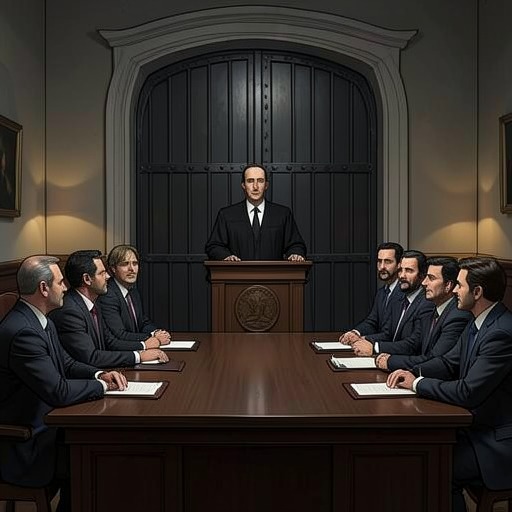
Anonymous tip about juror seven
The Brass VerdictThe anonymous tip about juror seven began as a covert defense maneuver and became a dangerous turning point in Mickey Haller’s case for Walter Elliot. Haller sent a letter to Judge Stanton alleging that the person occupying seat seven was a fraud who had lied about having a criminal record. He intended to remove David McSweeney and then try the case fairly; he did not foresee that the letter would reach the center of the conspiracy or help make him a target.
Background and Purpose
Haller’s defense was already challenging an investigation he believed had narrowed too quickly around Elliot. The prosecution had a theory of motive and opportunity, but Haller regarded the remaining evidence as thin and circumstantial. He argued that a positive gunshot-residue result had turned a broad investigation into a focused examination of Elliot, leaving other possibilities insufficiently explored. His defense sought to make the jury see not a settled account of the killings, but a case whose apparent coherence rested on gaps and assumptions.
The jury itself had become part of that struggle. Elliot had told Haller that Jerry Vincent planned to delay the trial because he had found a way to win without using a sleeper juror. In that account, the proposed fix was no longer needed, and Vincent’s decision to abandon it was connected to his murder. The existence of a planted juror therefore threatened both the fairness of Elliot’s trial and the integrity of Haller’s effort to defend him. The letter was Haller’s attempt to address that danger without openly identifying what he knew.
The Letter and Its Immediate Effect
Haller’s allegation was specific: juror number seven was phony and had lied about having a record. When the trial resumed, Judge Stanton told the parties that an anonymous letter had raised precisely that concern. The judge intended to question the juror, but the man failed to appear. Sheriffs went to his home and workplace; the person they brought back was not the juror who was supposed to occupy seat seven. The accusation had thus exposed a false identity in a way that disrupted the proceedings, even before its source or full implications were known.
Haller later explained that he had written the letter to get McSweeney off the jury so he could win the case fairly. That purpose matters: he did not describe the letter as a device for fixing the verdict in his own favor, but as a means of removing an allegedly planted juror and returning the case to a legitimate contest. At the same time, his intervention was concealed. He had not expected Judge Stanton to take the letter to other judges for advice, and the decision to seek counsel created an opening for the information to reach people Haller did not trust.
The Unintended Chain of Events
After the crisis, Haller reconstructed what he believed had happened. Judge Stanton, unaware that the chief judge was behind the larger scheme, had called her for advice. Haller concluded that the chief judge then warned McSweeney not to attend court and used him to help clean up the resulting problem. In this reconstruction, the missing juror’s absence was not an isolated response to an accusation: it was part of an effort to contain the exposure of the conspiracy. The man returned by the sheriffs was a concrete sign that the identity occupying the seat could not simply be taken for granted.
Haller’s account remained an inference about how the warning and cover-up unfolded. He told Harry Bosch that the chief judge must have recognized that Haller had sent the letter, because he knew too much. He connected that suspicion to the attempt on his life at the Mulholland Drive overlook, reasoning that the danger arose from his warning Judge Stanton, not from the newspaper story the investigators had planted. The letter therefore changed meaning in retrospect: a step intended to protect the trial had, in Haller’s view, revealed him as a threat to those manipulating it.
Consequences and Significance
When Bosch asked whether he had sent the letter, Haller admitted that he had. He also acknowledged that he had not anticipated Judge Stanton’s consultation with other judges. The exchange makes the action’s double consequence plain: the anonymous tip helped bring the false juror into view, but secrecy did not protect its author once the letter entered the compromised judicial chain of communication. Haller’s effort to act without becoming a witness or publicly disclosing his knowledge could not control who received the warning or how they used it.
The episode turns a procedural safeguard into a source of peril. A judge’s response to an allegation about a juror ought to protect the trial; here, Haller believed that seeking advice instead exposed the allegation to the very network capable of suppressing it. The false juror’s absence and the arrival of the wrong man sharpen the immediate crisis, while Haller’s later admission supplies the personal cost: his own attempt to remove an impostor may have helped identify him as someone who could unravel the broader scheme.