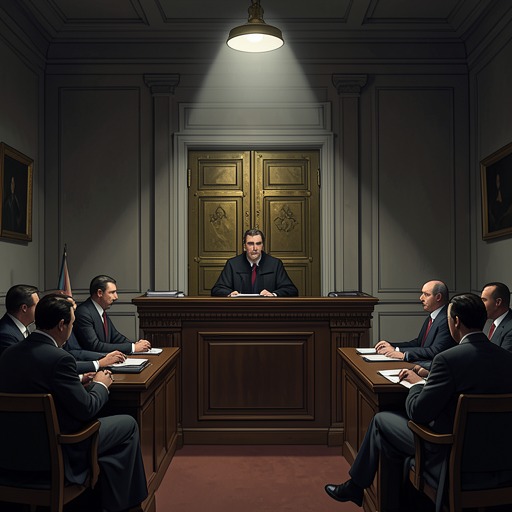
Barnett Woodson’s double-murder trial and acquittal
The Brass VerdictBarnett Woodson’s double-murder trial and acquittal became a defining test of how evidence, courtroom strategy, and professional conscience can collide. On the fourth day of trial, Mickey Haller challenged a witness’s account of a confession by pointing out that the two men the witness said Woodson had described killing did not match the two white men Woodson was charged with murdering. The contradiction opened a path through the prosecution’s case, but Haller’s decision to pursue it also put him at odds with Jerry Vincent. Woodson was acquitted; his sarcastic remarks to the media afterward turned the verdict into a public embarrassment for the prosecution and, as Haller later recalled, a career-ending blow for Vincent.
Background and Stakes
The trial took place in Department 109 of the downtown Los Angeles Criminal Courts Building. Haller was representing Woodson on two murder charges, and he understood a conviction to carry the gravest possible consequence. His recollection casts the fourth day as a turning point: the trial had reached a moment when the state’s account could be tested not merely for force or fluency, but for whether its details actually fit the charges before the jury.
The key witness was Ronald Torrance, who claimed that Woodson had confessed to killing two men. Haller’s cross-examination focused on the particulars rather than allowing the allegation to remain a general claim of guilt. He pressed Torrance to state the exact words he attributed to Woodson. Torrance then supplied an elaborate account, including a claimed admission about two men whose bodies had been left in a reservoir. That detail made the testimony concrete, but it also made the mismatch with the case unmistakable: Torrance described two black men, while Woodson was on trial for killing two white men.
The Testimony Breaks Down
Haller made the discrepancy explicit before the jury. His question was whether a confession to killing two black men could reasonably be treated as a confession to the murders of the two white men at issue. The force of the challenge lay in the gap between the witness’s vivid narrative and the identity of the victims in the prosecution’s case. Detail alone could not bridge that gap. Instead, the more fully Torrance recounted what he said Woodson had told him, the harder it became to treat the account as a confession to the charged crimes.
The exchange illustrates how the trial’s competing accounts depended on the jury’s ability to connect evidence to the particular deaths under consideration. Torrance’s testimony asserted a confession, but its central particulars did not correspond to the prosecution’s case. Haller did not need to supply a different account of the murders in order to expose that weakness; he asked the jury to notice that the witness’s own story pointed elsewhere. The contradiction transformed cross-examination from a general attack on credibility into a direct challenge to the relevance of the alleged confession.
Vincent’s Intervention and Haller’s Choice
After Haller had exposed the discrepancy, Vincent stood and asked the judge to recess the trial so he could confer with opposing counsel. Haller had expected to continue questioning Torrance and dismantle the witness’s credibility through the lie Haller believed he had exposed. Vincent instead told him not to proceed with the cross-examination. The available account records the instruction and Haller’s response, but does not specify Vincent’s reason for intervening.
Haller refused. He believed that following Vincent’s suggestion would make it impossible for him to look another client in the eye, and he feared becoming the person who had been deceived by the strategy. His objection was not simply that the cross-examination might help Woodson; it was that abandoning a challenge he regarded as necessary would compromise his ability to represent clients with integrity. The pause therefore sharpened the event’s central conflict: the courtroom tactic that could expose a damaging falsehood also tested the lawyer’s own standards. Haller chose to continue with the truth he believed the jury needed to confront.
Acquittal and Aftermath
Woodson was acquitted of the double murder. He left the courtroom and sarcastically apologized to the media for getting away with murder, a public reaction Haller remembered as an effort to rub the district attorney’s office in its defeat. The acquittal settled the charges in court, but Woodson’s remarks made the result more volatile outside it: they presented the verdict not as a quiet vindication but as an occasion for openly taunting the prosecution.
Haller later connected that display to Vincent’s professional fate, recalling that Woodson’s behavior pretty much ended Vincent’s career as a prosecutor. The episode thus closes on a consequence beyond the verdict itself. The cross-examination exposed the weakness in a purported confession, Haller’s refusal to retreat preserved the challenge, and the acquittal was followed by a public spectacle that damaged the prosecutor’s standing. In Haller’s account, the trial’s lasting significance lies in that chain: a witness’s details undermined his own claim, a lawyer chose to pursue the contradiction, and the victory proved costly in ways the courtroom result alone could not contain.