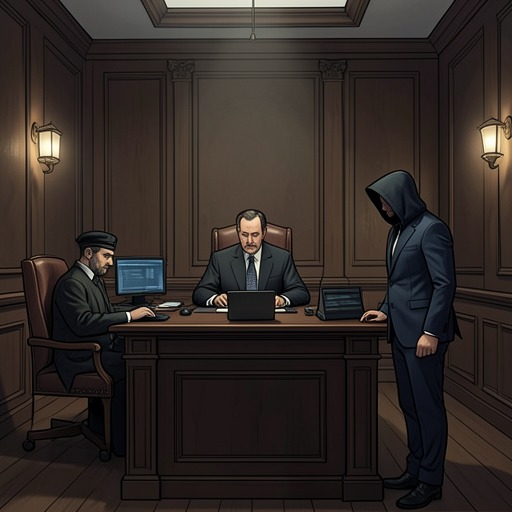
Bruce Carlin
The Brass VerdictBruce Carlin is Walter Elliot’s investigator, a figure whose personal connection to Elliot’s secretary gives him a place in the case’s possible love triangle, and whose later fee demand frustrates the defense team’s attempt to question him. The novel offers only fragments of his character, but those fragments connect a private investigator to both the prosecution’s account of Elliot’s household and the defense’s search for useful evidence.
Identity and Connection to Elliot
Carlin is identified as Elliot’s investigator during a discussion of the secretary’s alibi. The account says that she was involved with Elliot and with his investigator, and that she and the investigator were together on the night in question. The exchange does not describe Carlin’s duties or his history with Elliot; it establishes his role through this personal connection and its bearing on the timeline.
The secretary’s alibi was checked through witnesses. They placed her and Carlin with friends at a screening at Archway Pictures, an invitation Elliot had obtained for them. The screening gives their shared account external support, while the affair creates a different implication: Haller sees a possible triangle among Elliot, the secretary, and the investigator. The evidence presents the relationship as part of the surrounding circumstances, not as proof that Carlin participated in the murders.
Bosch’s Earlier Interview
Haller recognizes Carlin as the investigator whom Harry Bosch had questioned in a room on the first night. Haller infers the identity from Bosch’s own account of the questioning and connects it to the possible triangle, reasoning that it would have been a natural starting point for the investigation. The exchange reveals that Carlin had already attracted investigative attention, although it does not disclose what he told Bosch or what conclusions Bosch drew from the interview.
The Defense Team’s Attempt to Debrief Him
Later, Haller asks whether Cisco has debriefed Carlin and raises the possibility that Carlin might have Julio Muniz’s videotape. Haller’s interest in the tape is tied to his search for the key clue in the Elliot case, but the question establishes only a possibility: the evidence does not confirm that Carlin possessed the recording.
Cisco’s response is that Carlin is making things difficult. Rather than accept the proposed hourly rate of $200 for what Cisco expected would be two or three hours of work, Carlin demanded a flat fee of $10,000. The size of the request turns a short debrief into a dispute over terms and leaves Haller without the information he had hoped to obtain at that point. The account does not establish whether the team later paid him or completed the interview.
Narrative Role
Carlin’s brief appearances link two kinds of uncertainty. His relationship with the secretary helps explain why investigators would examine the people around Elliot, while his unexplained knowledge and refusal to proceed on the proposed fee leave open what he might contribute to the defense. The text keeps that possibility distinct from established fact: Carlin is identified as the investigator, placed with the secretary by witnesses, and approached for a debrief, but the hoped-for connection to the videotape remains unconfirmed.