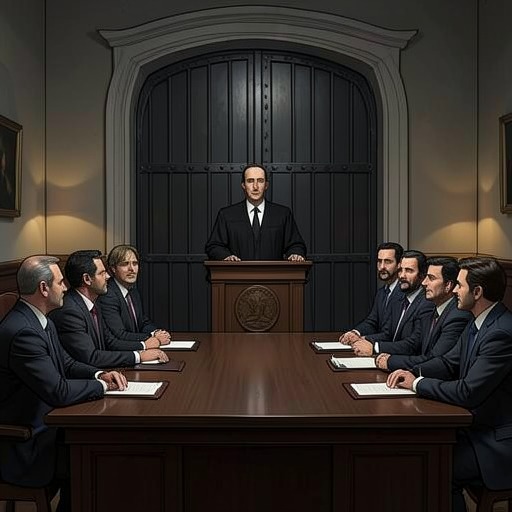
Dennis Wojciechowski
The Brass VerdictDennis Wojciechowski, usually called Cisco, is Mickey Haller’s trusted freelance investigator and Lorna Taylor’s partner. His importance lies in the way he connects practical investigative work to long-standing personal and professional ties: he can quietly gather information through contacts, assess what a case’s details imply, and challenge a client’s story with independent research. His history with the Road Saints Motorcycle Club informs his reputation, but his investigative value rests just as much on method and judgment as on his imposing appearance.
Identity and Background
Wojciechowski had known Haller for more than ten years before they worked together as investigator and attorney. Their earlier connection came through the Road Saints Motorcycle Club, for which Haller had served for several years as a kind of house counsel. Wojciechowski was an associate member, although he never wore the club’s colors. The group already had a member named Dennis, so the difficult-to-pronounce Wojciechowski acquired the nickname Cisco Kid, shortened in everyday use to Cisco. His dark looks and mustache helped inspire the name, even though he was Polish American, from Milwaukee’s south side.
He was a large, imposing man, but his time around the Saints did not leave him with an arrest record. That clean record later helped him obtain a state private-investigator’s license. By the time Haller called on him for work, the long hair of his earlier years was gone and his mustache had been trimmed and was turning gray. The old nickname endured, as did his attachment to classic Harleys built in his hometown.
Investigative Work
Haller brings Cisco into the work after realizing he needs an investigator. Cisco is already familiar with Haller’s practice: he had worked on several of Haller’s cases, and his first meeting with Lorna had come when he collected payment for investigative work. Haller asks Lorna whether she is comfortable working with Cisco, and she agrees while wishing Haller would explain what the matter is about. The exchange establishes Cisco as both a professional in Haller’s working circle and a person whose private relationship with Lorna overlaps with that circle.
Cisco’s professional strengths are complementary. He is described as thorough and thoughtful, and he has contacts useful for finding out what is happening beyond the immediate reach of an attorney. His size and strength can also make him physically intimidating when dealing with people on the edges of a criminal case. The narrative presents that presence as a practical asset, not a substitute for investigation: his work includes checking information, contacting people with relevant expertise, and reporting what those inquiries actually establish.
That combination appears in his work on Jerry Vincent’s killing. Haller asks Cisco to use his contacts and keep close watch on the detectives’ investigation, since the murder inquiry may become entangled with the cases Haller has inherited. Cisco calls someone he knows in forensics while the crime scene is still being processed. The information he obtains is limited but concrete: Vincent had been shot at least twice, and investigators found no shell casings. Haller draws the further inference that the shooter either used a revolver or deliberately collected the ejected casings. Cisco’s contribution is the timely field report; Haller supplies the interpretation. Their division of work shows how a small forensic detail can become a lead without being mistaken for a complete answer.
Later, Cisco tests Walter Elliot’s claim that he was acting as a front for an organization and had been sent to invest its money. Rather than accept Elliot’s apparently sincere account, Haller asks Cisco to see whether it can be confirmed. Cisco hires a private investigator in Fort Lauderdale whom he has worked with and trusts, even though Tampa is elsewhere in Florida. The resulting research traces Elliot’s family business: his grandfather founded a phosphate-shipping operation seventy-eight years earlier, his father later ran it, and Elliot himself worked there before selling it a year after his father died of a heart attack. The privately held company’s sale was not publicly recorded, although newspaper coverage put the price at about thirty-two million dollars. The investigator finds no sign of organized-crime involvement. Cisco’s report therefore exposes a consequential omission in Elliot’s account: Elliot had sold his own company and brought the proceeds west, a fact he had not told Haller when describing himself as an organization’s front man.
Relationships and Personal Life
Cisco’s relationship with Lorna develops from professional acquaintance into a committed partnership. Haller had introduced them when he hired Cisco on a case; by the time the relationship is discussed, they have been together for about a year and, as far as Haller knows, are living together. Cisco later tells Haller directly that he and Lorna are going to marry, asking whether Haller is all right with it. The announcement carries particular weight because Haller and Lorna had been friends for fifteen years before a brief, ill-advised marriage of their own. They had divorced after recognizing their mistake but remained close. Haller still loves and trusts Lorna and says he will always protect her, making Cisco’s request an acknowledgment of that continuing bond rather than a simple piece of news.
Cisco’s familiarity with Haller is evident in their easy, informal exchanges. When Haller reaches him by phone, Cisco is riding his 1963 Panhead, and the wind and exhaust make conversation difficult despite the helmet’s phone equipment. Haller tells him to pull over and later teases him about the bike’s loud pipes. The moment conveys a working relationship at ease with blunt humor, while also grounding Cisco’s Harley-riding identity in an ordinary interruption to a call about work.
Role in the Investigation
Cisco’s investigations repeatedly give Haller grounds to distinguish evidence from assertion. The forensic update on Vincent’s murder narrows the possibilities without identifying the shooter; the Florida inquiry, by contrast, directly undermines Elliot’s account by establishing a plausible source for his money and finding no evidence of the organization he described. In both instances, Cisco supplies information that Haller can use to revise his understanding rather than merely reinforce an existing theory.
Near the end of the available events, after a weapon has been found and Harry Bosch and Agent Armstead are examining it, Haller’s phone rings with the William Tell Overture. The call is from Cisco. Haller says he will call back, but Cisco presses him to make it quick, saying he has something important to report. The information itself is not disclosed in this exchange. It leaves Cisco’s investigative work in motion at a moment when the case is still developing, while preserving the distinction between what he has learned and what the reader has yet to hear.