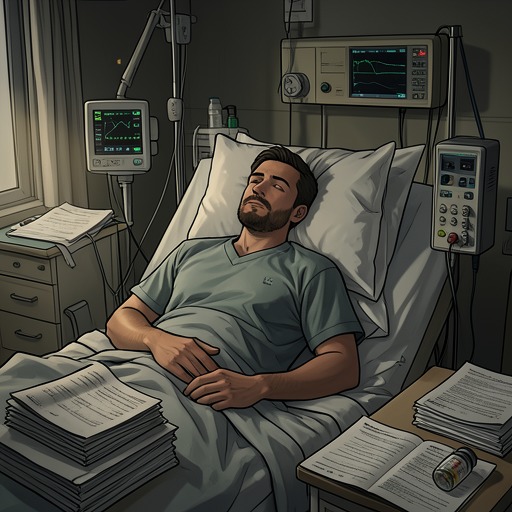
Elaine Ross’s relapse
The Brass VerdictElaine Ross’s apparent relapse brings the fragility of recovery into the present tense: after a period in which staying clean has been treated as a daily practice supported by work and companionship, a police officer reports that she has passed out on Mulholland Drive. Mickey Haller fears that she has fallen back into addiction and that arrest will return her to jail and rehabilitation. The call ends with his decision to collect her, before the narrative establishes whether she is arrested or what becomes of her afterward.
Conditions of Recovery
The novel places Elaine Ross’s crisis alongside the precarious recovery of Patrick Henson. When Haller takes over Jerry Vincent’s cases, Patrick explains that he has no money because he is concentrating on getting and staying clean. He says he gave Vincent his surfboards as payment; Vincent counted them as five thousand dollars, although Patrick believes their value was higher. With the case delaying his return to work, Patrick has little financial room to support recovery. Vincent had presented sobriety as Patrick’s chance to stay out of jail, making it both a personal commitment and a condition tied to his legal situation.
Haller’s own history makes that vulnerability more than an abstraction. He recalls that, after driving his eleven-year-old daughter home to her mother, he tripped outside his house and badly injured his face. The emergency-room photograph became a reminder of the period when he was taking 320 milligrams of OxyContin a day, crushing and snorting it after waking in the afternoon. His memory gives recovery a concrete measure: the danger is not merely an eventual return to drug use, but the way addiction can enter ordinary responsibilities, including driving his daughter.
Mutual Support and Renewed Risk
Haller proposes that he and Patrick help one another through the coming weeks, with either able to talk to the other if the pull to use returns. The offer establishes recovery as reciprocal rather than solitary. Yet Haller does not tell Patrick that he may need the support more: pressure from his expanding caseload has begun to revive his own craving for the distance the pills once provided from reality. Their arrangement is therefore made under unequal awareness. Patrick accepts a promise of mutual help, while Haller privately recognizes that the support may be most urgent for himself.
This exchange supplies an important context for Elaine’s later crisis. The book shows several forms of strain around sobriety: Patrick’s lack of money and interrupted work, Haller’s mounting professional pressure, and the possibility that Elaine’s recovery has also faltered. It does not explain Elaine’s circumstances or establish a cause for what happens to her. The parallel lies in the uncertainty and vulnerability of maintaining recovery, not in any stated equivalence among their experiences.
The Police Call
The disclosure comes when Los Angeles police officer Randall Morris calls Haller and asks whether he knows Elaine Ross. Morris reports that she is on Mulholland Drive, should not be driving, and has passed out after handing over Haller’s card. The card gives the officer a way to reach someone connected to her; the scene does not specify why she had it or what had happened before Morris encountered her.
Haller’s immediate reaction is fear. The call seems to confirm what he had already worried about: Elaine has fallen back. He anticipates that an arrest could put her back into the system and probably cost her another stay in jail and rehabilitation. That outcome is Haller’s apprehension, not a confirmed consequence. Morris explains that taking her to be booked would keep him working for roughly two extra hours, beyond the overtime allowance he has left for the month. Rather than proceed with booking, he offers Haller the chance to come for her or send someone.
Haller agrees to collect Elaine and asks for the address. Morris identifies the overlook above Fryman Canyon. That exchange is the scene’s endpoint: Haller has committed to going, but the text supplied here does not show the pickup, Elaine’s condition afterward, or a final decision about arrest.
Significance and Limits
The episode makes relapse a moment of acute practical consequence without turning suspicion into a settled diagnosis. Morris describes observable circumstances—Elaine should not be driving and has passed out—while Haller interprets the call through his fears about her recovery. The distinction matters: the narrative presents his belief that she has fallen back, but does not provide Elaine’s own account or independently confirm the cause of her condition.
The officer’s offer also places the immediate stakes between formal procedure and personal intervention. Booking Elaine could send her back into institutions Haller fears will compound the crisis; collecting her offers an alternative in that moment, though the scene does not say whether it succeeds. Set beside Patrick and Haller’s proposed system of mutual support, the call gives that promise a darker resonance: people may agree to watch for one another’s return to addiction, yet recognition and help arrive under pressure, with the outcome still uncertain.