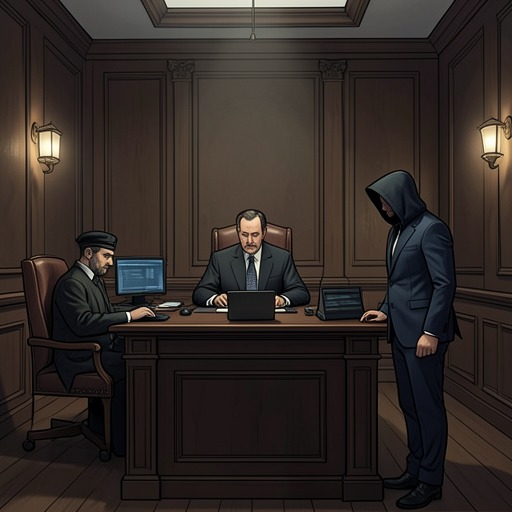
Federal indictments in the court-corruption case
The Brass VerdictThe federal indictments in the court-corruption case mark the point at which a jury-fixing scheme tied to Walter Elliot’s murder trial becomes a coordinated federal prosecution. Harry Bosch tells Mickey Haller that the grand jury has returned indictments against Judge Holder, Mitch Lester, Carlin, David McSweeney, and a supervisor in the jury office, with arrests planned simultaneously that morning. The charges include conspiracy to commit murder and corruption, and the evidence described to Haller suggests that the scheme reached beyond a single trial or courthouse.
Causes and Background
The investigation grows out of the attempt to rig Elliot’s defense at trial. Elliot tells Haller that Jerry Vincent had been approached with an offer to place a favorable juror on the panel. The intended juror would hold out for acquittal and persuade other jurors during deliberations. The trial needed to remain on schedule so that the planted juror would serve. Elliot and Vincent accepted the offer when Elliot feared that, despite being innocent, he would otherwise be convicted.
That arrangement changed when Vincent later told Elliot that the trial should be delayed: Vincent believed he had found a way to win without the sleeper juror. Elliot understood the reversal as dangerous. He told Haller that Vincent’s change of course must have led to his killing, although at that point he could only infer what had happened within the conspiracy. The later account Bosch gives Haller connects that fear to the indictments: Vincent’s withdrawal threatened to expose the people who had arranged the fix.
The money trail forms part of the background. Vincent’s firm held $38,000 in its operating account and $129,000 in its client trust account; the imbalance was explained by a $100,000 check Elliot had deposited the previous Friday. Haller also learns that Vincent had accumulated $100,000 in a personal investment account five months earlier and instructed his broker to cash it out a week later. Those figures raise questions about the handling and movement of money, but the indictments conversation identifies phone records and transfers, rather than those amounts alone, as part of the federal case.
The Indictments and Evidence
Bosch tells Haller that the indictments name Judge Holder, her husband Mitch Lester, Carlin, McSweeney, and a woman who supervised the jury office and provided access to its computers. The planned arrests are to take place simultaneously. Haller is struck by the seriousness of the case and cautions that an accusation against a judge must be firmly supported. Bosch assures him that the evidence is solid: McSweeney has disclosed what he knows, investigators have phone records and money transfers, and McSweeney recorded Holder’s husband during some of their conversations.
The conversation identifies Carlin as a central intermediary. He had a longstanding connection to Judge Holder and, according to Bosch’s account, approached Vincent about the jury fix. Vincent then used Carlin to deliver money. When Vincent began to have second thoughts as the FBI drew closer, Carlin learned of the change and informed Holder. Bosch says Holder and Lester then sent McSweeney to kill Vincent, describing the effort to silence him as a response to the danger that the conspiracy would be exposed. These are the investigators’ account and the basis for the indictments, not a report of convictions.
Bosch also explains how the investigators believe Vincent was monitored. Haller asks whether Wren Williams was involved; Bosch says that is what they think. The investigators believe McSweeney became close to Williams to keep watch on Vincent, while Williams herself may not have known what was happening. That distinction leaves her role uncertain: the account presents her as a possible route by which the conspirators tracked Vincent, not as a proven participant in the plot.
Scope of the Conspiracy
When Haller asks what charges the indictments contain, Bosch identifies conspiracy to commit murder and corruption. He stresses that this is only the first wave and that additional indictments may follow. The case is therefore presented as broader than the immediate effort to control Elliot’s jury or the killing of Vincent. Bosch reports that McSweeney had served on four juries over the preceding seven years, with two acquittals and two hung juries, in three different courthouses.
That history widens the possible reach of the scheme without establishing that every earlier verdict was corrupt. The record Bosch describes is a pattern investigators intend to examine: repeated jury service, outcomes that include acquittals and deadlocked panels, and access to multiple courthouses. The distinction matters. The conversation signals a potentially extensive operation, but it does not identify the other cases or prove that McSweeney manipulated each one.
Consequences and Significance
The indictments turn the hidden machinery behind the Elliot trial into an active criminal case. The jury supervisor’s access to computer systems, the money transfers, recorded conversations, and McSweeney’s disclosures give the federal investigation several kinds of evidence to pursue. Simultaneous arrests indicate an effort to act against the named suspects at once, before the group can be alerted piecemeal.
For Haller, the news also confirms that Vincent’s murder cannot be understood in isolation from the trial Vincent had been handling. The alleged conspiracy links a proposed juror, payments, Vincent’s change of strategy, surveillance, and the decision to silence him. Haller had wanted to see Judge Holder taken from the courthouse in handcuffs, but Bosch’s warning to keep the arrests secret makes clear that the immediate priority is securing the operation. The scene ends with indictments and an impending roundup, not with the case resolved: further charges are anticipated, and the full extent of the jury-rigging remains to be established.