First 48 hours rule
The Brass VerdictThe First 48 hours rule is an investigative maxim that makes time itself part of a homicide inquiry: Harry Bosch says the chances of clearing a case diminish by almost half each day if it is not solved in the first forty-eight hours. The book presents it not as a legal deadline but as a practical warning about the diminishing prospects of finding a killer as time passes. Its force is both operational and dramatic: it explains why investigators press for leads early, and why the absence of one can become a source of acute pressure.
The maxim and its urgency
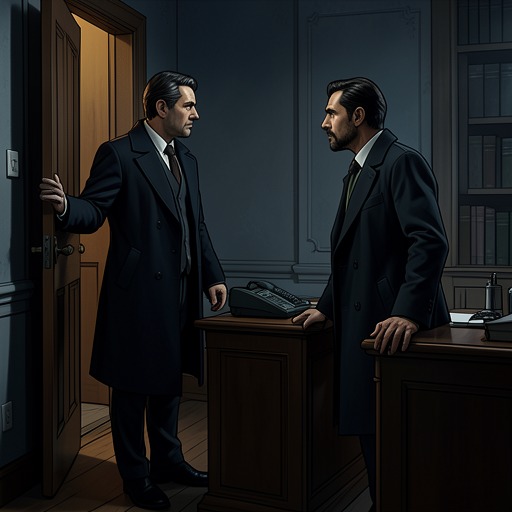
Bosch introduces the rule while speaking with Mickey Haller about the unsolved killing of Jerry Vincent. He is nearing the seventy-two-hour mark and has no suspect, no viable lead, and nothing to point him in a direction. The statistic therefore lands as more than general police wisdom: it measures how far the investigation has already drifted beyond the period Bosch considers most promising.
Bosch also reveals why he has raised the subject with Haller. He hopes that pressure might frighten some useful information out of him. Haller has to absorb both the urgency of the rule and the implication that Bosch suspects he may know who killed Vincent and be withholding it. The maxim thus becomes an instrument in their conversation, not merely background about investigative practice.
Early action and the Elliot investigation
The book places the principle alongside the rapid, consequential steps taken after Walter Elliot reported finding his wife and Johan Rilz dead at the Malibu house. Elliot first gave investigators an account of what he had found and was taken to the Malibu substation while detectives worked at the scene. After he spent three hours waiting in an unlocked interview room, investigators interviewed him; he stopped answering and asked for an attorney once the questioning turned toward interrogation.
During that interval, investigators obtained warrants to search the house and Elliot’s car and to test his hands and clothing for gunshot residue. After the initial interview, his hands were bagged, and he was taken to the sheriff’s headquarters in Whittier for testing. The laboratory found high levels of residue on his hands and sleeves, and he was formally arrested on suspicion of murder. These steps show how swiftly evidence can be gathered in the immediate aftermath of a killing. They also establish the chronology that Haller later needs to examine in preparing Elliot’s defense.
Urgency, evidence, and tunnel vision
The rule’s emphasis on speed sits uneasily beside the danger of allowing an early theory to narrow an investigation. Haller argues that once investigators believed Elliot had tested positive for gunshot residue, their inquiry shifted from a full-field investigation to one tightly focused on him. He points to unanswered questions about Rilz: investigators did not go to Germany to examine his background or possible enemies there, and Haller argues that they had not thoroughly investigated his life in Los Angeles either.
At trial, the residue result remains real, but its meaning is contested. The defense expert, Shamiram Arslanian, agrees that the tests showed elevated levels of elements associated with gunshot residue, then explains that residue could have transferred to Elliot inadvertently. Her account identifies the four-alpha patrol car as the source: when Elliot was handcuffed and placed in it, his hands, arms, and clothing came into contact with residue from another case. She further explains that material transferred from his hands and arms to the front of his jacket through ordinary movement. The evidence therefore illustrates the distinction between obtaining a result quickly and establishing what caused it.
The rule as a narrative measure
The maxim links the book’s two investigations through different kinds of pressure. In Vincent’s case, Bosch confronts the dwindling window with no suspect or workable lead. In Elliot’s case, investigators act quickly, but Haller’s defense turns on whether that early activity produced a reliable interpretation or an overly narrow one. The rule gives urgency a measurable form while leaving open the question of what urgency can and cannot accomplish.
That contrast also sharpens the book’s treatment of evidence. A fast investigation may secure warrants, interviews, and forensic samples while the scene is still under active examination; it does not, by speed alone, resolve what those findings prove. The First 48 hours rule is consequently both a practical maxim and a structural counterpoint: time presses the search for answers, even as the courtroom later tests the assumptions formed during that race.