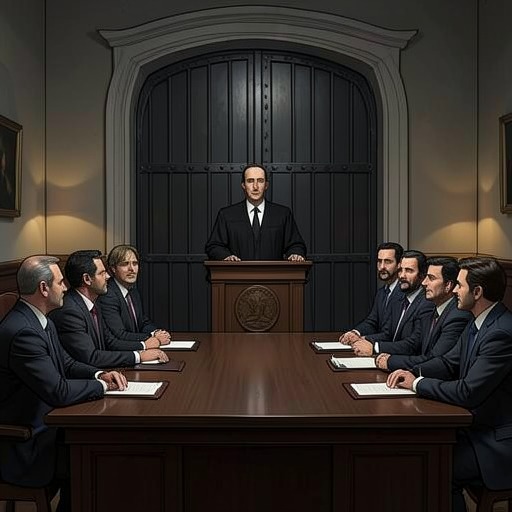
Haller secretly investigates juror seven
The Brass VerdictHaller secretly investigates juror seven after Walter Elliot discloses that Jerry Vincent had been approached with an offer to place a sleeper on the jury. The inquiry turns a hidden threat to the trial’s integrity into a dangerous question of identity: Haller must determine whether juror seven is legitimate without crossing the line into jury tampering himself. The available evidence raises suspicion about David McSweeney but does not establish that the suspected impersonation has been proved.
The alleged sleeper and the jury-selection system
Elliot tells Haller that, after the trial date was set, an unknown party approached Vincent with a proposal to place a sleeper on the jury. The arrangement depended on the trial proceeding on schedule: if the date changed, the sleeper could not simply be transferred to the new trial. Elliot further reports that Vincent later told him a delay would make the fix unnecessary because Vincent had found a way to win without the sleeper. Elliot connects Vincent’s change of course to his death, although the account presents that connection as Elliot’s conclusion rather than an independently established finding.
Haller works through what the offer would require. The jury process involves several stages of random selection: citizens are initially summoned from records that include voter registrations, property records, and public-utility records; a courthouse computer then selects prospective jurors for a particular trial; and the order in which the first twelve names or numbers enter the jury box is also computer-generated. For a sleeper to reach the box as described, the unknown party would need access to each of those stages. Once seated, the sleeper would have to avoid both sides’ challenges—appearing acceptable to the prosecution while remaining someone the defense knew not to remove with a peremptory strike. The plan’s dependence on an unchanged trial date makes its logistics, rather than simply the presence of a suspicious juror, central to Haller’s reasoning.
A private request at Book Soup
Haller’s investigation begins amid the ethical pressure created by Elliot’s disclosure. Haller recognizes that the reported jury-tampering crime has not yet reached the stage of deliberations, while the conduct that has already occurred—including the offer to Vincent—is in the past. He understands that confidentiality rules therefore bear directly on what he can do with what his client has told him. That conflict does not resolve his duty to protect the trial; it makes the next step more hazardous.
While Patrick Henson waits in the Lincoln outside Book Soup, Haller goes inside to make a call where Patrick will not overhear it. He leaves the crowded mystery section for an empty alcove among large coffee-table books and contacts Cisco. After their brief exchange, Haller asks Cisco to shadow juror number seven and find out everything he can. The request is not treated as routine background work: Haller warns that if Cisco is caught, both of them could suffer serious consequences.
Haller knows that Judge Stanton has taken steps to preserve juror anonymity. Investigating a report of misconduct may be defensible, but Haller sees that an inquiry aimed at identifying an anonymous juror could itself be viewed as interference. He anticipates that Stanton might report him to the bar and higher judicial authorities, potentially ending Haller’s role in the Elliot trial. The investigation therefore places the defense in an exposed position: it seeks to test a threat to the proceedings by using methods that may themselves draw judicial scrutiny.
The identity suspicion
Cisco reports that he followed juror seven and identified him as David McSweeney, but he cannot confirm that this was the name concealed on the juror sheet. The distinction matters: identifying a person outside court does not prove that the person was lawfully summoned or seated under his own identity. Cisco checks one concrete part of McSweeney’s apparent background and finds that the claim he works as an engineer for Lockheed does not hold up; the company has no David McSweeney in its phone directory. With only a night’s work behind him, Cisco thinks the name itself may also be false.
Haller develops the possibility that McSweeney has taken over a legitimate juror’s name and possibly that person’s summons, then entered court posing as the summoned citizen. Cisco describes a vulnerability in the check-in process: clerks compare a driver’s license with the list, so a false license could potentially help an impostor pass. Haller understands the implication as a scheme to enter jury duty rather than evade it. At this point, however, the evidence supports a working suspicion, not a verified account of how juror seven was seated; Cisco himself cannot say whether McSweeney’s name matches the redacted entry.
The defense’s competing account of the evidence
The inquiry takes place against a prosecution case Haller describes as relying heavily on motive and opportunity: Elliot’s wife was having an affair, the prenuptial agreement gave the state a proposed financial motive, and investigators argued that the timing of Elliot’s drive from Archway Pictures made the killings possible. Haller’s public position is that these circumstances do not add up to strong direct evidence. He frames the trial as a contest over whether the jury will accept the prosecution’s connected account or recognize reasonable doubt.
A prominent piece of physical evidence, the gunshot-residue test, illustrates why Haller is alert to the way evidence can be interpreted. Elliot’s hands and clothing tested positive after he was taken from the scene, handcuffed, and transported in a four-alpha patrol car. At trial, defense expert Shamiram Arslanian accepts that the tests showed elevated elements associated with gunshot residue but attributes the material to transfer: she testifies that contact with residue in the patrol car could have placed it on Elliot and that movement could then have transferred it again onto his jacket. Her account does not prove juror misconduct, but it reinforces the broader defense effort to question how apparently incriminating facts were produced and what they actually establish.
Haller’s secret inquiry thus operates on two levels. It seeks information about a possible sleeper whose presence could distort the jury’s decision, while also forcing Haller to weigh client confidentiality, juror anonymity, and the danger that investigative conduct could compromise the defense. The available evidence ends with a serious identity suspicion and an unresolved procedural risk, not a definitive confirmation of how juror seven entered the box.