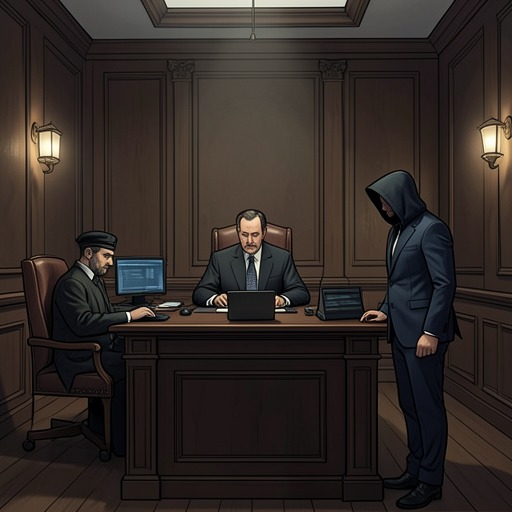
Jerry Vincent
The Brass VerdictJerry Vincent is a Los Angeles criminal-defense attorney whose professional legacy is defined by two linked reversals: Mickey Haller’s victory over him in the Barnett Woodson trial helped end Vincent’s career as a prosecutor, while Vincent’s murder transferred his practice and its unfinished secrets to Haller. Behind the successful lawyer’s public work lay an undisclosed jury-bribery arrangement in Walter Elliot’s case, and evidence that Vincent may have reconsidered his involvement before he was killed.
Identity and Career
Vincent and Haller first opposed one another in court when Vincent was a prosecutor and Haller worked for the public defender’s office. Their defining early encounter was the double-murder case against Barnett Woodson. Haller secured Woodson’s acquittal; afterward, Woodson left court and sarcastically apologized to the media for getting away with murder. The defeat damaged Vincent’s standing as a prosecutor and led him toward private practice. Haller later described the irony plainly: by ending Vincent’s prosecutorial career, he had helped start Vincent’s career as a defense attorney.
The two lawyers eventually left public service for private practice at around the same time, each operating a one-man shop. Their connection was professional rather than intimate. They sometimes worked cases together, including drug trials, and occasionally covered for one another. Vincent also referred cases to Haller when he did not want to take them. They might share a drink or attend a game at Dodger Stadium, but Haller knew little about Vincent’s private life and considered any claim of close friendship an exaggeration. Their familiarity rested on years of legal work, not personal confidences.
Vincent became a high-profile defense attorney whose reputation and prosecutorial experience attracted prominent clients. Walter Elliot, facing a double-murder case, was among them. Haller understood that Vincent’s practice drew clients able to pay well, clients who appeared demonstrably innocent, or clients whose public standing made their defense politically or socially legible. Vincent could take on a client forcefully when the case did not leave him feeling compromised. That professional image makes the later evidence of his participation in jury tampering a revealing contradiction, rather than a simple extension of his public reputation.
The Woodson Trial and Haller
The Woodson case remained an important point of reference between the lawyers. Years after Haller’s acquittal, Vincent appeared as prosecutor in the trial, calling Ronald Torrance to testify that Woodson had confessed to killing two young men. The prosecution presented Torrance as a credible witness, preparing him for court and eliciting his account of a conversation in jail. Vincent used long, tightly controlled questions designed to produce short answers and to establish that Torrance knew details supposedly known only to the killer.
Haller deliberately declined to interrupt, even when Judge Companioni signaled that he might object. He wanted the jury to observe the prosecution’s method before he began cross-examination. When Vincent finished his direct examination, Haller refused the judge’s offer of an early lunch and went to the lectern with a thick file and legal pad. The exchange shows their contrasting courtroom approaches: Vincent sought control through carefully structured questions, while Haller planned to give Torrance room to speak and expose the testimony through its own development.
The later relationship was marked by mutual professional utility but also by the unresolved weight of that earlier defeat. Vincent’s career as a defense lawyer was, in Haller’s account, partly an unintended consequence of Haller’s success. Yet Vincent went on to send him work, and after Vincent’s death Haller was the lawyer positioned to take over his clients’ cases. Their history therefore links rivalry, practical cooperation, and inheritance: the former opponent became the successor charged with making sense of Vincent’s unfinished work.
Elliot’s Case and the Hidden Bribery
Vincent’s representation of Walter Elliot concealed a plan to influence the jury. Elliot later told Haller that, about five months earlier, Vincent had reported being approached by someone offering to place a favorable juror on the panel. The proposed juror would hold out for acquittal and actively persuade other jurors during deliberations. The arrangement depended on the trial proceeding on schedule so that the planted juror would reach Elliot’s jury. Elliot said that he and Vincent accepted the offer. At the time, he believed the evidence against him was formidable, feared conviction despite his claimed innocence, and saw no effective defense.
Other evidence tied Vincent to the mechanics of the arrangement. Haller accused Judge Holder of controlling access to the jury pool, planting the sleeper juror, and receiving money from Vincent. Harry Bosch later explained that Bruce Carlin had approached Vincent on the judge’s behalf and had delivered the money. Bosch said Vincent had come to the Federal Bureau of Investigation’s attention as a possible participant in state-court corruption: investigators had heard rumors about what he claimed he could arrange and had invited him to cooperate. Vincent declined, and, according to Bosch, pressure on him was increasing when he was killed. Bosch also said that Vincent began to have doubts as the investigation drew closer. These accounts place Vincent inside the conspiracy while leaving open how far he had moved toward exposing it.
A personal financial transaction added to Haller’s questions without, on its own, resolving them. Vincent accumulated one hundred thousand dollars in a personal investment account and, a week later, instructed his broker to cash it out. The timing attracted attention as Haller examined Vincent’s private accounts alongside the records of his law practice. In Elliot’s case, Vincent had also prepared but not filed a motion for a continuance. Its coding indicated that he printed it on the Monday just hours before his death, suggesting that he may have wanted to delay the trial. Elliot disputed that interpretation, saying that Vincent had agreed with him to proceed on schedule. The unfiled motion thus became a concrete sign of uncertainty around Vincent’s late-stage intentions, not proof of what he planned to do.
Investigation and the Missing Work
Vincent’s case materials were both an inheritance and a set of gaps. In the Eli Wyms matter, the file Haller received from prosecutor Joanne Giorgetti contained copies of discovery materials, chiefly sheriff’s documents about the incident, arrest, and follow-up investigation. Vincent’s own notes, strategies, and defense papers had been in the original file, which was missing. The surviving documents therefore preserved the official account while withholding the lawyer’s working interpretation of it.
As Haller questioned people connected to the Wyms case, Angel Romero recalled that Vincent had said Wyms fired the magic bullet, though Romero had not understood the phrase at the time. Haller later compared the Wyms records with the Elliot investigation and recognized the importance of patrol-unit designations in both files. Studying the witness list and his Christmas-tree timeline, he concluded that he had found Vincent’s magic bullet: a clue embedded in the way the cases’ records intersected. Vincent’s legal work had connected investigations that initially appeared separate, and the missing defense file made Haller reconstruct that connection from the remaining paperwork.
The physical loss of Vincent’s materials affected the Elliot defense as well. Whoever killed him stole his briefcase, which contained his laptop and calendar. Haller’s team could rebuild the calendar, but the laptop had been the central store of case information and strategy, while the hard files left in the office were incomplete. Vincent had, however, backed up his computer to a digital flash drive attached to his key chain. Haller worked through the stored data and recovered pieces of Vincent’s strategy for Elliot’s trial. The backup did not restore everything, but it changed the inheritance from a near-total loss into a partial recovery.
Death and the Transfer of His Practice
Vincent was found in his car in the garage beside his office, in the 200 block of Broadway. He had been shot twice in the head. When news of his death first reached Haller, the crime scene was still being investigated and no arrests had been made. The killing immediately raised questions about the cases he had left behind, particularly Elliot’s high-profile defense.
Vincent had made legal arrangements allowing Haller to take over his practice if he died. Haller, returning to law after a year-long sabbatical, went from having no cases to inheriting thirty-one active clients. He had to inventory the practice, contact every client, and cooperate with investigators within the limits of attorney-client protections. One client had a sentencing hearing the day after Vincent’s death, requiring Haller to interrupt the work of organizing the files and appear in court. Each remaining client had to be told what had happened and given the choice of retaining a different lawyer or continuing with Haller.
Elliot’s case came with an additional condition: Elliot would keep Haller only if the trial was not delayed. That demand made Vincent’s unfiled continuance motion especially consequential. Haller had to prepare quickly without the complete original file, while Elliot insisted on proceeding. Vincent’s absence was therefore not merely a vacancy in the courtroom. It shaped the timetable, restricted Haller’s choices, and left him to rebuild a defense from incomplete documents and the surviving flash-drive backup.
Narrative Role
Vincent is present throughout the case as both a professional legacy and an unresolved absence. His controlled courtroom style, history with Haller, influential clientele, and apparent success establish a figure whose public competence does not disclose the risks he has taken in private. After his death, documents and testimony supply conflicting indications: he participated in the jury scheme, may have sought to delay the trial, and had drawn the Federal Bureau of Investigation’s attention, yet the evidence does not settle whether he intended to cooperate or what he would have revealed.
That uncertainty gives Vincent’s missing records a double force. The stolen laptop and briefcase remove information that could explain his choices, while the backup, financial records, unfiled motion, and cross-case clue allow Haller to recover fragments of his work. Vincent’s murder thus sets the plot in motion and makes his unfinished professional decisions part of the danger inherited by his successor. He is not simply the dead lawyer whose clients must be reassigned; he is the point where courtroom rivalry, a compromised defense, and the investigation of judicial corruption converge.