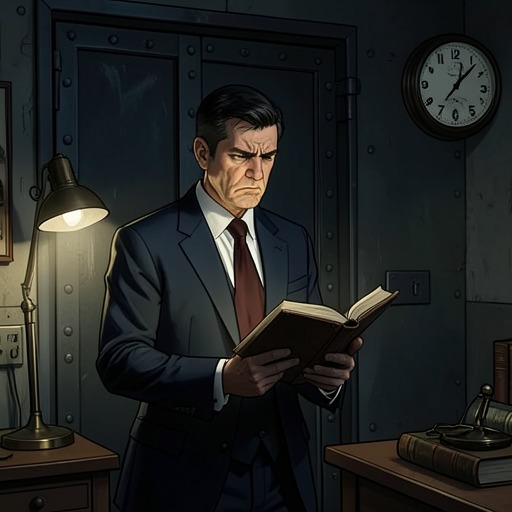
Mickey Haller
The Brass VerdictMickey Haller is a Los Angeles defense lawyer whose defining skill is building a case from what the prosecution can prove, rather than from what he believes about a client’s guilt. After a year away from practice, he returns to court and inherits Jerry Vincent’s cases, including the defense of Walter Elliot. The work restores his courtroom momentum, but Elliot’s eventual confession forces Haller to confront the distance between defending a client’s rights and living with what that defense may enable.
Identity and Return to Practice
Haller’s professional instincts are visible in his defense of Barnett Woodson, a case he handled through the Public Defender’s Office. During prosecutor Jerry Vincent’s direct examination of witness Ronald Torrance, Haller deliberately refrained from objecting to questions he considered leading. He wanted the jury to see how the prosecution was presenting its case before he began cross-examining Torrance. His approach was controlled rather than passive: he let the testimony develop, then prepared to use its weaknesses against the prosecution.
Haller understood the boundary between his belief and his duty. He believed Woodson had killed two young men, but he regarded his responsibility as testing the state’s case with the best of his ability. After the jury’s decision, Woodson wanted more from him, but Haller refused to encourage the hope that the verdict meant he could escape responsibility for the deaths. His defense had achieved its legal purpose; it had not changed Haller’s private assessment of his client.
A year after leaving the courtroom, Haller is summoned to the chambers of Judge Mary Townes Holder, chief judge of the Los Angeles County Superior Court. He arrives in a Corneliani suit he associated with verdict days, retrieved from a plastic bag in the back of his closet. The summons unsettles him because he wonders whether a complaint or courthouse inquiry has followed him from his former practice. Instead, Holder explains that Vincent’s professional arrangements and an earlier court motion make Haller the successor to Vincent’s cases, Walter Elliot’s among them. The clients remain free to choose another lawyer, but Haller has the first opportunity to represent them. The meeting converts his uncertain return into an immediate professional responsibility.
Inherited Cases and the Work of Defense
Haller’s first contact with Detective Harry Bosch begins with uncertainty: he is sure they have never met, although Bosch already knows who he is. Haller describes Vincent as a colleague and friend, while making clear that they were not especially close. He is willing to find a way for them to cooperate, but frames that cooperation around protecting people’s rights. His wary question about how Bosch’s information would help the detective shows that Haller regards investigation as a negotiation between legitimate interests, not as a free exchange of everything either man knows.
Once Haller takes on Elliot’s defense, he describes the prosecution’s case as resting on motive and opportunity. The state argues that Elliot had a financial motive connected to his wife’s affair and their prenuptial agreement, and that his car’s departure from Archway Pictures Studio left time for him to reach the Malibu house. Haller considers the evidence itself thin and circumstantial. His task, as he explains it to Elliot, is to make the jury distinguish a persuasive-looking theory from proof sufficient to convict.
His preparation makes the defense a deliberate act of construction. Alone in the office, Haller lays out fresh legal pads and sharpens four Black Warrior pencils. Vincent had divided the case into a large prosecution file and a thinner defense file; Haller knows that material placed in the defense file must be disclosed. Without Vincent’s laptop or the benefit of Vincent’s private knowledge, he reads the prosecution file page by page, studies crime-scene photographs with a magnifying glass, lists the people in the case, and draws a time-and-action chart. The procedure turns a stack of records into a trial narrative he can test and present. As the case begins to take shape in his mind, he stops thinking of it simply as Vincent’s inheritance and starts treating it as his own work.
Elliot’s Case and Haller’s Ethical Conflict
In court, Haller presents Elliot as composed and engaged, directing him to take notes rather than respond visibly to the prosecution. In his opening statement, he counters Jeffrey Golantz’s elaborate account by portraying the case as a maze of smoke and mirrors and promising that the evidence will not establish guilt beyond a reasonable doubt. This is not merely a denial of the prosecution’s story; it is an effort to give jurors a simpler competing account in which the apparent connections do not amount to proof.
The defense’s technical argument concerns gunshot residue found on Elliot. Dr. Shamiram Arslanian explains that Elliot’s hands, arms, and clothing came into contact with residue in the back of a four-alpha patrol car. The account then develops into a compound-transfer explanation: residue moved from the car to Elliot’s hands and arms, and from there onto the front of his jacket during ordinary movement. Haller’s examination guides the jury through the distinction between the initial contact and the later transfer, offering an alternative explanation for evidence that might otherwise appear incriminating.
Elliot privately tells Haller that Vincent had said he possessed a decisive defense point and planned to proceed without the sleeper juror arranged through a jury-fixing scheme. Elliot believes Vincent was killed because he changed course. The disclosure places Haller in a professional dilemma: Elliot’s admissions are protected by the attorney-client relationship, but the planned jury tampering has not yet occurred. Haller considers whether his duty to report the impending crime can be avoided by stopping it from happening. His reasoning does not erase the conflict; it makes clear that he is searching for a lawful way to prevent corruption without simply betraying a client’s confidence.
Confession, Consequences, and Character
After Haller’s courtroom presentation, Elliot celebrates what he sees as a successful attack on the prosecution and the sheriffs. In private, however, he reveals that he had been performing for Haller, supplying the degree of apparent guilt he thought would restore his lawyer’s determination. Haller recognizes that Elliot did murder his wife and her lover. When asked about the gun, Elliot says he bought a .44 at a flea market in the 1970s and kept it at the beach house. The confession overturns the defense relationship: Haller’s client is not merely a difficult man whose case is weak, but a killer who has manipulated his attorney’s belief and professional commitment.
That discovery bruises Haller less because guilty clients are unfamiliar to him than because he realizes how effectively Elliot used him. He also feels responsible for the damage the defense may inflict on Johan Rilz’s family. Rilz’s father and brothers had chosen to return home rather than remain to watch the case proceed, and Haller cannot separate his work from the cost of subjecting them to the American justice system. Although he is prepared for the next day of trial and believes he can still present the French police captain’s testimony, his confidence in his professional role has been shaken.
Haller’s concern for others is not confined to clients or courtroom duties. Under a revised custody arrangement, he sees Hayley Haller on Wednesday nights and every other weekend, a reduction from the shared custody he once had with his former wife, Maggie McPherson. He recognizes that he lost that arrangement, along with a second chance with Maggie. He also tells Cisco Wojciechowski that Lorna Taylor is among the most important people in his life and warns him that he will respond if Cisco hurts her. The protectiveness is blunt, but it reveals the personal loyalties that exist beside Haller’s calculated professional restraint.
When Detective Bosch intervenes during a confrontation with David McSweeney, Haller learns that Bosch has just saved his life. Later, Haller tells Judge Holder that he will resign from the remaining Vincent cases. The available account does not present the resignation as a simple rejection of legal work; it follows a case in which inheritance, client loyalty, judicial corruption, and concealed murder have become inseparable. Haller’s arc turns on that pressure: the lawyer can defend a person without endorsing him, but he cannot always prevent the work from exacting a moral price.