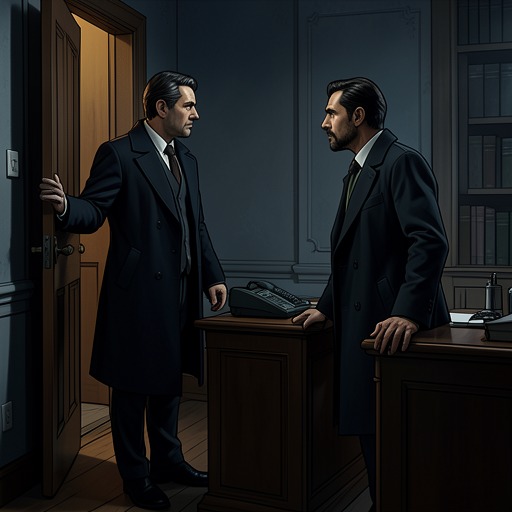
Mickey Haller and Harry Bosch
The Brass VerdictMickey Haller and Harry Bosch develop an investigative partnership out of a struggle over evidence rather than an easy agreement between colleagues. As Haller takes responsibility for Jerry Vincent’s legal practice, Bosch seeks information that may explain Vincent’s killing; Haller, bound to protect his clients and their files, resists giving the detective unrestricted access. Their relationship proceeds through confrontation, negotiated cooperation, and persistent mutual questioning, with neither man treating the other’s account as sufficient on its own.
A partnership formed under pressure
The relationship begins in the wake of Jerry Vincent’s death, when Bosch is already examining material in Vincent’s office. Haller finds the detective and another man reading from a stack of files on the table. Bosch identifies himself as a member of the Los Angeles Police Department, while Haller asserts that the files belong to him and orders the men to put them down. The first encounter establishes the central conflict: Bosch approaches the office as part of a murder investigation, whereas Haller sees the files as connected to his clients and his professional responsibilities.
The exchange is not simply a contest over possession. Bosch regards the office as part of the crime scene and tells Haller that he must leave; Haller counters that the crime scene is in the garage and that the court order does not permit police to extend it to the office and its files. He insists that he will remain to look after his clients. Bosch does not read the order or vacate the premises, and warns that if he leaves he will shut the office down and seal it. The clash gives their later cooperation a defined boundary: investigating Vincent’s death cannot, in Haller’s view, erase the rights attached to the legal files.
From confrontation to a negotiated channel
Haller does not reject cooperation outright. He proposes first to understand the situation and then arrange a discussion, seeking a way for them to work together without trampling on anyone’s rights. When he reads the name on the detective’s card, he recognizes that Bosch had known who he was before they met, though Haller himself is sure they had never previously been introduced. Haller describes Vincent as a colleague and a friend, while qualifying that they had not been especially close. Bosch’s brief response leaves the practical question unresolved: what, precisely, can that personal connection provide to the investigation?
The pair later meet at Parker Center. Haller walks there from their telephone exchange and finds Bosch beside the fountain memorializing officers killed in the line of duty. Bosch has white earbud wires running from his ears to his jacket pocket; he removes the earbuds when Haller approaches. The setting and small exchange about Bosch shutting out the world do not dissolve the tension, but the meeting shifts their dispute into a more deliberate negotiation. Haller reports that he has met with Judge Holder in chambers and worked out a plan to give Bosch what he needs from the files without turning the files themselves over to him. The compromise recognizes both sides’ stakes: Bosch can pursue information, while Haller can maintain control of protected client material.
Mutual suspicion and the limits of disclosure
The arrangement does not settle what Bosch is actually seeking. Haller distinguishes between sharing threat information from closed cases and disclosing information about active cases, which he is less willing to do. He also tells Bosch that he understands the detective to be asking for more than information about threats. Haller suspects Bosch believes Vincent discovered something, or knew something, that led to his death. Bosch slowly nods, confirming the suspicion without supplying the missing details.
Haller then turns the demand for transparency back on the detective. He asks what Bosch knows that he has not disclosed, and specifically presses him about the contents of Vincent’s missing laptop and portfolio. The questions make their partnership reciprocal in principle but unequal in information: each man needs something the other controls, and each suspects that important facts are being withheld. Bosch’s earlier refusal to accept Haller’s boundaries and Haller’s later insistence on answers show that cooperation does not mean trust. It is a working arrangement maintained by negotiation and the recognition that the other man may hold a necessary piece of the investigation.
The shape of their investigative alliance
Their relationship is therefore defined less by personal ease than by competing duties and a shared need to understand Vincent’s death. Bosch brings the authority and investigative purpose of a police detective; Haller brings access to the legal practice and a duty to protect the clients whose files are at issue. The office confrontation makes those roles collide, while the plan developed with Judge Holder supplies a limited means of working across the divide.
The exchange over the laptop and portfolio keeps the alliance open-ended. Haller is willing to help Bosch obtain information, but not to surrender the underlying files or accept a one-way flow of disclosure. Bosch, for his part, signals that the investigation reaches beyond the narrow question of threats. Their partnership takes shape in this tension: cooperation is possible, but only so long as each continues to test what the other knows and what the law permits him to share.