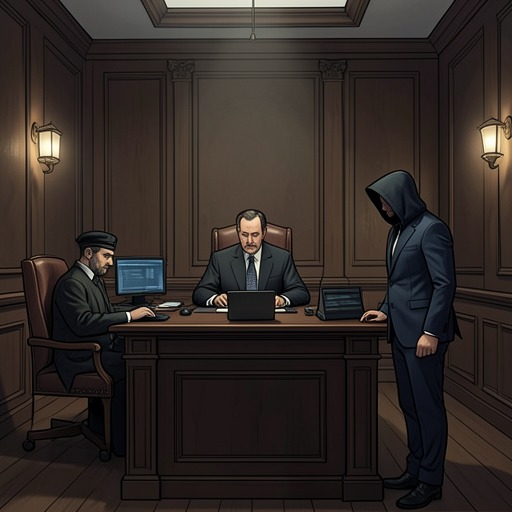
Mitch Lester
The Brass VerdictMitch Lester is a lawyer and the husband of Judge Holder whose connection to David McSweeney helps expose the network behind the jury-tampering scheme in Walter Elliot’s trial. His importance lies less in any courtroom appearance than in the link between his past legal work and the conspiracy’s eventual exposure: he is implicated as part of the group indicted, though the account does not establish a conviction or specify every act attributed to him.
Identity and Background
Lester is identified as Judge Holder’s husband. The evidence of his professional background comes through his prior representation of McSweeney, a connection Haller traces while confronting Judge Holder about the scheme. Nine years before the confrontation, McSweeney was arrested for an ADW, and Lester represented him. The following year, McSweeney was arrested again, this time for fraud, and Lester was again his attorney.
Those two cases make Lester more than a name attached to Judge Holder. They establish a prior relationship with the man later identified as the scheme’s operative against Jerry Vincent and others. The available account does not describe Lester’s legal career beyond these representations, or show him participating directly in the Elliot trial.
Connection to the Jury-Tampering Scheme
Haller assembles the relationship as a triangle: Judge Holder had access to and control over the jury pool and selection process; McSweeney had been represented by Lester; and Lester was Judge Holder’s husband. Haller uses the two earlier cases to support his conclusion that McSweeney’s connection to the judge ran through Lester. He then accuses Judge Holder of arranging the placement of a sleeper juror and of sending McSweeney after Jerry Vincent when Vincent changed course.
The account distinguishes the evidence against Lester from the accusation against Judge Holder. Haller’s confrontation presents Lester’s earlier representation of McSweeney as the link that helps him reconstruct the conspiracy, but it does not detail a specific jury-system operation personally performed by Lester. Bosch later says that Judge Holder and her husband sent McSweeney to deal with Vincent, placing Lester within the alleged response to Vincent’s withdrawal from the bribery plan.
Indictment and Outcome
The conspiracy’s exposure culminates in federal indictments. Bosch tells Haller that the grand jury indicted Judge Holder, Lester, Bruce Carlin, McSweeney, and a supervisor in the jury office who had given them access to the computers. The arrests are to be carried out simultaneously, underscoring the breadth of the operation and the need to prevent its targets from being warned.
Bosch’s account also clarifies the roles surrounding Vincent: Carlin had helped approach Vincent and deliver money, while Judge Holder and her husband sent McSweeney after Vincent began to have doubts. Lester is therefore named among the indicted conspirators and tied to the scheme through both his relationship to Judge Holder and his past representation of McSweeney. The account ends with the indictments and planned arrests; it does not provide Lester’s later legal outcome.
Narrative Role
Lester functions as a connecting figure in the discovery of institutional corruption. His earlier attorney-client relationship with McSweeney gives Haller a concrete lead from which to link the judge’s household to the person used in the conspiracy’s violence. The connection also reveals how the scheme reaches beyond the courtroom: control of jury selection, legal relationships, and the use of an intermediary are presented as parts of one coordinated system.
His limited direct presence sharpens that function. Lester becomes legible through the chain of relationships and the indictments rather than through an extended personal account, leaving the evidence to define his significance while preserving the distinction between being implicated and being shown to have been convicted.