Surveillance photo
The Brass VerdictThe Surveillance photo begins as an uncertain image offered in an investigation and becomes a test of how readily an image can command belief. Shown by Harry Bosch to Mickey Haller as a possible likeness of Jerry Vincent’s killer, it seems to place an armed man outside the Legal Center. Haller later reads it differently: in his account, the image was staged to identify an information leak and to make him reveal what he knew. Its importance lies in that reversal, from apparent evidence to a suspected instrument of deception.
Appearance and Provenance
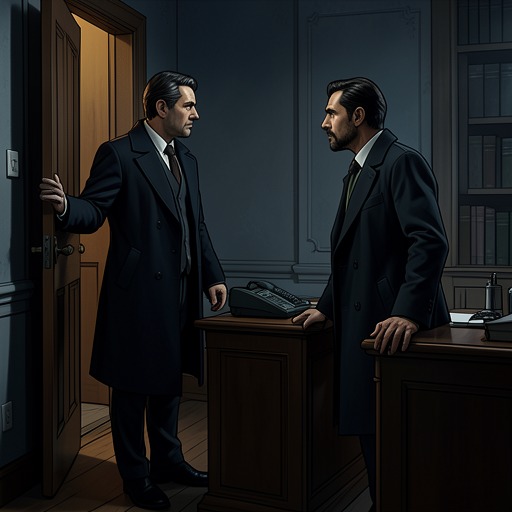
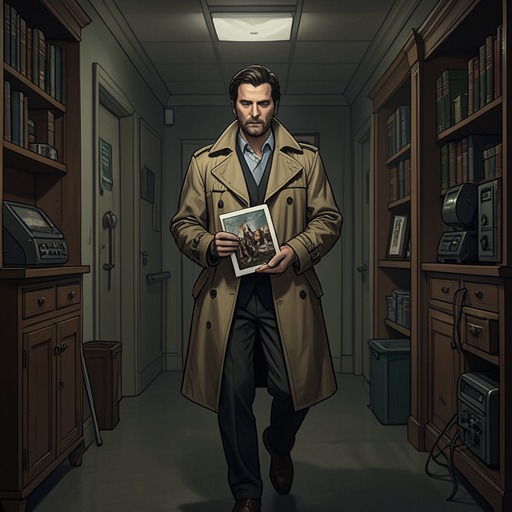
Harry Bosch produces the photograph at Mickey Haller’s desk after beginning to leave, then asks whether Haller recognizes the man. It is a grainy still taken from video, showing someone pushing through the Legal Center’s front door. The camera was a street camera at Broadway and Second, which had captured the man for only a few seconds; Bosch presents the still as the best image available.
The enlargement makes the picture less, not more, conclusive. Its pixels are spread, and the man’s features remain unclear. Haller describes him as appearing to be of Latin origin, with dark skin and hair, a mustache, a Panama hat, an open-collared shirt, and what looks like a leather sport coat. The detail that gives the image its apparent evidentiary force is also the detail that raises the stakes: as the jacket opens, Haller thinks he can see the top of a pistol tucked into the man’s waistband. Yet Haller does not claim certain recognition; he says he is not a hundred percent sure and questions whether the hair and mustache might be a disguise.
The camera’s location gives the image a plausible but limited reach. Haller knows that street cameras had been installed on major routes and regards Broadway as a likely site: the street is busy with pedestrians and traffic and is also used for protest marches. This context explains why the camera might have recorded a passerby, but it does not establish who the man is or what he has done. The still offers a brief view, not a settled identification.
From Image to Apparent Threat
The photograph acquires a more immediate meaning when Haller sees a man walking up the ramp of the parking garage. The man is about fifty yards away, and Haller recognizes him as the figure in Bosch’s image. He concludes that the approaching man is the killer and has a gun, then turns and runs. In that moment, the indistinct still has become a template through which Haller reads a live encounter; the resemblance changes his understanding of the danger before he can verify the man’s identity.
This recognition makes the photograph more than an investigative lead. Whether or not Haller’s identification is correct, the image has already shaped his response to a person who appears in the same clothing and setting of threat it seemed to depict. Later, Haller tells Bosch that he believes the photograph was phony, choreographed to draw out a leak and then used to see whether Haller was concealing information. The shift is significant: the image that seemed to expose a suspect may instead have helped create the conditions for a confrontation.
Haller’s Reassessment
At Dan Tana’s, Haller sets out why he thinks Bosch’s presentation was a setup. One reason is that Bosch did not return, as Haller expected, to show the photograph to Vincent’s secretary, who would have been more familiar with the firm’s clients. Haller treats that omission as inconsistent with a genuine identification effort. He argues that if the person in the still were a legitimate investigative lead, the secretary’s recognition might matter more than his own uncertain response.
His second objection concerns the apparent weapon. Haller recalls that Vincent was shot with a .25-caliber gun and argues that this weapon was too small to fit the profile of the gun supposedly visible in the man’s waistband. He admits that he missed the discrepancy when he first saw the photograph. On reconsideration, that detail undermines the picture’s apparent coherence: what initially looked like corroboration of an armed suspect becomes, for Haller, evidence that the scene may have been constructed.
Haller also interprets the photograph as a leak-detection device. He believes it was shown to him because information passed through his investigator could return to Bosch and identify whoever was feeding information out. He accuses Bosch of using the image both to test him and to frighten him into disclosing what he knew. These are Haller’s conclusions in the confrontation, not independently established facts in the scene; the account records his reasoning and accusation rather than a direct confirmation of the staging.
Evidentiary and Narrative Significance
The photograph’s force comes from a tension between its apparent specificity and its actual ambiguity. It contains recognizable details—a doorway, distinctive clothing, and the suspected outline of a weapon—but its poor quality prevents confident identification. The camera’s brief view and the enlarged, pixelated still leave room for competing readings. Haller’s encounter with the man seems to confirm the image at first, while his later attention to the absent follow-up and the mismatch in weapon size reverses that impression.
As an object in the investigation, the still therefore carries two competing functions: it can be treated as a clue to Vincent’s killer, or as a deliberately misleading picture used to trace a leak and unsettle Haller. Its status depends not only on what it depicts but on who selected it, who saw it, and what happened after it was shown. The narrative does not resolve the image into an independently verified identification in these scenes. Instead, the Surveillance photo marks a point at which seeing, recognizing, and trusting evidence come apart.