Termination of the Elliot trial
The Brass VerdictThe termination of the Elliot trial came not through a verdict but through the murder of the defendant. When the court reconvened on Tuesday morning, Walter Elliot’s empty seat marked the abrupt end of a two-week proceeding; Judge Stanton told the jury that Elliot had been killed the previous night and discharged them from service. The case against Elliot was left undecided, while the courtroom became the place where his death was first formally announced to the jurors.
The case left unresolved
Before the trial was cut short, Mickey Haller had framed the prosecution’s account as a persuasive story built from motive and opportunity rather than strong direct evidence. The state pointed to Elliot’s wife’s affair, a prenuptial agreement that had vested twelve years earlier, and the timing of his car’s departure from Archway. Repeated drive-time tests, prosecutors argued, showed that he could have reached the Malibu house when the killings took place. Haller’s counterargument was that these circumstances created plenty of suspicion but did not prove guilt beyond a reasonable doubt.
In his opening statement, Haller described the prosecution’s case as a labyrinth of smoke and mirrors and promised the jurors that they would find no fire behind it. The staging reinforced the argument: Elliot sat alone at the defense table, nodded solemnly when Haller introduced him, and wrote on a pad while Haller spoke. The defense was presenting not only an alternative interpretation of the evidence but an image of a defendant engaged in his own defense. The trial’s sudden end prevented that argument from reaching a jury decision.
The disputed evidence and the hidden plan
The defense’s effort to challenge the physical evidence included testimony from Shamiram Arslanian about gunshot residue. She explained that when Elliot was handcuffed and placed in the 4-alpha patrol car, his hands, arms, and clothing came into direct contact with residue from another case. In her account, the initial transfer occurred in the car; ordinary movement then carried residue from his hands and arms onto the front of his jacket. The proposed sequence offered an explanation for the residue without establishing that Elliot had fired the weapon.
The trial also sat within a concealed dispute over jury tampering. Elliot told Haller that Jerry Vincent had said he possessed a magic bullet and intended to delay the trial, proceeding without the sleeper juror. Haller connected Vincent’s decision to withdraw from the scheme with his killing; Elliot agreed that Vincent had been killed because he changed course. That account formed part of the private understanding surrounding the case, not the public announcement that ended the proceedings.
The announcement in court
Photographers had access to the courtroom and repeatedly photographed Elliot’s vacant chair. Across the aisle, Jeffrey Golantz waited alongside Haller. The gallery was already buzzing about the murders of Elliot and Nina Albrecht, but the attempted killing of Haller at the Fryman Canyon overlook remained secret. Investigators were proceeding cautiously after David McSweeney said he wanted to cooperate, and Haller had agreed to keep quiet for the time being.
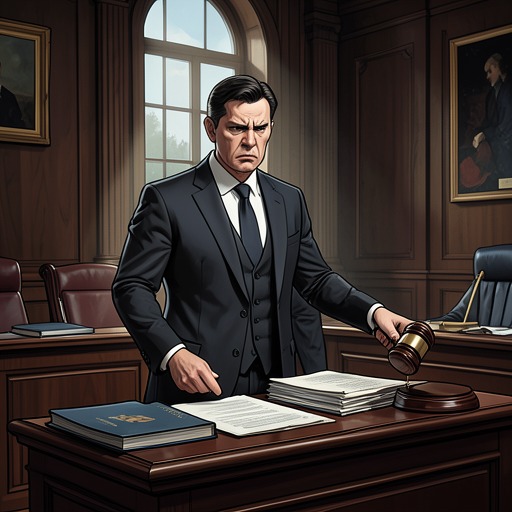
Judge Stanton called the jury in and explained that Elliot was absent because he had been the victim of a homicide the night before. The news produced a visible shock: some jurors’ mouths fell open, while others registered surprise in their eyes. A low murmur spread through the courtroom. Then Mitzi Elliot’s mother began clapping from behind the prosecution table. Golantz hurried over and gently stopped her, while tears continued to run down her face. Stanton struck his gavel and warned that no one in the gallery would be allowed to demonstrate.
Discharge and aftermath
Stanton told the jurors that authorities were investigating and thanked them for their service. He directed them to collect their belongings from the deliberation room before going home. The jury filed out without deliberating, leaving the murder charge against Elliot without a verdict. Stanton then thanked Golantz and Haller for their professional conduct, thanked his staff, and adjourned court.
Haller had not unpacked his files. He remained still after the judge left, until Golantz approached with his hand extended. Haller shook it, and Golantz praised him as a good lawyer. Haller’s silent correction placed that praise in the past tense, giving their courteous exchange a note of finality. The proceedings had ended, but neither the unresolved case nor the investigation into the killings had reached its conclusion.