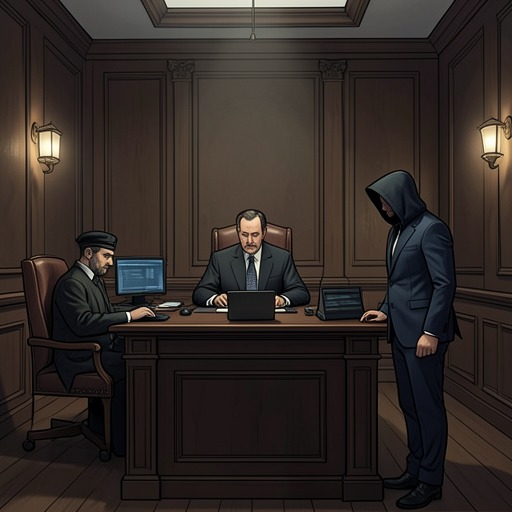
Walter Elliot and Jerry Vincent's jury-bribery scheme
The Brass VerdictWalter Elliot and Jerry Vincent's jury-bribery scheme was an effort to purchase a favorable presence inside Elliot’s murder-trial jury. Vincent, Elliot’s defense attorney, arranged the proposed placement of a concealed pro-defense juror; Elliot agreed to finance it. The plan depended on keeping the trial on schedule and on manipulating the selection process without making the planted juror appear suspicious. When Vincent later said he had a new defense and no longer needed the arrangement, the scheme became a possible explanation for the events surrounding his death—and a serious ethical problem for his successor, Michael Haller.
Origins and Financial Trail
About five months before the trial, an unidentified person approached Vincent with an offer to place a sleeper on Elliot’s jury. Vincent described the proposal to Elliot as a way to secure a juror who would hold out for acquittal and influence the other jurors during deliberations. The proposed recruit was not simply to vote for the defense: he was to act as a practiced persuader working from within the jury room. A strict condition was that the trial remain on its existing schedule, because the planted person could not be moved to a new trial date.
Elliot and Vincent accepted. Elliot later told Haller that he had been frightened and believed he might be convicted despite maintaining that he had not killed his wife. He said they had no magic bullet at that point and that the odds appeared stacked against him. His account frames the bribe as a response to perceived weakness in the defense, not as a last-minute reaction to a particular piece of trial evidence.
The payment structure gave the arrangement a measurable price. Elliot said he paid $100,000 up front, routed through Vincent’s fees: Vincent inflated the fee, received the money from Elliot, and then paid for the juror. Elliot said a further $100,000 was promised for a hung jury and $250,000 for an acquittal. He also reported that Vincent had said the people behind the offer had fixed juries before. These were Elliot’s disclosures to his lawyer; the account establishes the terms he described, not the identity of the person who made the approach or the full extent of that person’s network.
The firm’s records gave Haller an independent reason to examine the money. When he took stock of Vincent’s practice, the accounts showed $38,000 in the operating account and $129,000 in the trust account. Vincent had recently deposited a $100,000 check from Elliot, leaving an unusually large balance in the client trust account. Haller also knew from Vincent’s private financial records that Vincent had accumulated $100,000 in a personal investment account five months earlier and instructed his broker to cash it out a week later. The financial trail raised questions, but Haller’s later confrontation with Elliot was what brought the alleged purpose of the payment into the open.
How the Arrangement Was Supposed to Work
The scheme required access to several stages of jury selection: the summons process, the drawing of the trial venire, and the selection of the first twelve people seated in the jury box. The planted juror would have to reach the box and remain there. The defense would avoid removing him with a peremptory challenge, while his apparent alignment with the prosecution was meant to keep the prosecution from challenging him. Maintaining the trial date was therefore not a minor scheduling preference but a condition on which the placement depended.
That design made the conspiracy more than a private bargain between a lawyer and a client. As Haller later reasoned, the unidentified party would need access to the random processes that brought potential jurors to the courthouse and selected the trial jury. The plan’s effectiveness rested on the gap between how those procedures appeared and how they could allegedly be manipulated. Elliot and Vincent could purchase an outcome without openly selecting a juror themselves, while the person arranging access could remain concealed from them.
The Reversal and Vincent’s Death
Elliot told Haller that, on the Monday when Vincent was expected to seek a delay, Vincent instead said they no longer needed the sleeper. Vincent claimed to have found the magic bullet and believed he could win without the planted juror. The change directly contradicted the scheme’s no-delay condition: Vincent had first accepted a plan that required the trial to stay on schedule, then appeared ready to alter the schedule and abandon the paid arrangement.
Haller asked whether the bribe explained Vincent’s death. Elliot initially described the death as the result of converging events, then acknowledged that Haller might have found the reason. After recounting Vincent’s decision to withdraw, Elliot said he believed the people behind the arrangement would not let someone simply change his mind and pull out. His account connects the attempted withdrawal to a possible motive for Vincent’s killing, but it remains Elliot’s interpretation rather than proof, in these disclosures, of who killed Vincent or why.
Haller’s Ethical Position and Wider Exposure
The revelations came while Haller represented Elliot and were made within the attorney-client relationship. Haller understood that Elliot’s past admissions were confidential, but distinguished the already completed bribery payment from the jury tampering that was still to occur during deliberations. He believed the planned tampering triggered a duty to report it, while also recognizing an alternative: if he could stop the future crime, he would not have to report it. His predicament arose because the same information that could expose a criminal scheme was protected by his professional obligations to the client who had confessed to participating in it.
The disclosed plan also became part of a broader exposure of corruption in the jury system. A later grand jury returned indictments against Judge Holder, Lester, Carlin, McSweeney, and a supervisor in the jury office who had provided access to its computers. Those indictments indicate that investigators identified a wider network and a means of reaching jury-selection data; they do not, by themselves, establish the final outcome of each prosecution. The relationship between Elliot and Vincent thus extends beyond a corrupt defense arrangement: their agreement links private legal representation, concealed payments, jury-system access, and the danger created when one participant tries to withdraw.