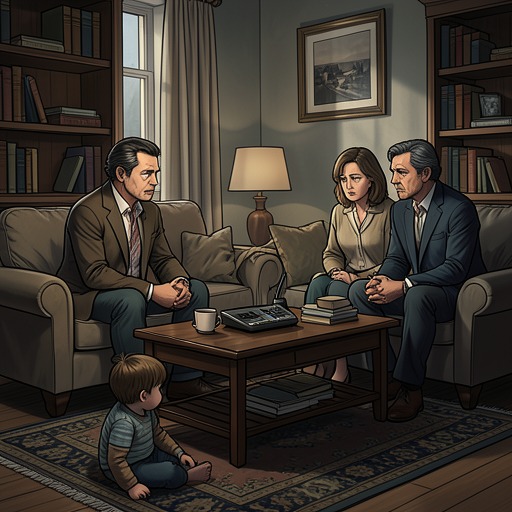
Walter Elliot and Mitzi Elliot's marriage strained by divorce and murder allegations
The Brass VerdictWalter Elliot and Mitzi Elliot's marriage strained by divorce and murder allegations stands at the center of the case against Walter and of the account he eventually gives his lawyer. Prosecutors frame the marriage’s breakdown as a motive for murder: Mitzi was leaving, she had an affair with Johan Rilz, and divorce threatened Walter’s wealth and control of Archway Studios. Walter’s later explanation is different and more complicated. He says he still loved Mitzi, went to Malibu to try to stop her departure, and found her and Rilz already dead. The marriage thus becomes both the prosecution’s proposed explanation for the killings and the setting for Walter’s claim that a larger organization intervened in its collapse.
Marriage, separation, and the financial stakes
The surviving account gives little ordinary history of the marriage; its decisive personal and legal change comes after its twelfth anniversary. On the following morning, according to Walter, Mitzi told him she was leaving and intended to divorce him. The timing mattered because their prenuptial agreement had vested. Mickey Haller understood that this would entitle Mitzi to half of Walter’s holdings in Archway Studios. The separation was therefore not simply a private rupture: it had a stated financial consequence on a scale that could shape both the marriage’s ending and the criminal case built around it.
Prosecutors made that consequence part of their motive theory. Haller summarized their position as alleging that Mitzi’s affair angered Walter and that the vested agreement meant divorce would cost him more than one hundred million dollars, potentially weakening his control of the studio. The state also relied on the opportunity it believed Walter had to travel from Archway Studios to the Malibu house at the time of the killings. In this account, the marriage is translated into a prosecution narrative of infidelity, financial loss, and access. Haller, while acknowledging the force of motive and opportunity as allegations, regarded the evidence against Walter as circumstantial and planned to challenge how jurors interpreted it.
The competing accounts of the killings
Publicly, Walter denied killing Mitzi and mourned her. At a court hearing, he said that he had loved his wife, would miss her, and wanted the trial to begin so that he could establish his innocence. His denial did not resolve the prosecution’s account: investigators said the couple had been found together at the Malibu home and alleged that Walter killed Mitzi and Rilz in a fit of rage. They also cited forensic testing indicating that Walter had recently fired a weapon and said that his statements during and after the initial investigation were inconsistent. The murder weapon had not been found.
One inconsistency concerned what Walter had seen at the house. He told investigators that after entering, he went directly upstairs to the bedroom, found the bodies, and called for help. Yet he also explained that Mitzi had parked outside so Rilz could use the garage’s single available space, where Rilz had hidden his Porsche. To the investigator, that explanation suggested Walter had looked into the garage, contrary to his account of having been only in the bedroom. This detail mattered because it gave the prosecution a basis to argue that Walter had concealed what he knew about Rilz’s presence. It also left the marriage’s private circumstances entangled with the question of what Walter had known before the deaths.
Walter’s later account of the marriage
In a later conversation with Haller, Walter described Mitzi’s decision to leave as the moment that brought him to the Malibu house. He said he had tried to change her mind, but she would not listen; she was in love with Rilz and believed he could protect her. Walter then told Haller that the organization had Mitzi killed. This account assigns responsibility for the killings not to Walter but to the organization whose investments, Haller understood, lay behind Walter’s apparent holdings in Archway Studios. The divorce settlement threatened money that Walter did not truly control as an individual.
Walter described his own reason for going to Malibu in emotional rather than strategic terms. He said that he still loved Mitzi in some way and wanted to fight for her, perhaps to stop the separation, save the situation, and win her back. He said he had no plan; he simply did not want the divorce to happen. By the time he arrived, he said, both Mitzi and Rilz were dead. His account does not erase the evidence that had made investigators suspicious, nor does it independently settle every question about what happened at the house. It does, however, distinguish his stated motive for going there from the prosecution’s theory that he went there to kill them.
The marriage as evidence and conflict
The relationship reaches the reader through incompatible forms of testimony. In court and in public, Walter presents himself as a husband grieving his wife and an innocent defendant. The prosecution treats the marriage as a chain of material incentives: an affair, an impending divorce, a newly effective agreement, and the threatened loss of wealth and influence. Walter’s private account retains the emotional bond while adding a coercive financial structure around it: he says he wanted Mitzi back, but that the organization would not allow its investment to leave through the divorce settlement.
That conflict also makes Mitzi’s decision central while leaving much of her perspective unrecorded in the available account. Her intention to divorce Walter, her relationship with Rilz, and her belief that Rilz could protect her are conveyed through Walter or through the prosecution’s description of events, rather than through an extended account from Mitzi herself. Consequently, the marriage is never only a background fact. It is the contested explanation for Walter’s alleged motive, the reason he gives for going to Malibu, and the personal relationship caught inside the larger financial and criminal interests surrounding Archway Studios.