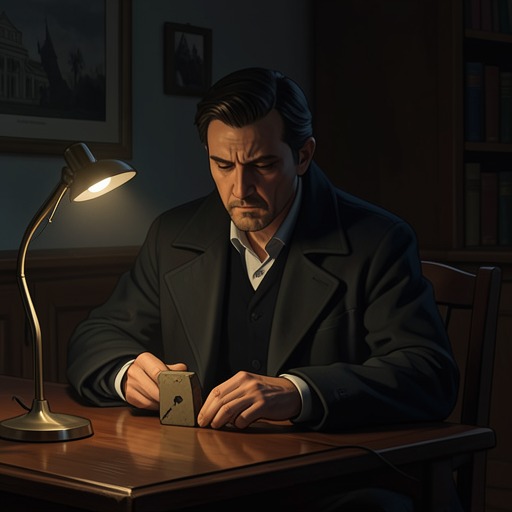
Walter Elliot confesses to Mickey Haller
The Brass VerdictWalter Elliot confesses to Mickey Haller that he murdered Mitzi Elliot and Johan Rilz, transforming Haller’s understanding of his client from a man whose innocence had fueled the defense into a killer who had deliberately used that belief. The confession also reveals that Elliot’s apparent trust in Haller was partly a calculated performance: he wanted the lawyer to believe he had not committed the murders so that Haller would fight with renewed force. Yet Elliot denies killing Jerry Vincent, leaving that separate crime unresolved within the conversation.
The confession and its purpose
Elliot explains that from the beginning he wanted Haller to believe he was innocent of the central crime. In his account, this was not simply an effort to secure a defense; it was a way to ensure that Haller would bring his full determination to the case. He had recognized that the lawyer needed something to believe in and had fashioned a partial version of guilt that would restore Haller’s fighting spirit without revealing the truth of the murders. The confession therefore exposes two kinds of deception at once: Elliot had concealed his own culpability, and he had shaped Haller’s belief as a means of making the defense more forceful.
Haller’s response marks the reversal. He recognizes Elliot’s explanation as a performance and understands that his client had killed his wife, Mitzi Elliot, and her lover, Johan Rilz. Elliot does not present himself as overwhelmed by remorse. Haller contrasts his coldness with the visible distress he has encountered in other clients who confessed to crimes. The difference matters to the scene: the admission brings no display of grief that might soften or complicate the account. Instead, Elliot’s pride in having made Haller more relentless remains part of what Haller must confront.
The account of the killings
In recounting what happened at the beach house, Elliot says he went there intending to confront Mitzi about the person she was seeing. He says he then discovered that the man was Rilz, whom Mitzi had presented in their shared social life as someone other than her lover. Elliot describes feeling anger and humiliation at what he understood as their deception and ridicule. He then says he took the .44 Magnum from a cabinet, put on rubber gloves kept beneath the sink, and went upstairs to confront the two of them. His account places the weapon and the gloves within the house, while identifying his discovery of Rilz’s relationship with Mitzi as the immediate cause he gives for his anger.
Elliot says he had not gone to the house alone. According to his account, another person took the gun, the gloves, and the clothes he had first worn, then left by walking along the beach, returning to the Pacific Coast Highway, and taking a cab. Elliot says that he washed and changed before calling 911. When Haller asks who helped him, Elliot refuses to say. Haller does not accept the refusal as proof that he lacks a theory; he silently recalls that Nina Albrecht had been able to unlock the deck door easily, a detail that had already suggested to him that she knew the bedroom and its access intimately. The scene supports Haller’s suspicion, but Elliot does not confirm the helper’s identity.
The gun and the forensic reversal
Elliot says he had bought the .44 Magnum at a flea market in the 1970s and kept it at the beach house for protection. He also says he had not anticipated that gunshot residue would transfer to him. When investigators proposed testing, he believed he would test clean and that the absence of a gun and residue would end the case. His confidence rested on a mistaken assumption: the transfer evidence had created a danger he had not expected, even though he had arranged for the weapon and other items to be removed.
This admission reframes the forensic issue from Elliot’s perspective. He had believed the missing gun and his expectation of a clean test would keep the case from reaching him, but residue transfer threatened to connect him to the murders. He credits Haller’s lawyering for helping him through that close call. The remark also sharpens the scene’s moral contradiction: Elliot acknowledges that his lawyer’s work protected him from the consequences of evidence while disclosing that he was guilty of the killings Haller had been trying to defend against.
What remains undisclosed
Haller asks directly whether Elliot killed Jerry Vincent. Elliot looks him in the eye and shakes his head. He denies that killing, then characterizes Vincent’s death as a fortunate break because it led to Haller becoming his lawyer. The answer does not resolve who killed Vincent; it establishes only Elliot’s denial and his view of the resulting change in counsel. Set beside the detailed account of the beach-house murders, the denial draws a clear boundary around what Elliot chooses to confess and what he refuses to claim.
The conversation ends not with a formal interruption of the trial but with its immediate resumption. A deputy signals Haller that the break is over and the judge is ready to return to the courtroom. Haller asks the deputy to wait, knowing the judge will not take the bench until the lawyers are in place. The confession thus remains an intimate exchange inside an ongoing public proceeding: Haller has learned the truth about his client, but the trial is about to continue. That contrast gives the disclosure its decisive force. The defense lawyer must return to court carrying knowledge that overturns the premise on which he had pursued the case, while the identity of Elliot’s accomplice and the truth about Vincent’s murder remain unanswered.