Crimson Leather Book
The CEO’s Baby Girl: A Workplace Reverse Harem Romance (Age-Gap Billionaire Obsessions)The Crimson Leather Book is a ritual object in the Vale Library and the material focus of Ariella Monroe’s initiation into Dominic Vale’s magical world. Its decisive power lies in turning a personal act of writing into an occult act of recognition: when Ariella signs its blank page, the library accepts her, and her relationship with Dominic becomes more than a private encounter. The book therefore joins identity, place, devotion, and magic in a single physical object.
Appearance and Setting
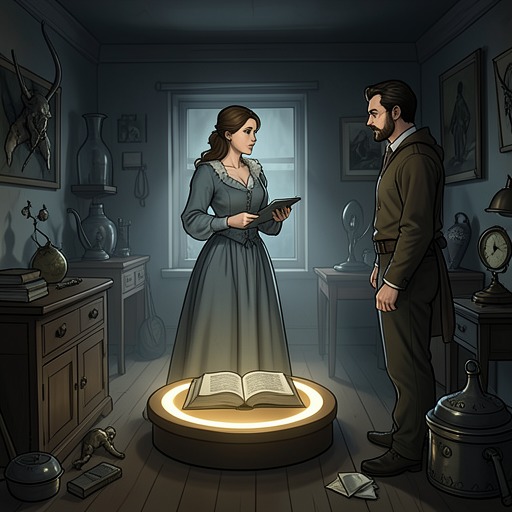
The book is bound in crimson leather and kept in Dominic Vale’s library, a place presented as both intimate chamber and supernatural institution. Dominic retrieves it from a drawer after leading Ariella to a heavy leather chair and kneeling before her. That reversal of posture matters: although Dominic remains the figure who controls the ritual, the book’s presence frames the scene as something larger than ordinary seduction or coercion. He tells Ariella that their connection involves devotion, trust, and magic, establishing the book as an instrument of initiation rather than a decorative volume.
The book is opened to a blank page. Its emptiness is functional rather than meaningless, since the page waits for Ariella’s name and makes her inscription the act that activates the object. The contrast between the stark, imposing environment of Dominic’s office and the library’s responsive atmosphere gives the book a threshold quality. It belongs to a world of ancient forces, but it becomes active only when Ariella places her identity into it.
The Naming Ritual
Dominic asks Ariella to write her name in the book. When she questions the purpose, he explains that the library will remember her and that she will become part of the library and part of him. The request thus carries two linked consequences. It grants Ariella a place within the magical space, while also drawing her into Dominic’s personal sphere of possession and devotion. The book records her not as an anonymous visitor but as Ariella Monroe, a named participant in the library’s hidden order.
As Ariella writes, the ink shimmers silver and sinks into the page like water. The physical writing therefore refuses to remain ordinary writing: the name is absorbed, transformed, and made permanent through a visible magical response. Ariella’s skin tingles and the air shifts, marking the ritual through bodily sensation as well as visual spectacle. The event is not merely a declaration spoken by Dominic; the book itself appears to answer her, making the object an active witness to her entry.
The Library’s Acceptance
The signing awakens the surrounding room. Books rustle behind Ariella, the fire roars, and the pendant at her throat pulses with light. These reactions connect the Crimson Leather Book to the wider magical environment rather than isolating its power within the page. The book serves as a conduit between Ariella’s action and the library’s response, allowing the room to behave as though it recognizes the newcomer.
Dominic watches the transformation with both hunger and reverence before declaring that Ariella has taken the first step and that the library has accepted her. His statement gives the ritual an explicit status: the book marks the beginning of an initiation. Ariella’s signature changes her relation to the setting, from outsider entering a mysterious space to someone claimed and remembered by it. The object consequently establishes the library as an entity capable of judgment, memory, and acceptance.
Connections and Consequences
The Crimson Leather Book links Ariella’s magical awakening to the larger binding between Ariella and Dominic. The scene presents the inscription as the first stage of incorporation, while later magical marking and binding continue the same movement from voluntary-looking participation toward an embodied and enduring connection. The book’s function is therefore foundational: it supplies the textual and ceremonial beginning for changes that later appear on Ariella’s body and in her relationship with Dominic.
Its symbolism is deliberately double. A written name can signify agency, because Ariella takes the pen and makes the defining gesture herself. Yet Dominic determines the terms of the act and explains its consequences, including her becoming part of him. The book consequently preserves the story’s tension between initiation and possession, choice and submission, personal identity and absorption into another power. Ariella is not erased; her full name is what the book receives. But the supernatural act makes that identity newly available to the library and to Dominic’s claim.
Narrative Significance
As an object, the Crimson Leather Book converts atmosphere into evidence. The surrounding setting suggests that something ancient and dangerous is present, but the book supplies a concrete mechanism through which that hidden world recognizes Ariella. Its silver-absorbed ink, awakened books, roaring fire, and pulsing pendant give physical form to the story’s movement from erotic encounter into magical transformation.
The book also establishes a recurring logic of the narrative: bodies, names, marks, and spaces can all become records of power. Ariella’s signature makes the library remember her, just as the later mark above her hipbone is described as having been kissed into permanence and pulsing as though alive. In this pattern, inscription is never neutral. To be recorded is to be recognized, but it is also to become bound to the authority that performs or governs the recording. The Crimson Leather Book remains significant because it is the first object to make that exchange visible: Ariella writes herself into the magical world, and the magical world answers by claiming that it has accepted her.