Project Marrow File
The CEO’s Baby Girl: A Workplace Reverse Harem Romance (Age-Gap Billionaire Obsessions)The Project Marrow File is the decisive archival object in Ariella Monroe’s story. It reveals that her apparent recruitment into Dominic Vale’s world was connected to a planned program of magical experimentation, transforming the meaning of his binding, his sexual control, and the danger surrounding their relationship. The file does not merely preserve information about a past subject: it places Ariella inside a system that had classified, prepared, and potentially replaceable subjects before she understood that she was being studied.
Discovery in the Hidden Vault
The file appears after Ariella receives an anonymous warning on her phone. The message directs her to check the Vault Beneath the Library and ask Luca about Project Marrow, immediately linking the object to concealed knowledge that Dominic has not voluntarily disclosed. The warning arrives after Ariella has been physically and magically drawn into Dominic’s authority, when she feels gloriously claimed and still bears the bodily consequences of the night before. That timing makes the file a rupture in her understanding: intimacy and evidence collide, and the relationship’s language of possession is recast as a possible mechanism of control.
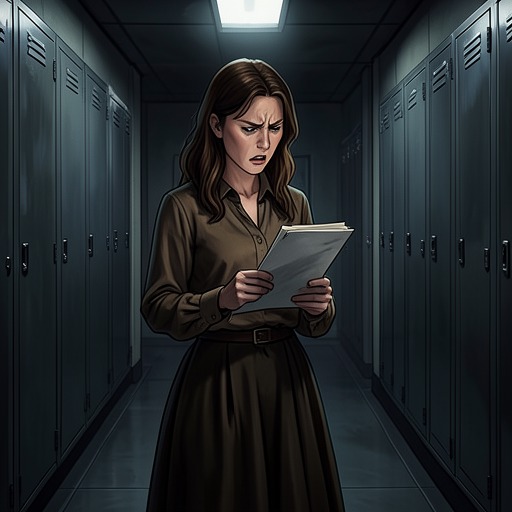
Ariella enters the library and discovers that a vault exists at all. The space has been hidden behind a slight seam in the stone, and its concealed entrance opens only when she touches a symbol formed by a vertical slash through a crescent moon. Inside, the chamber is small and circular, lined with shelves of scrolls and files, as well as strange black orbs pulsing faintly inside glass cages. The file occupies the chamber’s central pedestal, giving it a deliberate prominence among the stored materials. Its placement makes the dossier seem less like an incidental record than a preserved core of the institution’s forbidden history.
Contents and Classification
The dossier is labeled in bold, dark script, “PROJECT MARROW: SUBJECT A.001.” The designation is crucial because it identifies Ariella not by her name or personal history but by an experimental classification. Her individuality is displaced by a code, while the use of “A.001” implies an organized sequence of subjects and makes her position within the program legible only through its bureaucratic system.
The file contains grainy, aged photographs of a young woman bound in ritual and marked in the same manner as Ariella. The woman is pale, tear-streaked, and beautiful, but her eyes are empty. The images supply a visual predecessor to Ariella’s own experience and connect the experiment to bodily restraint, magical marking, and the destruction of recognizable personhood. They also substantiate Jenna’s warning about the previous girl. Jenna had described the last subject as a younger, attractive intern who entered Dominic’s orbit believing she had found the job of her dreams, only to be taken and twisted into his fantasy. The dossier turns that spoken account into material evidence.
A dry clinical report states that the subject displayed accelerated magical adaptation when bonded with the Primary, that intimacy significantly amplified latent channels, and that emotional attachment was unnecessary for the bond’s efficacy. It further records that the subject was terminated after attempting a breach, with secondary candidates pending. The language is chilling precisely because it removes suffering, desire, and coercion from the record. A person is reduced to an adaptive response, intimacy becomes an experimental instrument, and the failure to remain contained becomes a reason for termination rather than a sign of abuse.
Ariella’s Predetermined Place
The most personal discovery comes when Ariella turns through pages of arcane equations, diagrams, and spells. Her name is written on them in fresh ink, even though the preparation predates her arrival. The detail establishes that the program was not simply a historical project that accidentally resembled her circumstances. Ariella had been anticipated. The file and its associated workings had already made room for her identity, suggesting that her recruitment and treatment were shaped by a design whose existence she had never been allowed to see.
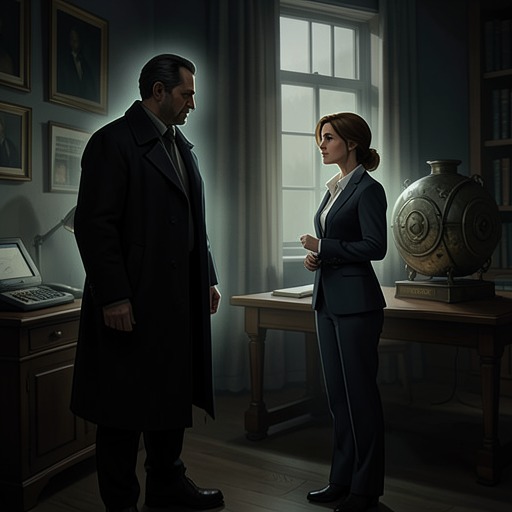
This discovery changes the significance of Dominic’s conduct at the beginning of the story. At Vale Enterprises, he receives Ariella in a vast glass-and-steel office above the city, a setting that presents power as architectural inevitability. He later tells her that discipline is required because she arrived already aroused, treating her body’s response as unauthorized and subjecting it to punishment. Read alongside the dossier, such scenes acquire an institutional dimension: the language of discipline and ownership is not isolated erotic play but part of a relationship in which Dominic’s knowledge and magical authority remain radically greater than Ariella’s.
The file also complicates Isadora Vale’s account of the past. Isadora tells Ariella that she and Dominic were once bonded through an ancient, powerful, and apparently unbreakable connection until Dominic broke it. Her testimony offers a personal history of bonding, betrayal, and rupture, while the Project Marrow File supplies an impersonal record of bonding as experimental procedure. Together, they suggest that Dominic’s relationships cannot be understood solely through the romantic language of destiny or solely through Isadora’s grievance; they are also entangled with a concealed magical structure that treats intimacy as a source of measurable power.
Consequences and Narrative Significance
The dossier functions as an object of counter-memory. Dominic’s authority depends partly on controlling what Ariella is permitted to know, while the file preserves what his spoken version of events omits. Jenna’s warning, the anonymous message, and the photographs each provide fragments of the suppressed past, but the dossier assembles them into a pattern: an earlier subject existed, the bond amplified magic, emotional attachment was not required, escape was treated as breach, and further candidates were already contemplated. The file therefore changes secrecy into evidence and suspicion into a documented system.
Its power also lies in its physical form. The hidden seam, the cold air of the chamber, the central pedestal, the heavy file, and the aged photographs make knowledge materially difficult to reach but impossible to dismiss once uncovered. The dossier is both an object and a threshold: before Ariella opens it, Dominic’s control can still be interpreted through the unstable mixture of desire, submission, and claimed protection; afterward, every such interpretation must contend with the possibility that her body and magic were selected for use.
The file’s revelation is reinforced by the fate of the earlier subject. She was terminated after trying to escape, and secondary candidates remained pending. Later, when Ariella’s magic collapses and she falls unconscious, her power gone and her memory erased, the earlier report becomes a grim framework for reading the consequences of magical domination. The dossier thus foreshadows not only physical danger but the destruction of continuity itself: a subject may be contained, altered, or removed while the archive preserves the procedure in language that conceals the human cost.
The Project Marrow File remains significant even as Ariella’s life moves toward a pregnancy revelation. Her statement that she is pregnant introduces a future that cannot be reduced to the file’s categories of primary, subject, termination, and candidate. Yet that future does not erase the dossier’s threat. Instead, the file remains the record that exposed how thoroughly Ariella’s present had been prepared by someone else, and it gives the story’s later claims of intimacy, bonding, and shared destiny a permanent political and ethical shadow.