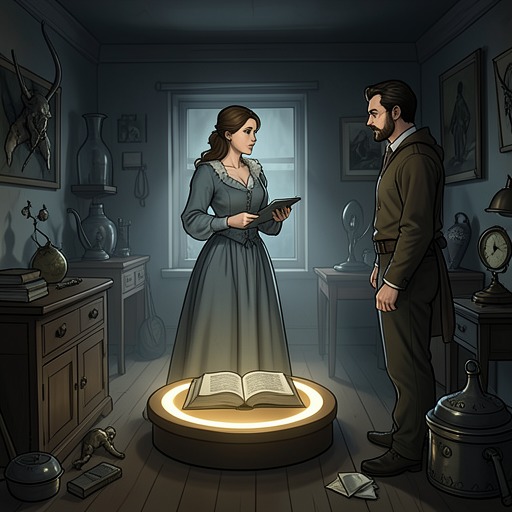
Vale Library
The CEO’s Baby Girl: A Workplace Reverse Harem Romance (Age-Gap Billionaire Obsessions)Vale Library is the concealed supernatural heart of Dominic Vale’s domain: an impossible archive reached through a private elevator, where corporate modernity gives way to inherited magic, ritual knowledge, and suppressed history. Its decisive significance lies in the way it joins initiation to evidence. Ariella Monroe first enters as a chosen participant in Dominic’s world, but returns as an investigator; the same space that receives her name into its magical order also leads her toward the file proving that women like her have been treated as experimental subjects.
Definition and Setting
Vale Library first appears beyond the private elevator serving Dominic Vale’s penthouse. When the doors open, Ariella finds neither the sleek residence she expects nor an ordinary executive interior, but low golden light that flickers like candlelight, the smell of old books and leather, and an atmosphere charged with something primal. The transition makes the library a literal threshold between Dominic’s visible life as a powerful executive and the older, concealed order he claims as his inheritance.
Its architecture rejects corporate modernity. Ancient double doors stand ajar, carved with strange symbols in a language Ariella cannot read. Beyond them stretches a vast room lined with shelves rising toward a vaulted ceiling painted with slowly shifting constellations. Tall windows are covered in black velvet, while a violet-blue fire burns in the hearth. At the center stands a massive obsidian desk veined with silver. The room therefore behaves less like a repository of books than like a living ceremonial environment: its materials, light, silence, and symbols make knowledge feel embodied and potentially dangerous.
Dominic Vale’s Legacy and the Library’s Power
The library is where Dominic explains that his authority predates his wealth. He describes himself as born into a legacy of power older than money and language, claiming that it has existed in his blood since before the city had a name. His statement recasts him from CEO to heir and guardian of an occult inheritance. The library is the spatial proof of that claim, an institution in which secrets and boundaries are possessed rather than merely studied.
The onyx pendant worn by Ariella is central to the library’s operation. Dominic identifies it as more than a mark, calling it a key, and tells her that wearing it makes the place and its truths hers as well. The pendant subsequently allows the private elevator to recognize her and glows as she passes beneath the library’s vaulted threshold. Its practical function makes the library part of an active magical system rather than a passive setting: access depends on a relationship between object, body, and authority.
The library also gives physical form to Dominic’s philosophy that power is taken and claimed. When he leads Ariella to a heavy leather chair and kneels before her, he presents the encounter as devotion, trust, and magic rather than merely sex. He then retrieves the Crimson Leather Book, opens it to a blank page, and asks her to write her name. The library’s ritual vocabulary turns a personal gesture into an act of incorporation.
The Binding and Ariella’s Initiation
Ariella writes “Ariella Monroe” in the Crimson Leather Book. The ink shimmers silver before sinking into the page, while her skin tingles, the books rustle, the fire roars, and the pendant pulses with light. The response is immediate and distributed across the room: the book, shelves, fire, pendant, and Ariella’s body participate together in the awakening. The library thus appears to possess an agency that exceeds decoration, reacting materially when her identity is entered into its record.
This initiation changes Ariella’s relation to Dominic’s hidden world. Before entering the library, she knows Dominic primarily through his public status and their intimate power dynamic. Inside it, she learns that his authority is magical, hereditary, and connected to objects and spaces that can recognize, mark, and bind her. The library does not simply reveal information; it makes knowledge consequential by attaching Ariella’s name and body to the system she is beginning to understand.
The scene also establishes a tension that later becomes central. Dominic presents the library as a place whose truths now belong to Ariella because she wears the pendant, but the subsequent discovery of Project Marrow shows that access to truth remains controlled. Her inclusion is real enough to open a path, yet incomplete enough to conceal the archive’s most damaging record. The library’s promise of belonging therefore contains the possibility of surveillance and possession.
The Vault and Project Marrow Discovery
The library’s meaning reverses after Ariella receives an anonymous message warning that Dominic did not bind her to protect her, but to control what he had broken. The message directs her to the vault beneath the library and tells her to ask Luca about Project Marrow. Although Ariella initially considers deleting it and returning to Dominic’s bed, she chooses investigation. She dresses quickly and descends through the private elevator, whose recognition of her and whose pendant-lit access now carry a darker implication: the key that grants entry also confirms her incorporation into Dominic’s system.
The library appears unchanged when she returns, with ancient-paper scent, velvet silence, and moonlight bending strangely against the bookshelves. Yet the sigils on the floor are now cold and dormant. This contrast separates the earlier initiatory library from the later investigative one. The room has not lost its supernatural atmosphere, but the signs of active ritual have withdrawn, leaving Ariella to proceed through a space whose power is concealed rather than theatrically displayed.
At the back wall, Ariella discovers a vault she did not know existed. Her fingers find a seam in the stone, and touching a symbol shaped as a vertical slash through a crescent moon causes the wall to tremble and open. Inside lies a single thick file labeled “PROJECT MARROW: SUBJECT A.001.” The archive’s secrecy is therefore architectural as well as documentary: the evidence is hidden behind a wall that becomes visible only through Ariella’s altered access and deliberate search.
The file exposes the library’s most disturbing function. It contains the record of a young woman bound in ritual and marked in a manner resembling Ariella’s own marking. The report states that the subject developed accelerated magical adaptation when bonded with the Primary, that intimacy significantly amplified latent channels, and that emotional attachment was unnecessary for the bond to work. It records that the subject was terminated after attempting a breach, with secondary candidates pending. The clinical language converts a human life into experimental data and recasts Dominic’s language of devotion as potentially compatible with an impersonal program of magical exploitation.
Consequences and Narrative Significance
The library is consequently both sanctuary and crime scene, temple and archive. Its sacred silence and gothic beauty create an atmosphere of awe, but the hidden file reveals that the same system of symbols, bindings, and magical adaptation may have produced suffering and disappearance. Jenna’s account of a pretty, younger intern who entered Dominic’s world bright-eyed and was twisted into his fantasy provides an oral warning that the Project Marrow file renders bureaucratic and evidentiary. The two forms of knowledge—testimony and record—converge in the library.
The archive also governs what can be remembered and what can be erased. The Project Marrow report records a terminated subject, while later events leave Isadora Vale unconscious, powerless, and without memory after her magic collapses. Read alongside the library’s hidden documents, that loss makes memory itself part of the story’s power struggle. The library preserves selected histories in books and files, but the surrounding magical order can also suppress, classify, or eliminate the people those histories concern.
For Ariella, the library marks the movement from submission toward knowledge. She first crosses its threshold under Dominic’s guidance, writes her name at his request, and is told that its truths are now hers. She later crosses it alone, follows a warning, opens a concealed vault, and reads evidence that destabilizes Dominic’s account of their bond. The same threshold thus measures her changing position: from recipient of a secret to a reader capable of discovering what the secret was designed to hide.
Vale Library’s gothic power comes from this double structure. Its shifting constellations, violet-blue fire, ancient doors, and responsive books make hidden knowledge appear alive, while its sealed wall and dry experimental report reveal knowledge as something organized by ownership and coercion. The library does not merely contain Dominic Vale’s secrets; it stages the conflict between being admitted into another person’s world and gaining the independence to interpret that world. Its deepest revelation is therefore not only that Project Marrow exists, but that access, intimacy, and truth have been bound together—and that Ariella must learn to separate them.