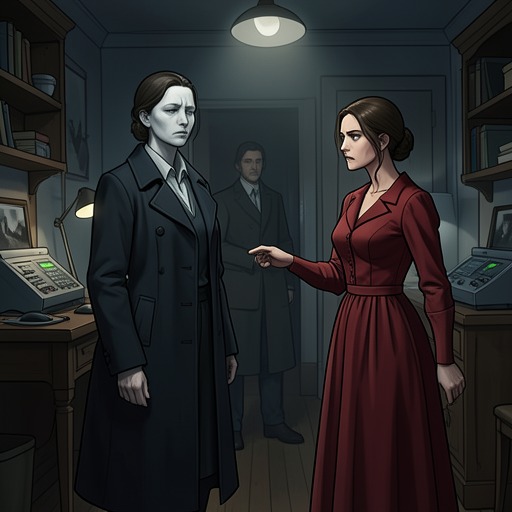
Isadora's Kidnapping of Ariella
The CEO’s Baby Girl: A Workplace Reverse Harem Romance (Age-Gap Billionaire Obsessions)Isadora's Kidnapping of Ariella is the turning-point abduction in which Isadora Vale prevents Ariella Monroe from severing her magical bond with Dominic Vale. The episode converts Ariella's intended act of liberation into an imposed encounter with Isadora, exposing how the bond restricts movement while forcing Ariella to confront desires and powers that cannot be reduced to her relationship with Dominic.
Causes and Background
The kidnapping occurs after Ariella has reached a crisis in her attachment to Dominic. Earlier, Dominic recruited her as both his assistant and his private possession, defining the office beyond its glass walls as a space in which she belonged to him. The arrangement was reinforced by the Vale Ownership Contract, including a clause that authorized discipline for noncompliance through impact, denial, restraint, or another method at Dominic's discretion. His control was therefore not presented only as erotic language; it was organized through explicit rules and consequences.
The danger of that arrangement has already been recognized by Jenna. When Jenna asks Ariella whether she feels safe with Dominic, Ariella hesitates and the narration makes the answer clear: she does not. That hesitation gives the later abduction a larger context. Ariella is not leaving a relationship whose coercive dimensions have gone entirely unnoticed; she is trying to act after her bodily attraction, fear, and dependence have become impossible to separate.
The immediate cause is Ariella's decision to sever the bond. The event is identified as “Kidnapped by Desire,” and it begins at 2:17 a.m. during violent rain and lightning. Ariella stands on her rooftop with the Onyx Pendant clenched in her fist while Luca waits below in the prepared Ritual Chamber Beneath the Tower. Candles have been lit, circles drawn, and the severing spell is nearly ready. The ritual represents a concrete route out, but Ariella experiences the anticipated absence of Dominic as a hollowness already opening inside her, making the decision both deliberate and agonizing.
The Abduction
Ariella turns to leave the rooftop and proceed toward the prepared ritual, but the world vanishes before she can complete that choice. A flash of light and a disorienting lurch erase the building from her surroundings. When her vision clears, she is no longer on her own rooftop; she has been transported to a room cloaked in velvet and shadows, marked by an atmosphere of jasmine, sex, and betrayal.
Isadora is waiting there, and her first words frame the abduction as a deliberate intervention rather than an accident: “You really thought I’d let you give him up that easily?” The question asserts Isadora's knowledge of Ariella's plan and her refusal to permit the separation. Ariella responds with fury and demands to know what Isadora has done, but the scene immediately establishes that physical power is not the only force at work. Isadora has interrupted Ariella's movement at the exact moment when Ariella was trying to reclaim control over it.
Isadora's treatment of Ariella is presented as sensuous rather than openly violent. She reaches for Ariella without roughness, touching her collarbone while the Onyx Pendant continues to hum, confused by its new surroundings. This reverent gesture produces a bodily response Ariella does not welcome: her body shivers even as her anger remains intact. The contrast is central to the event. Ariella's resistance is verbal and intentional, while sensation operates beneath or beside intention, allowing Isadora to press her claim without needing to overpower Ariella through ordinary force.
Isadora then tells Ariella that she has already tasted Dominic's power and urges her to taste both her own power and Isadora's, asking what her body craves when it is unbound. Ariella wants to refuse, but the desire to refuse does not immediately restore her freedom. Isadora later explains that Ariella cannot portal out yet because the bond will not allow it. The magical bond thus becomes an instrument of confinement: even after Isadora has taken Ariella, Ariella's connection to Dominic prevents her from escaping Isadora's space. Ariella answers by promising to break the walls down, preserving her defiance even while the supernatural rules of the bond limit her available actions.
Participants and Stakes
Ariella is the abducted subject and the immediate agent of resistance. She has come close to an organized act of separation, with Luca and a ritual chamber ready to support her, but the kidnapping removes her from that setting before the severing spell can be performed. Her stake is therefore not merely physical escape. She is trying to decide whether freedom requires the destruction of a bond that has become painful, alluring, and structurally controlling.
Isadora is both captor and challenger. Her purpose is not stated as a neutral rescue, and her language makes clear that she intends to prevent Ariella from giving Dominic up. By presenting herself as the person who can reveal Ariella's unbound appetite and latent strength, Isadora combines possession with seduction and turns captivity into a test of competing influence. Her approach differs in manner from Dominic's contract-based discipline, but it still denies Ariella the ability to leave when she chooses.
Dominic does not appear in the room, yet his presence governs the scene through the bond. Isadora's intervention is defined by Ariella's attempted separation from him, and the bond's prohibition on teleportation makes Dominic's claim materially effective even in his absence. The abduction therefore creates a three-way power structure: Isadora controls Ariella's immediate location, Dominic's bond restricts Ariella's escape, and Ariella struggles to make her own decision within both forms of control.
Luca's role is equally important as a condition of the interrupted action. He has prepared the Ritual Chamber Beneath the Tower and waits for Ariella below, making him the ally associated with the planned severance. The kidnapping prevents the ritual from becoming the scene's defining action. Instead of reaching a chamber designed to undo the bond, Ariella is delivered into a room designed by Isadora to exploit the desires and powers that the bond has awakened.
Consequences and Aftermath
The immediate consequence is the failure of Ariella's attempt to sever the bond. The planned movement from rooftop to ritual chamber is replaced by involuntary transportation, and Ariella's intended escape becomes confinement in an unfamiliar room. The value at stake shifts sharply from possible freedom to constrained resistance: Ariella has chosen separation, but the result is that she is placed more deeply inside a conflict over who may define her desire and power.
The event also reveals that magical connection in this story is not equivalent to safety or consent. Ariella's bond with Dominic can bind, limit, and block her, while Isadora's sensual attentiveness can coexist with abduction. The scene refuses to make bodily response a simple measure of willing participation. Ariella's traitorous shiver does not erase her fury, and her attraction does not cancel the fact that she cannot leave. The kidnapping makes that contradiction physically unavoidable.
Isadora's intervention further changes Ariella's relationship to her own power. Isadora insists that Ariella has only tasted Dominic's power and has not yet confronted what belongs to herself. The proposed encounter therefore threatens to become both seduction and awakening: Isadora seeks access to Ariella by offering self-discovery, while Ariella must determine whether an experience imposed by a captor can genuinely produce freedom. Her declaration that she will break the walls down keeps the scene open as a struggle rather than a completed submission.
The larger arc eventually moves beyond the unequal arrangements that shape this kidnapping. At the book's ending, Dominic stands beside Ariella not as her master or captor but as her partner, and their daughter is born under a full moon with silver, wild eyes. That later transformation does not erase the coercive structure exposed here; instead, it gives the abduction retrospective importance as one of the crises through which the story tests the difference between possession, captivity, and partnership. The kidnapping is the point at which Ariella's attempted escape is stopped, but it is also the pressure chamber in which the story's later claim to mutuality must be measured.