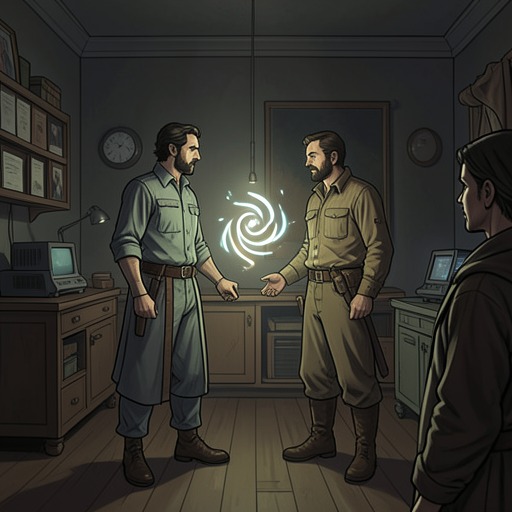
The Mutual Essence Ceremony
The CEO’s Baby Girl: A Workplace Reverse Harem Romance (Age-Gap Billionaire Obsessions)The Mutual Essence Ceremony is the culminating rite through which Ariella Monroe and Dominic Vale redefine their bond. Unlike the earlier structures of domination that marked their relationship, this ceremony does not make Ariella an object of ownership. It turns mutual power into an explicit choice: she offers her strength as a gift, he offers his darkness as protection, and together they reject the language of possession in favor of a shared identity.
Setting and Separation from Earlier Bonds
The ceremony takes place at night in an open natural space, under the stars, with the wind as witness and the moon functioning as its vow. Its privacy is essential: there is no altar, priest, or audience, and no written record, ring, or conventional promise capable of containing what Ariella and Dominic have become. The absence of institutional witnesses separates the rite from ordinary marriage and from the formal mechanisms that previously governed Ariella’s submission.
That contrast reaches back through the relationship’s earlier magical episodes. Dominic once knelt before Ariella while presenting the act as devotion, trust, and magic, then led her into a circular sigil and required her obedience. Later, Ariella claimed the awakening power as her own, while Dominic’s kneeling came to signify surrender rather than worship. The Mutual Essence Ceremony gathers those earlier images and reverses their meaning: the circle is no longer simply a site into which Ariella is placed, and kneeling is no longer evidence of her subordination. The ceremony occurs after betrayal, survival, and Ariella’s recovery of selfhood, so its central question is not whether she belongs to Dominic, but whether she can choose intimacy without relinquishing herself.
Participants, Implements, and the Blood Rite
Only Ariella and Dominic stand at the center of the ceremony, but Luca serves as its immediate ritual witness and officiant. Dominic appears with his chest bare, the rune of his bloodline drawn across his skin in silver ash, while Luca carries an obsidian bowl of oil and a moonstone dagger. The materials give the scene a distinct magical and bodily vocabulary: oil prepares or seals, moonstone lends the blade an otherworldly quality, and blood makes the bond physically irreversible.
Luca states that the rite must be sealed with intention, placing the emphasis on conscious purpose rather than involuntary enchantment. Ariella accepts the dagger without fear and with clarity. Dominic extends his hand, palm upward, and she cuts her own palm first before cutting his. Neither flinches. Their wounds are therefore reciprocal acts rather than a punishment imposed on one participant by the other; Ariella initiates the exchange, and Dominic submits his body to the same deliberate vulnerability.
When they press their hands together, their blood mingles and heat moves through them. The sigils carved into the stones ignite in stages, changing from white to gold and then to deep red. The progression makes the rite visible as a transformation: the ceremony begins in formal magical structure, intensifies into shared force, and culminates in a color associated with blood, desire, and embodied commitment. The physical marks do not merely decorate the ritual. They register a new relation in which both participants are altered by the same act.
Vows, Reversal, and Shared Identity
The ceremony’s decisive movement occurs in the vows, which convert the blood exchange from a magical procedure into an ethical redefinition of the relationship. Ariella gives Dominic her strength, explicitly describing it not as surrender but as a gift. Dominic answers by giving her his darkness, not as a burden but as a shield. Their language therefore preserves difference while making protection reciprocal: she is not absorbed into his power, and he does not claim her strength as a resource. When Ariella says that she is not his and Dominic answers that he is not hers, the rite directly repudiates the possessive formula that had governed their earlier bond. Their shared declaration, “We are ours,” replaces ownership with mutual belonging and makes equality the ceremony’s central magical principle.
The scene’s imagery confirms that this is not a symbolic adjustment but a supernatural transformation. At the couple’s joined hands, the surrounding sigils flare white, gold, and finally deep red before the light around them explodes in an exhalation described as fusion rather than violence. Ariella’s mark brightens on her skin, Dominic’s chest burns with a corresponding fire, and the Silver Flame Pendant she wears glows until it embeds itself in her chest and vanishes. The rite thus inscribes their mutual essence into their bodies, while also making the former external token of their bond part of Ariella herself. The result is neither the erasure of individuality nor a return to the earlier ownership structure; it is a shared magical state formed through two deliberate offerings.
Ariella’s altered position is reinforced by the gesture that follows. Dominic draws her close, but she enters his embrace neither as a submissive nor as a prize. She is presented as a force made flesh: a woman who has chosen the ceremony after surviving betrayal and becoming her own savior, yet who still chooses to return to desire. This embrace matters because it joins intimacy to recovered agency rather than treating agency and desire as opposing conditions. The fire pit in the glade then blazes to life on its own as they walk toward it hand in hand and step into the circle of stones, giving the rite a final image of voluntary passage into a shared future.
Consequences, Recognition, and New Terms of Intimacy
The ceremony’s meaning becomes clearest after the supernatural display has subsided. Ariella explains that the decisive change was not the rite itself, but the moment when she stopped needing to belong to anyone and began wanting to share everything. Her distinction separates dependence from chosen intimacy: she does not return to Dominic because the old claim has been restored, but because she can now participate without surrendering the self she fought to recover. Dominic’s whispered assertion that she is his therefore remains deliberately unsettled by the vows that preceded it. The language of possession survives as an erotic residue, yet it no longer defines the bond’s legal or magical foundation; the ceremony has already established that neither belongs to the other and that their binding is mutual.
Narrative Function and Value Shift
As a late turning point, The Mutual Essence Ceremony gathers the book’s recurring images of collars, marks, circles, kneeling, and magical binding into a new arrangement. Early scenes frame Ariella’s body and obedience as territory controlled by Dominic, while later reversals allow her to claim power in her own name. The ceremony does not erase those earlier structures; it answers them. Dominic’s earlier kneeling before Ariella was associated with the revelation that their relationship involved devotion, trust, and magic, and his later kneeling is explicitly identified as surrender rather than worship. In the final rite, however, neither partner is reduced to a fixed role. Ariella gives without being conquered, Dominic protects without possessing, and both accept vulnerability through the same blood-marked action.
The value shift is consequently from ownership to reciprocity, and from imposed identity to self-authored relation. The ceremony’s private setting, absence of conventional authorities, reciprocal wounds, and fused sigils make intention more important than public recognition. Ariella’s final understanding of belonging gives the event its emotional resolution: freedom does not require the rejection of desire, and desire does not require a return to submission. The rite’s promise is therefore not that power has disappeared, but that power can be shared under terms Ariella consciously chooses.
Later Revelation and Lasting Significance
The ceremony also establishes the immediate emotional and magical context for the ending’s pregnancy revelation. After the rite, Ariella tells Dominic that she is pregnant, and his response is framed by a silence described as sacred before he exhales as though he had been holding the breath since before meeting her. The revelation extends the ceremony’s movement from a private bond into a future capable of producing another life. It does not replace the equal bond with domestic conventionality; instead, it confirms that the relationship’s new form has consequences beyond the two participants.
The event is thus both culmination and threshold. It closes Ariella’s movement from a young woman entering Dominic’s world under rules she did not author to a woman who can define the terms of a magical partnership, while opening the final phase in which that partnership becomes generative. Its most important transformation is not the disappearance of dominance, desire, or danger, but their reorganization around explicit mutuality. The fused light, the vanished pendant, the handclasp, and the declaration that they are theirs together give physical form to a conclusion in which Ariella remains fully herself precisely because she chooses to share her strength.
Later Revelation and Lasting Significance
The Mutual Essence Ceremony also establishes the immediate emotional and magical context for the ending’s pregnancy revelation. After the rite, Ariella Monroe tells Dominic Vale that she is pregnant, and his response is framed by a silence described as sacred before he exhales as though he had been holding the breath since before meeting her. The revelation extends the ceremony’s movement from a private bond into a future capable of producing another life. It does not replace their equal bond with domestic conventionality; instead, it confirms that the relationship’s new form has consequences beyond the two participants.
The event is therefore both culmination and threshold. It closes Ariella Monroe’s movement from a young woman entering Dominic Vale’s world under rules she did not author to a woman who can define the terms of a magical partnership, while opening the final phase in which that partnership becomes generative. Its most important transformation is not the disappearance of dominance, desire, or danger, but their reorganization around explicit mutuality. The fused light, the vanished Silver Flame Pendant, the handclasp, and the declaration that they are theirs together give physical form to a conclusion in which Ariella Monroe remains fully herself precisely because she chooses to share her strength.