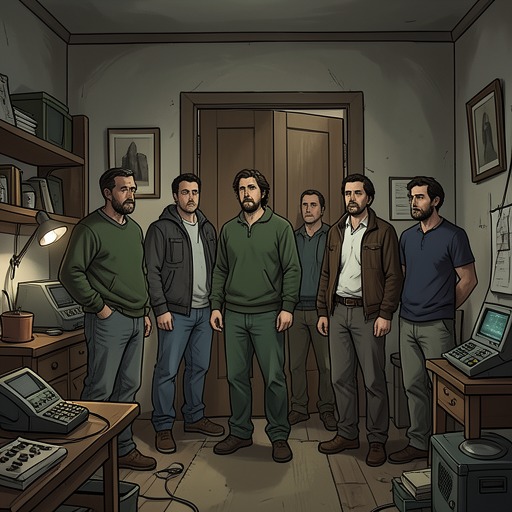
“Let’s Make a Deal”
The Cabin at the End of the World“Let’s Make a Deal” is both the title of Part 2 and a phrase spoken as the cabin’s intruders present their ultimatum to Andrew, Eric, and Wen. Its breezy, game-like language sits uneasily beside the demand it names: the family is told to choose one of its three members to die or face the end of the world. The expression turns the central conflict into a supposed negotiation, even as the family has little freedom to refuse its terms.
The phrase and the ultimatum
The phrase appears in the conversation about the intruders’ proposal alongside the joking line, “Yeah. Let’s make a deal. Door number three, man, it’s always door number three.” The image of selecting a door makes the danger sound like a wager or a game of chance. That levity is sharply at odds with Leonard’s explanation: the family must willingly choose one of its own and carry out the killing; if they do not, the rest of humanity will perish, while the three family members survive to witness the devastation and remain alone. The casual language does not soften the stakes so much as expose the gap between the intruders’ presentation and the violence their proposal requires.
A choice presented as a gift
Leonard promises that the intruders will not harm the family further, but says they must remain in the cabin until they choose or their allotted time runs out. Later, he presents the choice again as a gift and says the family can make it the following morning, or let the clock move closer to the world’s end. He promises to tend to their needs within reason and leave them alone to reflect. The language of generosity therefore accompanies continued confinement and a threat encompassing everyone beyond the cabin. “Deal” suggests mutual agreement; the conditions Leonard describes leave the family with no ordinary way to bargain, withdraw, or accept freely.
Delay and refusal
Andrew says they do not need to wait until morning and that they will not change their minds. The intruders nevertheless press for an answer. When Adriane is holding up a mask and Sabrina says it is time to choose, Eric tries to keep the conversation going by asking Adriane about the restaurants where she used to work. His attempt to draw her into talking about her former life functions as a delay, not an acceptance of the proposed bargain.
The phrase’s underlying question remains active later, when Andrew asks Eric whether he believes one of them must be killed by another to prevent the world from ending. The exchange shifts attention from the intruders’ insistence on a transaction to the family’s struggle to decide whether its premise is true. The expression thus gathers together the story’s conflict over consent, belief, and responsibility: a choice can be announced as a deal, but its coercive terms do not make it a freely negotiated one.