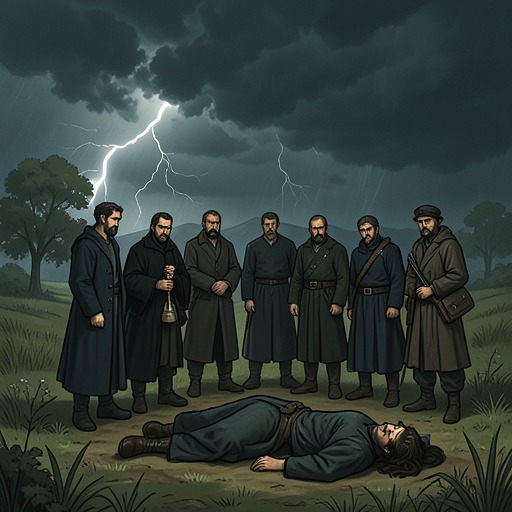
Aleutian Islands earthquake and tsunami
The Cabin at the End of the WorldThe Aleutian Islands earthquake and tsunami is the first major natural disaster shown on the cabin television as evidence in the visitors’ apocalyptic argument. News reports describe a powerful earthquake followed by a tsunami warning and flooding in Hawaii; for Leonard, the sequence confirms that the family’s refusal to select a sacrifice has consequences. Yet the coverage also reports successful evacuations and no injuries or fatalities at the time, leaving a gap between the visitors’ catastrophic interpretation and the specific human toll presented on screen.
Background and warning
The earthquake is reported as a magnitude 7.9 event centered in the Aleutian Islands, a chain of volcanic islands stretching across the Bering Sea. By the time the network welcomes viewers back to its continuing coverage, the quake has struck more than four hours earlier. The report places its epicenter near the northern Pacific’s Ring of Fire, a region monitored by a network of tsunami detection buoys. The interval between the earthquake and the broadcast matters: the cabin’s occupants do not witness the seismic event itself, but encounter it through a news account assembled after the initial shock.
The U.S. National Tsunami Warning Center issues a cautionary advisory for British Columbia and more than a thousand miles of the Pacific Northwest coastline, including Seattle and Portland. The Pacific Tsunami Warning Center issues its strongest warning for Hawaii. Residents and tourists on north-facing coastlines are ordered to evacuate and seek higher ground. A spokesperson explains that nearly two dozen detection buoys across the Northern Pacific, including a cluster around the northern Ring of Fire, provide data indicating that a wave roughly fifteen to twenty feet high is moving south toward the Hawaiian Islands.
Television coverage and landfall
The broadcast moves from studio reporting to video of the consequences. A newscaster announces that a tsunami has made landfall, and the network shows a resort on Kauai. The footage’s status is left uncertain: the cabin’s viewers cannot tell whether it is live or recorded. The resort has already been evacuated. The incoming water floods its grounds and lower-level areas, while other reports show waves affecting smaller communities and less populated islands, including damage to boats, marinas, docks, and coastal roads.
The spokesperson acknowledges that erosion and property damage will be extensive, while describing the warning system as successful because authorities had time to evacuate exposed coastlines and low-lying areas. At this early stage, the broadcast reports no injuries or deaths. That qualification is important to the event’s presentation: the disaster is real and disruptive, but the available report does not depict a mass-casualty aftermath. Its images and figures arrive amid commercials, a scrolling ticker, and repeated studio coverage, making television both the cabin’s principal source of information and the medium through which distant catastrophe becomes immediate to its captives.
The disaster as proof
The earthquake and tsunami enter a cabin already governed by Leonard’s claim that the four visitors received a shared message and were united by a vision. He presents the family with a demand to choose and kill one of its three members, insisting that failure to do so will bring an apocalypse. When the Hawaiian coverage appears, Leonard treats the unfolding events as confirmation that the family could have prevented them by making the demanded choice. The news report itself establishes the earthquake, warnings, landfall, and evacuation; the assertion that these events prove the visitors’ mandate is Leonard’s interpretation of the report.
That distinction becomes sharper when the disaster is placed in the sequence described later by Sabrina. She counts Redmond’s death before the earthquake and tsunami, then Adriane’s death before the spread of bird flu, arguing that each death is followed by another calamity. The sequence turns separate events into a rule within the visitors’ reasoning: catastrophe is presented not as an isolated occurrence but as a response to the family’s failure to choose. The television’s coverage supplies observable events for that claim, while the visitors’ explanation supplies the supposed causal connection.
Escalation and narrative significance
The Aleutian disaster is followed, during the same period of confinement, by a report of a second major earthquake: magnitude 8.6, with an epicenter about seventy miles off the Oregon coast in the Cascadia Subduction Zone. Leonard greets the news as the next stage of the consequences he has predicted. The second earthquake is a distinct event, but its arrival extends the pattern established by the Aleutian quake and tsunami: successive broadcasts appear to turn the visitors’ warning into a chain of increasingly difficult events for the family to dismiss.
The television continues to shape how that chain is experienced. Later coverage shifts to a montage of airports, hospitals, crowded public spaces, and people wearing masks; a subsequent broadcast shows wrecked aircraft. These images broaden the apparent crisis beyond the Pacific disasters and reinforce the screen’s recurring function as a source of breaking calamity. The Aleutian earthquake and tsunami therefore mark a turning point in the cabin’s argument over what the family is seeing. The event lends force to Leonard’s claims without, by itself, establishing that the visitors’ demanded sacrifice could have prevented it.