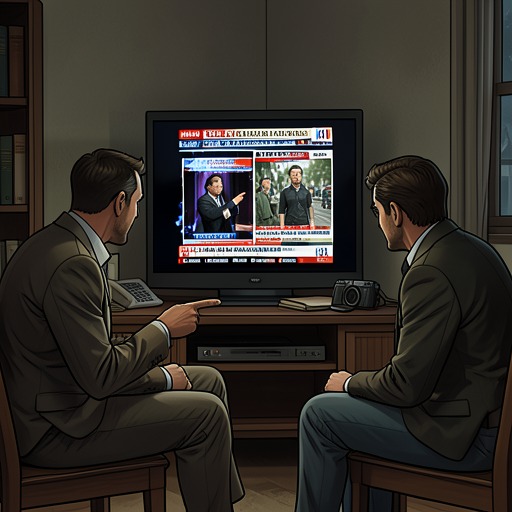
Andrew Smashes the Television
The Cabin at the End of the WorldAndrew Smashes the Television is the moment Andrew brings the family’s latest televised catastrophe to an abrupt end. After the screen reports that as many as seven airplanes have crashed without warning, he strikes it with a sledgehammer; the resulting black hole echoes the broadcasts’ images of smoke while cutting off the flow of disaster news.
The Television as Evidence
Earlier in the cabin siege, The cabin television had shown news of a 7.9-magnitude earthquake in the Aleutian Islands, which had struck more than four hours before the report. The U.S. National Tsunami Warning Center had issued a cautionary advisory for parts of the Pacific coast, while the Pacific Tsunami Warning Center warned Hawaii and ordered evacuations from north-facing coasts. The broadcasts supplied a developing sequence of details rather than a single image: detection buoys in the Northern Pacific registered a sizable wave, estimated at fifteen to twenty feet, moving toward the islands.
Footage from Kauai showed the wave flooding an evacuated resort, while other reports depicted damage to smaller coastal communities. At that point, the spokesperson described the warning system as having allowed time for evacuation and said that no injuries or deaths had been reported. The television then carried news of a second earthquake, measuring 8.6, near the Cascadia Subduction Zone off Oregon. Leonard treated the successive disasters as confirmation that the family had failed the visitors’ demand for a sacrifice, insisting that the events could have been prevented.
The Broadcast Returns
The television’s role in the siege recurs later, when Eric presses its concealed power button without recalling a deliberate decision to turn it on. The screen fills with rapid images of airports, hospitals, crowded streets and markets, and people wearing surgical masks. The abrupt sequence overwhelms him; he moves away from the couch and into Andrew, who asks why he turned it on. Eric can only explain that a fly had guided his hand toward the button.
After Sabrina unmutes the set, the news has moved to reports of aircraft wreckage. The images include crashed planes in fields and a wreck in the ocean; the commentator reports confirmation of as many as seven crashes without warning or distress calls. The report raises fears and speculation about a coordinated cyberattack on flight-management systems and says that airports around the world are canceling flights. The broadcast thus joins the earlier earthquakes and tsunami coverage in an accumulating record of apparently real disasters, even as the family remains unable to determine what the pattern means or who, if anyone, has correctly interpreted it.
The Smash
Andrew swings the sledgehammer into the middle of the television screen. The blow makes a hole in the display, black like the smoke shown rising from the wrecked aircraft. The action physically interrupts the broadcast at the point when its images have become difficult to separate from the visitors’ warnings and the family’s immediate crisis.
The scene does not establish a spoken explanation for Andrew’s act, so the break is most significant in its consequence: the stream of images stops. Earlier television reports had been watched under Leonard’s insistence that the family wait for the promised signs; now, after the report of multiple crashes, the screen itself is damaged. The destruction cannot undo the news or settle whether the disasters validate the visitors’ claims. It only removes the device through which the family has been made to watch them.
Narrative Significance
The television’s repeated appearances give the siege a public, mediated scale. Its reports move from a major earthquake to tsunami warnings and coastal flooding, then to another earthquake and, later, airplane crashes. Details such as the forecast wave height, the evacuated resort, and the absence of early casualty reports lend the coverage the texture of developing news, while the shifting footage and unresolved sources leave room for uncertainty.
Andrew’s blow converts that tension into an unmistakable physical gesture: instead of continuing to watch, he breaks the screen. Its dark opening recalls the broadcast’s smoke, linking the destruction of the television to the catastrophe it had been displaying. The action interrupts the family’s exposure to the news but does not offer escape from the events themselves.