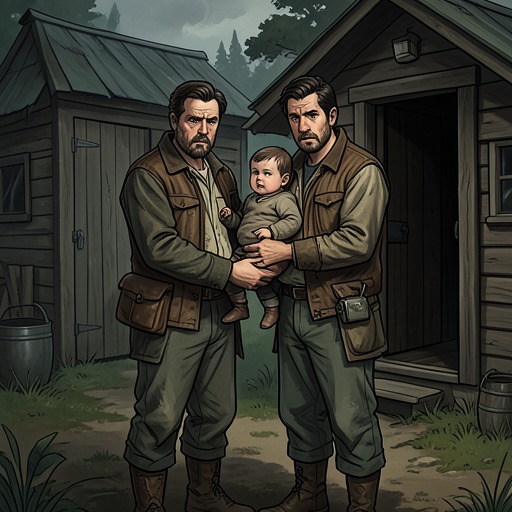
Andrew and Eric’s Marriage
The Cabin at the End of the WorldAndrew and Eric’s Marriage is defined in the novel’s final crisis by an intimate tension: each wants to protect the other, but neither can make the other’s terror or grief disappear. Their bond is shown not as an escape from catastrophe but as a way of facing it together. After Wen’s death, Andrew and Eric reach the point of a possible mutual sacrifice; the decisive change comes when Eric lowers the gun and they turn instead toward the difficult work of carrying their daughter’s memory forward.
Marriage and Family
The marriage is established in the immediate language of their shared life: Andrew is Eric’s husband, and Wen is their daughter. The crisis makes that family structure brutally concrete. Their care for Wen is not an abstract declaration of affection; in the aftermath, they envision lifting her into their arms, carrying her, remembering her, and continuing to love her. Their marriage is bound to parenthood, so the loss confronting them is both the loss of their child and a threat to the future they have made together.
The evidence does not present their relationship through a long account of its history. Instead, it gives the reader brief gestures and exchanges at the moment when ordinary tenderness has become difficult. That compression matters: the marriage is legible in what they attempt to do for one another while events overwhelm them. A touch that does not happen, a promise that sounds false even to the speaker, and a hand that finally lowers the gun carry the weight of a shared life without requiring an idealized portrait of the couple.
Intimacy Under Pressure
When the family leaves the cabin, Andrew is the last to go. As Eric passes, Andrew thinks about reaching out to touch his husband’s shoulder, but he fails to lift his free hand in time. Eric is already down the stairs and on the grass. The missed gesture is small, but its timing makes it revealing: Andrew’s wish to comfort Eric is present, while shock and exhaustion keep that wish from becoming action. Their closeness persists even when they cannot readily perform it.
At the SUV, Andrew reloads the handgun taken from the cabin and says he will throw it away once they are safe. Eric offers to help him find somewhere to discard it. The offer comes out too eagerly and sentimentally, and Eric recognizes it as an obvious lie. He cannot make the weapon harmless by promising a future in which they are safe; what he can offer is a future action undertaken with Andrew. The exchange is tender precisely because it fails as reassurance. Their shared language reaches for a later time while both know that survival is still uncertain.
The novel also connects their present tenderness with an earlier moment of vulnerability. Before this day, Eric had seen Andrew cry only once: after Andrew returned to their apartment following a two-day hospital stay after the bar attack. Eric sat beside him on the edge of the bed and wrapped his arms around him; neither spoke while Andrew cried. When the crying stopped, Andrew said, “That’s enough of that.” The recollection gives their current grief a history without suggesting that Andrew has become comfortable expressing it. Eric remembers both the silence in which he held him and Andrew’s effort to close the moment down.
Love and Disagreement
As the crisis tightens around the demand that one of them die, love does not make Andrew and Eric agree about what has happened. Andrew rejects the claim that Wen’s death is not an adequate sacrifice and turns his anger on the people making that demand and on their god. His insistence breaks into sobbing. Eric, meanwhile, affirms that he believes Andrew experienced something real, while continuing to believe that Andrew’s perceptions were caused by his concussion. Andrew tells him to stop saying so; Eric refuses, explaining that he will not stop because he loves Andrew and will not let him do this.
Their disagreement is not a withdrawal of affection. Eric’s refusal is an act of protection as he understands it, while Andrew’s pain makes that protection feel like a failure to recognize what he has experienced. The exchange leaves no easy reconciliation: Eric does not retract his explanation, and Andrew does not simply accept it. Yet Andrew answers that he loves Eric too, “more than you know,” before insisting that one of them must die. The marriage holds both the declaration of mutual love and the unresolved pressure of the sacrifice Andrew believes necessary.
Choosing to Go On
The final reversal is physical. Eric pulls the gun off Andrew’s chest, lowers his arm, and drops the gun onto the forest floor. He leans into Andrew, who leans back into him. They stand cheek to cheek, their arms hanging at their sides, and find one another’s fingers. The weapon that had made the possibility of one spouse killing himself for the other immediate is no longer in either man’s hand. Their embrace does not undo Wen’s death or settle their disagreement about the light; it changes what they do next.
They imagine retrieving the truck keys from the mud and carrying Wen down the road, even if floodwaters, fallen trees, or fissures obstruct the way. The list is practical and ceremonial at once: the keys mean movement remains possible, while carrying and remembering Wen gives their continued life a purpose that includes the child they have lost. Their promise is not that the danger has passed. In the storm, they acknowledge that this one may be different from the others, or may not be. Their marriage reaches its ending not in certainty or safety but in joined action and touch. “We will go on” names a shared decision: neither will make the other’s death the price of continuing, and neither has to continue alone.