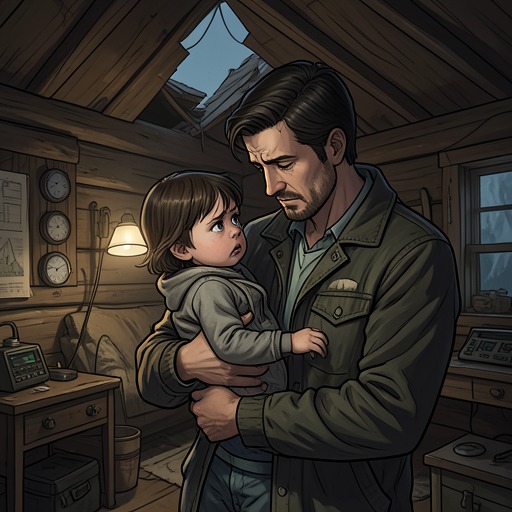
Andrew and Wen’s Father-Daughter Bond
The Cabin at the End of the WorldAndrew and Wen’s Father-Daughter Bond is the intimate center of Andrew’s life as a parent and the most devastating relationship transformed by the cabin siege. Their closeness appears in ordinary lessons, jokes, and confidences as well as in Andrew’s instinct to shield Wen from danger. When that protection fails and Wen dies, the bond persists as a physical and moral presence: Andrew mourns the child he cannot hold and rejects the claim that her death should count as an acceptable sacrifice.
Identity and Everyday Care
Wen calls Andrew Daddy Andrew, one of her two dads. Their family life is affectionate and familiar rather than idealized: Wen is direct and determined, sometimes besting her dads in battles of wills and in scripted wrestling matches on their bed. Andrew knows her habits and interests well enough to become her guide in small discoveries. When she goes looking for grasshoppers in the yard, he teaches her to sweep her foot through the grass like a scythe, then explains the unfamiliar tool with the help of smartphone images. The lesson combines attention to her curiosity with a willingness to stop and make the world intelligible to her.
Andrew’s closeness is also present in the details Wen notices about herself and her place in the family. Her eighth birthday is six days away, but she has overheard her dads wondering whether it is her actual birth date or one assigned by the orphanage in China’s Hubei Province. Her repaired cleft lip leaves a thin white scar beside her philtrum, a trace of surgeries between ages two and four. Wen remembers the first and last hospital visits but not those in between, a gap that bothers her. Her dads’ knowledge of her history and their response to her needs form part of her security, even as the uncertainty about her early life remains unresolved.
Trust, Play, and Protection
The bond is made of practical care as much as affection. Wen once promises Andrew that she will release the grasshoppers before they are cooked inside her homemade terrarium. She thinks carefully about shade, the jar’s sharp holes, and catching smaller insects that will have more room. Andrew’s earlier teaching has given her a way to find them; her own careful plan shows how she has taken responsibility for what he helped her discover. Their connection therefore includes both instruction and independence: he gives her knowledge, while she makes decisions and expects to be taken seriously.
During the cabin siege, Wen tries to protect her family in the ways available to a child. When Leonard speaks from outside, she walks in front of her retreating dads and shouts, “Leave us alone, Leonard! You’re scaring us! You’re not my friend! Go away! Just go away!” She hopes she sounds angry and in control rather than frightened. Andrew and Eric crouch to her level and hug her, but she listens for Leonard’s answer. Her effort to confront the threat shows how closely she is involved in the crisis, not simply kept beyond it.
As danger becomes immediate, Wen asks for something to hold. Andrew answers by fetching a minishovel from the woodburning stove. She grips it like a softball bat and swings, nearly catching Andrew in the knee as she turns. Neither father tells her to be careful. The moment conveys their predicament: Andrew gives her a means of feeling prepared, but the adults have no safe way to make a child’s participation in the danger harmless. His protective role is already constrained by the violence surrounding them.
The Siege and the Limits of Protection
When Adriane lowers Wen onto Andrew’s lap, Andrew’s attention turns entirely to getting his daughter away. Wen twists free and clings around his neck, her cheek hot and wet against his. He repeats her name and whispers that she must leave through the screen slider, cross the deck, and keep running. When she does not move, he stops whispering and yells for her to run. Wen shakes her head and says, “I can’t.” The exchange is a painful reversal of their ordinary relationship: Andrew can tell her what to do, but he cannot make her safe or make fear release its hold on her.
The siege also exposes a vulnerable part of Andrew’s past to Wen. He admits that a terrible person caused his scar and explains that he had hoped to tell her when she was older, when she could understand. He had wanted to postpone her knowledge of cruelty and injustice, not because he considered her untrustworthy, but because he wished to protect her childhood from them. Wen has already told Leonard what Andrew told her, prompting Andrew to acknowledge that both accounts are true. The scene makes their relationship one of confidence as well as shelter: Andrew tells her the truth, while recognizing that he cannot choose when the outside world will make its meaning unavoidable.
The Gun, Wen’s Death, and Andrew’s Guilt
A flashback to a family meeting shows Andrew explaining the gun and its safe to Wen. He displays a new silver safe and tells her the gun is not loaded but remains very dangerous. Andrew has a special license and has taken classes in keeping and using it; Eric emphasizes that the weapon is not a toy and that Wen must never touch it. Andrew asks whether she wants to hold the gun, but Eric changes his mind before she can answer, and Andrew does not argue. The scene shows the care with which the fathers try to establish boundaries, while also placing the gun within their family history before it becomes the instrument of catastrophe.
During the struggle with Leonard, the gun goes off while Leonard’s hands are pressed over Andrew’s. Wen falls, and Andrew and Eric gather around her body, holding and shielding her as they wail her name. Later, Andrew remembers how he had carefully positioned her arms at her sides beneath the sheet, and wonders whether they have shifted. He wants to unwrap her, check her hands and feet, kiss her forehead, and avoid looking at the lower half of her face. These specific impulses reveal grief as an ongoing physical relation to the daughter he can no longer tend: even after her death, his thoughts return to the small acts of care he wishes he could still perform.
Andrew’s guilt attaches itself to the chain of circumstances around the gun. He wonders whether Eric blames him for bringing it to the cabin, having it in his hand, and being unable to stop the trigger from being pulled. The weapon is in his back pocket while his hands hold the wooden handle of the weapon made by O’Bannon; he wishes instead to hold Wen. He also fears that Eric’s grief and shock have changed him beyond recognition, and longs for Eric to be himself again. Wen’s death therefore wounds not only Andrew’s bond with his daughter but his confidence in his ability to protect the family they made together.
Grief and the Bond’s Final Consequence
Andrew’s grief does not resolve into acceptance of the intruders’ explanation. After Sabrina runs, he says that they expect him and Eric to believe Wen’s death is not a good-enough sacrifice for their god. He rejects the demand in blunt terms and breaks down sobbing, tears mixing with rain on his face. His protest is rooted in his relationship with Wen: her death is not an abstract entry in a proposed exchange, but the loss of his daughter, whose body Eric is carrying and whose absence Andrew cannot stop confronting.
The bond ends in bereavement, but it continues to determine Andrew’s choices. He cannot restore the ordinary closeness of lessons, wrestling, and care, and he cannot undo his part in the events that killed her. He can, however, refuse to let the intruders define her death as the required price of salvation. In that refusal, Andrew’s love for Wen becomes both a source of unbearable guilt and a limit on what he will accept: her life cannot be made into a justification for the very violence that took it.