Andrew’s SUV
The Cabin at the End of the WorldAndrew’s SUV is both the family’s apparent route out of the cabin and the hiding place of Andrew’s handgun. During Andrew’s escape attempt, its slashed tires make it unusable for flight, while the gun stored in its trunk gives him a reason to risk reaching it. The vehicle’s role reverses at close quarters: it cannot carry him away, but its doors, seats, windows, and concealed storage compartment become the terrain of his struggle with Sabrina.
Position and Intended Escape
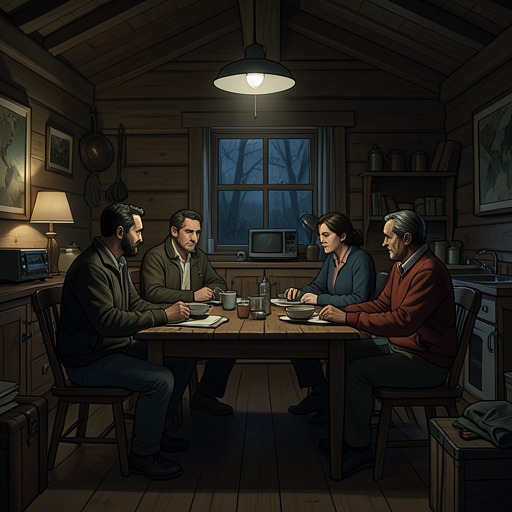
As Andrew frees his legs from the rope, he weighs two routes from the cabin to the SUV. The front door offers the shortest path, but would force him past the others and require time to unlock it; the deck slider promises a quieter exit, at the cost of a longer run down the stairs, around the cabin, and to the driveway. He understands that the delay could let one or more of the others reach the vehicle first. The SUV is therefore not simply a destination: getting to it depends on choosing between exposure and distance while the people inside the cabin are still trying to restrain Eric and Wen.
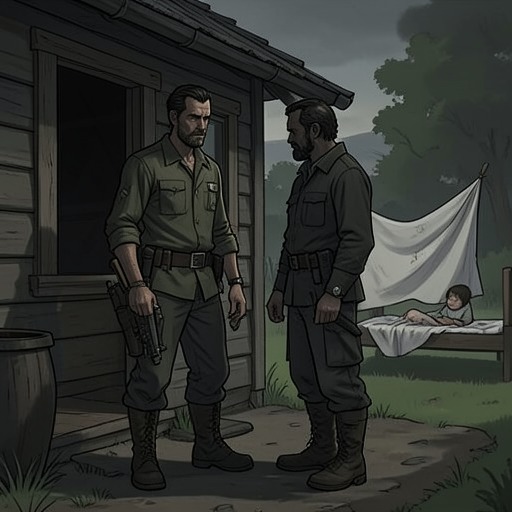
Andrew ultimately bursts through the front door, falls down the steps, and gets back onto his feet. The vehicle is only ten to fifteen yards away, close enough to make escape seem possible. Then its condition defeats that expectation. The driver’s-side front and rear tires are flat, with their sidewalls slashed. Andrew assumes the other tires have also been cut, leaving him to conclude that the SUV will not take him away. Its nearness intensifies rather than resolves the danger: he has reached the driveway, but not a functioning escape.
The keys are missing from Andrew’s shorts pocket. He remembers giving them to Eric the previous day, when the others were breaking into the cabin, and worries that locked doors would keep him from reaching the handgun in the trunk. The vehicle’s usefulness thus depends on several ordinary mechanisms and possessions—the keys, the locks, the tires, and access to the stored weapon—each of which becomes consequential under pressure. Andrew runs toward the passenger door without looking back, treating entry as necessary even though he does not know whether it will open.
The SUV as a Battleground
The passenger door is not locked. Andrew slips into the SUV and locks himself inside, but the shelter is temporary. His right knee, struck by Sabrina’s weapon, is already badly swollen and unstable; rather than rely on it, he drags his leg as he moves from the passenger seat over the center console toward the back. Sabrina reaches the vehicle and strikes the rear passenger window with her shovel-blade weapon. The glass cracks but initially holds, while Andrew scrambles toward the trunk compartment.
Andrew works his way across the back seat and pulls at two black plastic knobs in the side panel, turning them clockwise before removing the plastic hatch. Sabrina’s next blow shatters the window to his left. Small cubes of glass sting his bare lower legs and scatter into the trunk as he ducks and braces for another attack. The SUV’s interior, which might ordinarily offer privacy and protection, has become an exposed enclosure: Sabrina can reach through the broken window, and Andrew must continue searching while injured and under attack.
Concealed Storage and the Handgun
Behind the side-panel hatch is Andrew’s biometric gun safe, a silver aluminum-alloy case less than a year old and about the size of a thick, eight-hundred-page hardcover. Its compact, smooth design stands out amid the violence of the scene. Eric had joked that it resembled a panini maker and asked whether it could make him a tuna melt; here, the ordinary domestic joke gives way to the safe’s actual purpose. A sensor on top reads Andrew’s palm or thumbprint, and small hydraulic arms lift the cover when it opens.
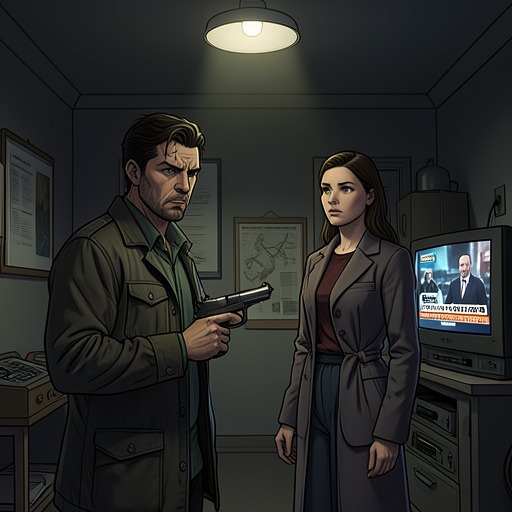
Andrew pulls the case into the trunk area and waves his palm over the sensor. Inside, on black neoprene lining, are his snub-nosed .38 special, loose bullets, and a small cardboard ammunition box with a torn, open flap. The box appears to have been roughly jostled during transport or storage. These details make access to the weapon a physical process rather than an effortless reversal: Andrew has to reach the panel, open the safe, and confront the ammunition and gun while Sabrina is breaking into the vehicle. The SUV’s concealed compartment makes the handgun available, but only after the vehicle has failed as transportation and become the setting for a close fight.
A Refuge That Cannot Carry Them Away
The SUV gives Andrew a locked space and access to his handgun, but neither advantage restores its original function. Its tires are damaged, Sabrina has broken a window, and Andrew’s injured knee makes moving through the vehicle difficult. The episode turns the SUV from a familiar, practical object into something newly prominent: its security depends on a door that happens to be unlocked, its storage on a biometric sensor Andrew can reach, and its promise of escape on tires that have been deliberately slashed.
Later, Eric proposes that he and Andrew get into the SUV and leave. Andrew answers that the tires have been slashed; Eric suggests driving on them anyway, but Andrew says the vehicle will not make it. The exchange preserves the difference between being able to enter the SUV and being able to use it to escape. In the cabin crisis, it offers no reliable way forward, even as its hidden gun safe briefly allows Andrew to arm himself. The vehicle’s importance lies in this divided function: it is at once a damaged means of transport, a contested refuge, and a repository whose contents alter what Andrew can do next.