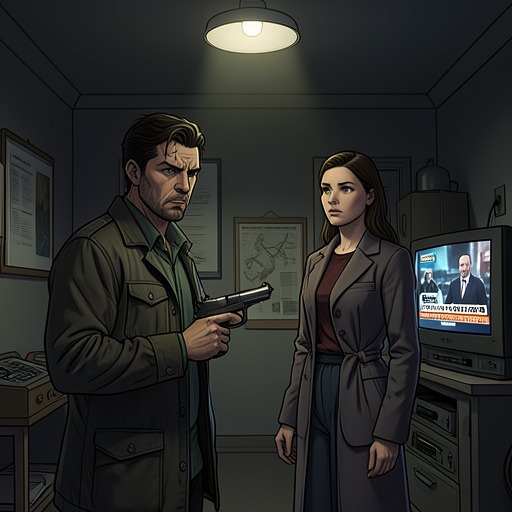
Andrew's .38 special revolver
The Cabin at the End of the WorldAndrew’s Taurus snub-nosed .38 Special is a firearm he brings to the New Hampshire cabin without telling Eric, hoping it will offer protection in an unfamiliar setting. Its presence matters less as an instrument used in the confrontation than as a source of private reassurance and a flashpoint in Andrew’s history of fear. When strangers threaten the family, Andrew says he has a gun, but the revolver is not within reach: it remains locked in a safe in the SUV. The distinction between owning a weapon and being able to use it turns his claim into a bluff, one that Redmond sees through.
Identity and Background
Andrew’s relationship with firearms begins in Vermont, where his father took him hunting. When Andrew was ten, his father gave him a .22 rifle. Andrew did shoot deer and squirrels, but he did not enjoy hunting or killing animals; target practice was the part he liked. As a teenager, he spent long stretches shooting at a gray tree stump behind the family farmhouse. Guns therefore predate his adult fear of violence: they belong to an earlier life he later tried to leave behind.
After moving to Boston, Andrew rejected the guns associated with his Vermont upbringing. That rejection changed after he was attacked in a bar near Boston Garden thirteen years before the cabin crisis. He took self-defense and boxing classes, which helped him feel more empowered and reduced his nightmares and anxiety, but did not make the effects of the assault disappear. Within a year of the attack, he obtained a Massachusetts gun license and joined a shooting range. The revolver reflects a return to a familiar skill as much as a new form of personal security.
Andrew tells himself that shooting helps reclaim a part of himself that the assault left feeling lost. His private explanation is not the whole story: he also finds it satisfying to imagine the paper target as the attacker while firing at the range, a practice he does about once a month. The gun thus holds two meanings at once. It is a means of rehearsing control, and a reminder that fear and anger still shape how Andrew imagines protection.
Storage, Secrecy, and the Cabin
At home, Andrew keeps the gun inside a notebook-sized safe in a closet. The safe, which he bought eight months earlier, can be opened with a touchpad combination or a biometric palm-print reader; a safety key provides another way to open it if the battery fails. The firearm is therefore not simply left accessible. Its storage arrangements also reflect the care Andrew and Eric have taken to keep it off-limits to Wen.
Andrew decides to bring the safe and gun only minutes before leaving for the cabin. While Eric and Wen are out getting coffee and doughnuts, he makes a final walk through the condo and abruptly decides the gun is important. He imagines possible dangers: wild animals, or people hostile to his family following them from a supermarket or finding them at their remote cabin. He recognizes that he is dwelling on worst-case possibilities and tries to make the thought seem ridiculous by humming Dueling Banjos, but he still puts the safe in the SUV’s side-panel storage compartment.
He does not tell Eric about the decision. The omission is deliberate: Andrew knows Eric would object to taking the gun on vacation and worries that the conversation would bring renewed concern about Wen finding the safe. The couple had already discussed the firearm more than once, including after adopting Wen, and agreed that it and the safe were not for her to access. Andrew understands that concealing the decision is unfair, but avoids the disagreement rather than resolving it.
The Bluff at the Door
When Redmond threatens to enter the cabin, Andrew yells that he has a gun. As he confronts the people outside, he imagines pointing its barrel at Redmond. The image is driven not only by the immediate threat but by what Redmond represents to Andrew: the familiar hostility of men who have made him feel watched, unsafe, or pressured to alter how he acts. Andrew’s anger gives the imagined weapon a force that the actual one cannot have in that moment, because he left it in the SUV rather than carrying it into the cabin.
Andrew names the gun and threatens consequences if the group breaks in, attempting to make his warning convincing. Eric pulls him away from the door and asks whether he really brought it. Andrew’s answer is qualified: he has brought the gun, but it is secured in the safe in the vehicle. The exchange makes the practical limitation plain. The weapon exists, but Andrew cannot simply produce it during the standoff, and the threat he has made exceeds what he can immediately carry out.
Redmond challenges the claim and calls Andrew’s bluff. His certainty changes the gun from a hidden safeguard into a liability in the confrontation: Andrew has revealed that he is willing to threaten force without having the firearm at hand. The scene does not show Andrew firing the revolver. Instead, it makes the difference between the gun’s imagined presence and its actual location part of the danger.
Significance
The revolver connects Andrew’s childhood familiarity with guns to adult vulnerability after the assault. It offers a way to recover a sense of agency, but that sense depends partly on private rituals and imagined scenarios: the monthly practice at the range, the target standing in for his attacker, and the decision to bring the weapon to a remote cabin. Those uses coexist with Andrew’s recognition that he is imagining risks, rather than proof that the feared events will occur.
The gun also exposes a tension between Andrew and Eric over safety. Andrew regards it as a possible answer to danger; Eric’s reservations concern the risks of keeping it in the family home, especially where Wen might encounter it. Andrew’s choice to bring it without telling Eric carries that unresolved disagreement into the trip. At the cabin, however, the firearm cannot settle the conflict or secure the family. Its storage in the SUV makes the object’s absence as consequential as its ownership, while Redmond’s response reveals that a threatened weapon has power only so long as others believe it can be brought to bear.