Cabin in New Hampshire
The Cabin at the End of the WorldCabin in New Hampshire is a small red lakeside house that becomes the center of a siege and an imposed sacrificial choice. Leonard says that he and his companions saw the cabin in visions before finding it, including its lake, dirt road, and front door; he believes a family there has been chosen to decide whether one of its members will die to save the world. The house’s rooms and domestic routines become part of that demand, while the family’s resistance gradually changes how the place is seen: by morning, Andrew regards it as a house transformed by the violence within it.
Setting and Recognition
The cabin is identified in Leonard’s account as a little red building beside a lake, reached by a dirt road. He describes recognizing not only the setting but details of its front door, including the grain of the wood. In his telling, the visions showed him that a family would be there and would face a choice involving sacrifice. He presents this foreknowledge as evidence that the group has been selected for a test, though Andrew disputes Leonard’s account of who is involved and what the visions mean.
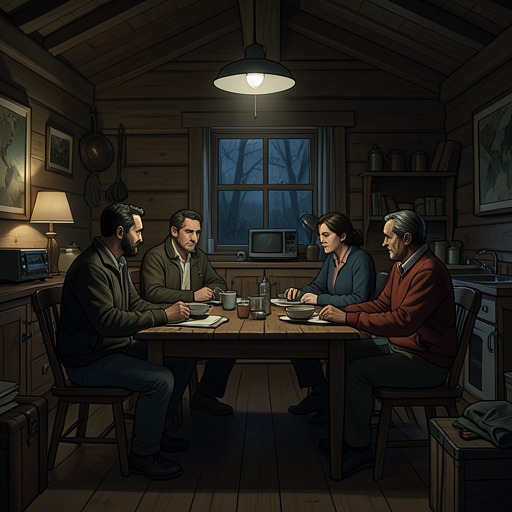
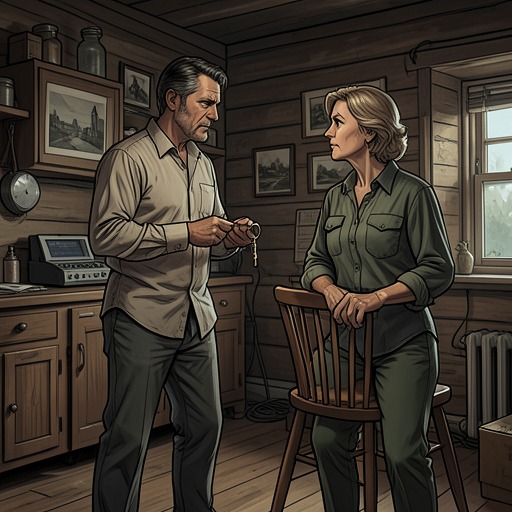
The building’s interior is organized around familiar household spaces: bedrooms, a common room, a bathroom, a couch, and a kitchen table. Its front door and the nearby windows define the limits of movement during the family’s captivity. The cabin also has a woodburning stove and a porous screen slider; when the temperature falls into the high fifties, a fire provides little lasting warmth because heat escapes through the screen. These details make the house both a lived-in family space and an inadequate shelter for people kept there overnight.
The Cabin Under Siege
The captors use the cabin’s common room for both routine and confrontation. After Sabrina changes the television from coverage of a devastating earthquake and tsunami in the northern Pacific to Cartoon Network, Wen sits with Eric and watches Adventure Time. Andrew’s suggestion that she sit with Eric serves a double purpose: he recognizes Eric’s need for time with Wen, while also wanting room to work on his restraints without drawing her attention. The cartoons provide a brief interval of ordinary family life amid the visitors’ continuing demand.
During a commercial, Leonard restates the choice. He calls the sacrifice a gift and says the family will have until the following morning to make it; otherwise, he says, the world will move closer to permanent midnight. He promises that the visitors will meet their needs within limits and leave them time to reflect. The cabin’s everyday amenities therefore sit alongside a repeated ultimatum: television, food, and sleeping arrangements are offered within a situation the family has not chosen.
As night approaches, the cabin’s rooms are rearranged around the captors’ control. The mattresses are moved into the common room, with the queen-size mattress placed between two singles. Andrew and Eric are kept seated near the front door, while Wen is allowed to sleep on the larger mattress. Leonard sits with Wen on the couch beside the sledgehammer. The contrast between a family sleeping arrangement and the men’s restricted place in the room makes the house’s domestic layout register the unequal conditions of their captivity.
Morning and Material Traces
The next morning, the cabin remains cold despite a fire in the stove. Andrew is confident he can free himself after the others fall asleep, while Eric, still recovering from a concussion, is exhausted. They kiss Wen good night and reassure her that they will protect her. She gives little response and goes to bed with Corey, her stuffed-animal pig. The scene makes the house a setting for care as well as confinement: Andrew and Eric’s efforts to comfort Wen persist even when their assurances cannot undo what she has witnessed.
After breakfast, Sabrina checks Eric’s dressing and says the wound is not infected. The visitors clear the blankets and mattresses from the common room, then Leonard moves Andrew, still tied to his chair, away from the front door. The chair’s passage leaves parallel gouges in the wooden floor. Eric asks not to be dragged because of his head and offers to walk; Leonard refuses. The cabin’s furnishings thus register the practical aftermath of captivity, with rearranged bedding and damaged floorboards marking the change from improvised household routine back to enforced control.
A House Changed by Violence
When Andrew returns across the front lawn, the cabin appears different to him despite the morning sunlight. He notices dulled paint on the door and trim, mildew spots on the shingles, and shingles that sit unevenly. He understands the house as having been marked by the previous day’s violence, and imagines further desperate acts accumulating there. This is Andrew’s perception of the place, not a separate change in its ownership or physical structure; the shift lies in what the building has come to mean after the family’s experience inside it.
The grasshopper jar in the lawn sharpens that change. It lies on its side in the grass, its glass catching the sunlight and its aluminum lid still tightly screwed on. Andrew had hoped Leonard had released Wen’s seven named grasshoppers, but now thinks the jar most likely still contains them dead. The object connects the cabin’s immediate crisis to Wen’s small, specific attachment, and makes the lawn part of the same pattern of threatened care that defines the rooms within.
Cabin in New Hampshire is therefore more than the location of Leonard’s test. Its screen, stove, bedrooms, television, door, floor, and lawn each acquire meaning through the struggle over who can move, who can care for Wen, and whether the family will accept the demanded sacrifice. The ordinary house that Leonard treats as proof of a divine selection becomes, in Andrew’s view, a place bearing the consequences of human violence.