Eric
The Cabin at the End of the WorldEric is Andrew’s husband and Wen’s co-parent, a protective father whose resistance to the visitors’ demand for a sacrifice is complicated by physical vulnerability, grief, and an unexplained vision. He tries to hold to the family’s refusal even as disaster reports seem to validate the visitors’ predictions; after Wen’s death, he briefly wavers, then joins Andrew in rejecting the final demand that one of them die.
Identity and Family Life
At Gaudet Lake, Eric’s attention is drawn both to the landscape and to the practical risks around his family. The cabin’s dock is warped, bleached gray, and visibly poorly maintained, so he would rather everyone stay off it. Andrew has promised to teach Wen to fish there, however, and Eric knows his partner may act before their discussion can settle the question: the previous afternoon Andrew ran across the dock and jumped into the lake. Eric’s concern is not simply about the structure. He imagines Wen reacting to the worm and the barbed hook, but also recognizes that she might enjoy fishing and insist on baiting the hook herself. Her fierce independence reminds him of Andrew; it makes him love her while increasing his worry for her safety.
The setting intensifies the contrast between domestic life and the ordeal that follows. From the elevated deck, Eric looks across the deep lake, ringed by forest and the distant White Mountains. The cabins and camps on the shore are hidden from view, and the family watches a yellow canoe disappear along the far side. The landscape is remote from their ordinary urban lives. In that apparent refuge, Eric’s attention remains fixed on keeping Andrew and Wen safe.
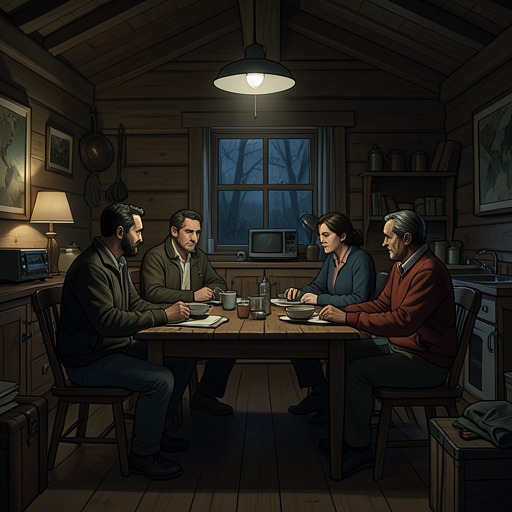
When Wen becomes frightened, Eric first tries to understand what has alarmed her. She urgently tells her fathers that people have arrived and want to speak with them, and that some of the visitors frighten her. Eric and Andrew follow her inside. Wen then blocks the sliding door with a sawed-off hockey stick, using a method Andrew had shown her the night before. The moment reveals both her ability to act under pressure and the parental knowledge that has prepared her to do so. Eric’s family role is expressed in this shared, practical response: Wen warns them, Andrew’s earlier instruction becomes useful, and Eric follows her lead into the cabin.
Resistance and Confrontation
The visitors’ demand forces Eric to state the family’s position plainly. He tells them that neither he nor his family will choose someone to die, and that they will not harm one another or anyone else. He presents refusal not as a temporary delay but as a boundary. Leonard counters by claiming that he and the others have been shown what will happen if the family does not make a sacrifice. Eric’s answer is important because it refuses the visitors’ framing of killing as an unavoidable decision, even as their certainty and the threatening circumstances make that refusal costly.
Eric also tries to persuade the visitors that they remain responsible for their own actions. When they return with the same choice, he tells them that they still have the power to release the family and that they need not continue what they are doing. He reads Adriane’s unease and empty hands as signs that she may be the next person placed in danger if the family refuses again. The thought frightens him because it suggests a cycle in which the visitors themselves may be killed, but he cannot see where such a cycle would end. His concern therefore extends beyond his immediate household, even while the visitors hold the power over it.
During a violent struggle in the cabin, Eric is left with a concussion and later faces a second, more intense period of symptoms. At another point he is still impaired and physically constrained, yet tries to protect Wen and keep her near him. When she begs to go outside because she believes seven grasshoppers remain trapped in a jar, Eric responds by drawing her close. His hands and wrists are raw from being bound, but he releases his arms from behind the chair and embraces her. The others react with surprise at how casually he has freed himself. The small domestic crisis of Wen’s named grasshoppers sits beside the larger threat: even in captivity, her distress matters to Eric as an immediate parental responsibility.
Vision, Doubt, and Grief
Eric’s experience of the visitors’ predictions is never purely intellectual. The news images and sounds leave him shaken, and he continues to question a remembered figure made of light. He cannot settle whether he saw something supernatural or whether the experience had a physical explanation. Earlier he has considered that a flash of light, an ocular migraine, concussion, or stress might account for what he experienced. His uncertainty remains part of the ordeal rather than being resolved into certainty.
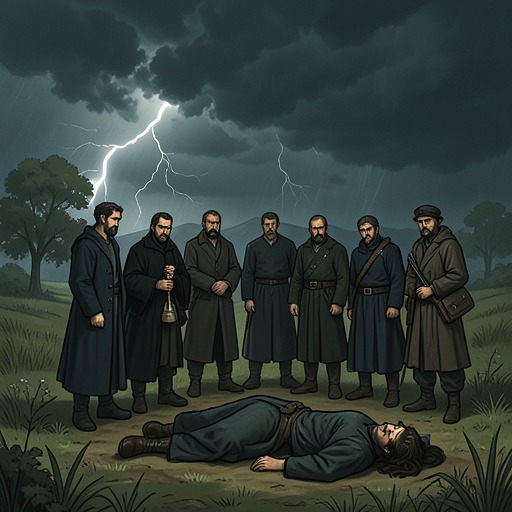
Later, Eric gives a more specific account of the vision to a nurse. Before Redmond was killed, he felt a presence in the room as if its arrival displaced the surrounding space. He says he saw the figure join the circle around Redmond before the others began beating him. Eric had tried to dismiss it as a flash, migraine, or hallucination brought on by concussion and stress, but remembers that it seemed to regard him. He says he felt the presence again after Adriane and Wen died, and that he shut the cabin’s front door to keep it outside. When asked whether it is present, he says no, though he believes it will return soon. The account deepens his doubt without confirming what the figure was.
Wen’s death changes the pressure on Eric’s refusal. Leonard argues that her death was accidental and therefore did not count as the willing sacrifice required to stop the apocalypse; he points to the predicted plague as confirmation that catastrophe is continuing. Exhausted and grieving, Eric fears that denying Leonard’s claim may mean the family will never be allowed to leave. He apologizes, a response that Andrew immediately recognizes as uncertain and challenges as a product of Eric’s impaired state. Eric’s momentary willingness to consider Leonard’s argument does not erase his earlier refusal, but it shows how grief and physical distress can make the visitors’ explanation feel persuasive.
Relationship with Andrew and the Ending
Andrew remains Eric’s closest source of support and the person with whom he must make the final decision. Their care for each other is not abstract: Andrew previously held Eric through a rare episode of crying after Andrew returned from a two-day hospital stay following an attack at a Boston bar. Now, after the losses at the cabin, Andrew apologizes for a remark about Eric’s Christianity. Eric tries to explain that he saw and felt something real, while Andrew maintains that concussion may explain the experience. They disagree about its cause without withdrawing their care for one another. Andrew’s response gives Eric room to describe what he believes happened without requiring Andrew to affirm it as supernatural.
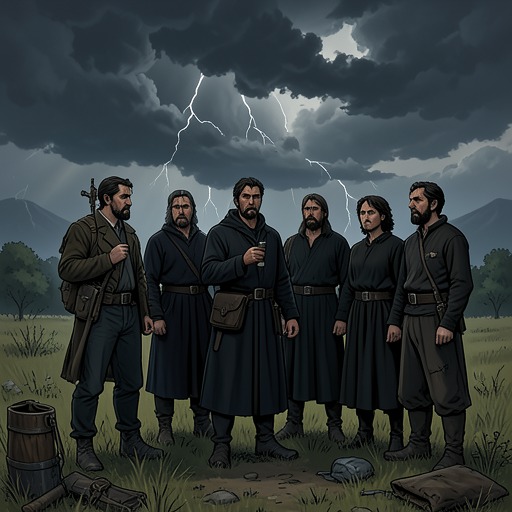
The closing decision brings their conflict back to the visitors’ demand: one of the two men must supposedly choose to die so the world can be saved. Eric and Andrew instead choose to remain together and continue living. Eric pulls the gun from Andrew’s chest, lowers his arm, and drops the weapon onto the forest floor. He leans into Andrew, who leans back; their fingers find each other and hold on. The storm around them remains threatening, and Eric cannot know whether this one differs from the others. The ending does not resolve the truth of the vision or promise that the apocalypse will stop. It resolves Eric’s choice: rather than turn love into a means of selecting a victim, he joins Andrew in facing uncertainty together.