Eric lowers the pistol and they choose to go on living
The Cabin at the End of the WorldEric lowers the pistol and they choose to go on living marks the decisive refusal at the story’s center: faced with a demand that one family member be killed to save the world, Eric and Andrew will not make one another the sacrifice. They set aside the weapon and commit instead to finding the truck keys, carrying Wen, and walking on together, even though they cannot be certain the catastrophe will not come.
The choice imposed on the family
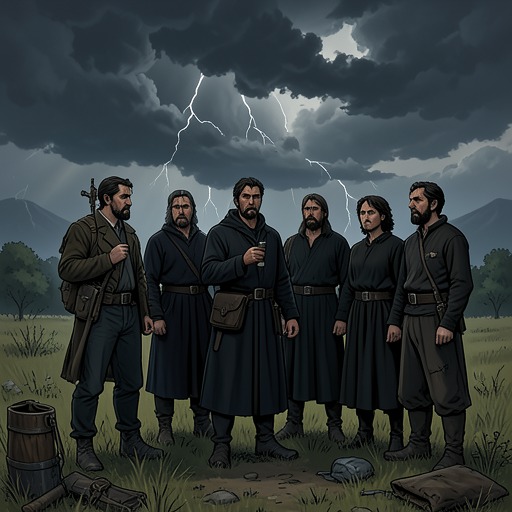
Leonard presents the family with a stark condition: they must willingly choose one of their three members and then kill that person, or the rest of humanity—more than seven billion people—will perish. He says the chosen family will survive only to witness the end and remain alone in the devastated world. Andrew is caught between terror at the possible consequences and disbelief at the demand; imagining Cambridge and Boston reduced to ruins makes the threat difficult to dismiss, but does not make the prescribed killing acceptable.
The choice is not offered under ordinary conditions. Leonard and his companions have entered the cabin by force, restrained Andrew, Eric, and Wen, and insist that the family remain with them until a choice is made or the available time runs out. Leonard promises not to harm the family further and says they will provide for their needs within reason, but that assurance leaves the central pressure intact: the family is confined, facing a threat to all humanity, and told that responsibility for preventing it rests on their decision. Leonard later calls the same demand a gift and says the family will be asked again the following morning. The language of choice and generosity therefore sits uneasily beside the confinement and the threatened consequences of refusal.
Delay and the question of belief
The family does not accept the demand when it is repeated. Andrew says that he and Eric will not change their minds, while Eric tries to keep the visitors talking rather than let the confrontation advance. He asks Adriane about the restaurants where she used to work, a bid to prolong the conversation at a moment when the group is closing in and Sabrina insists that the family must choose. The exchange makes the refusal more than a single declaration: under mounting pressure, Eric uses conversation to buy time, while Andrew’s earlier defiance remains unchanged.
Later, Andrew tries to make their disagreement explicit by asking Eric whether he believes one of them must be killed by the other to prevent the world from ending. Eric does not answer directly; he asks why the visitors would invent the story and put the family through the ordeal. He then points to the disasters they have witnessed—drowned cities, plague, and the sky apparently breaking apart—and challenges Andrew’s attempt to reason them away. The crisis is thus not resolved by proving the visitors wrong. The possibility that the threat is real remains present even as the family rejects the act demanded of them.
The pistol is lowered
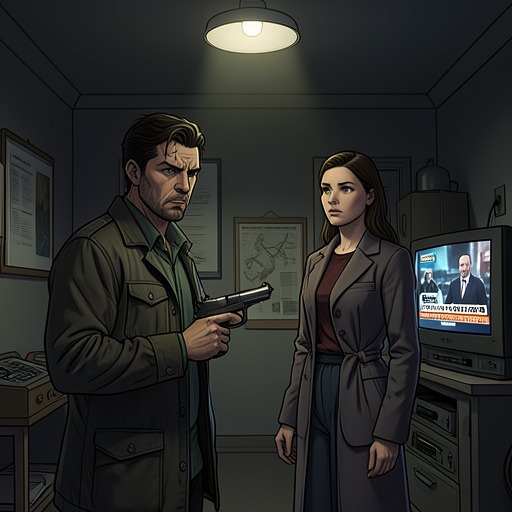
In the final exchange, Eric says he does not know what to do. Andrew answers with a concrete alternative: Eric will throw away the gun, and they will pick up the truck keys and walk down the road. Eric raises the possibility that the events are real. Andrew’s answer does not depend on disproving them; even if the prediction is true, he says, they still will not hurt one another.
Eric asks again what they can do if the catastrophe is real and they cannot go on. Andrew answers that they will go on. Eric has wanted to pull the gun away from Andrew’s chest and put it back beneath his own chin, but he does not do so. Instead, he pulls it away, lowers his arm, and drops the pistol onto the forest floor. Andrew leans into Eric, and Eric leans into Andrew. Their decision becomes physical: the weapon is no longer held between them, and they hold on to each other instead.
The family’s road forward
Their refusal does not produce a guarantee of safety or a resolution of the prophecy. The storm continues around them, and the possibility that it signifies something worse remains uncertain. What changes is what they are willing to do in response. They plan to retrieve the truck keys from the mud, lift Wen into their arms, and carry her with them. Their commitment includes remembering and loving her, as well as continuing to care for themselves; the family’s future is imagined as shared responsibility rather than a calculation of which member should die.
Andrew and Eric anticipate that the road may be flooded, blocked by fallen trees, or split by fissures. These are contingencies, not events the passage confirms have occurred. Their promise is to keep walking through whatever obstacles come, not to claim that the danger has passed. The closing declaration that they will go on turns the refusal into a chosen course of action. Eric’s lowered pistol is therefore both a rejection of the visitors’ sacrificial rule and a rejection of self-destruction: the two men accept uncertainty without making violence against one another its price.