Faith and Doubt
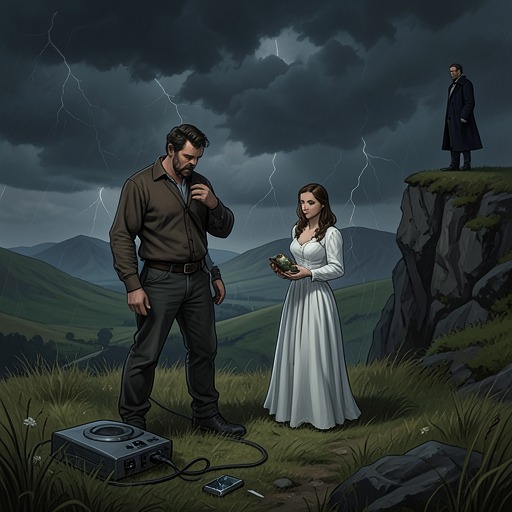
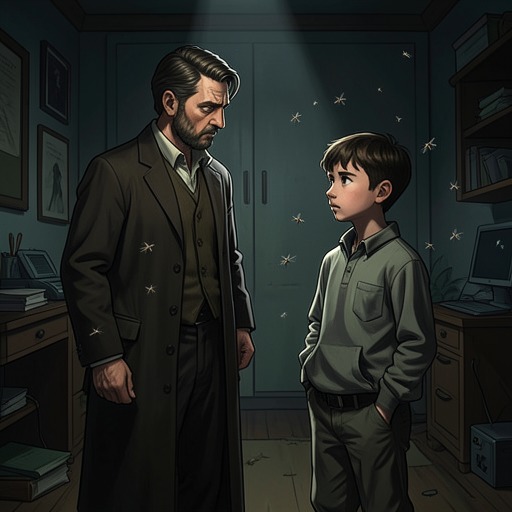
The Cabin at the End of the WorldFaith and Doubt is the struggle to decide what the visions mean, whom to trust, and whether any claimed divine command can justify what the group is demanding. In the cabin, religious conviction, skeptical explanations, personal testimony, and apparent predictions all collide. The narrative gives the characters reasons to question one another without finally settling whether the extraordinary events have a supernatural cause.
Claims of Revelation and the Demand for Proof
The visitors present their mission as a matter of salvation: they believe that a sacrifice can stop the approaching catastrophe. Andrew challenges the basis of that claim directly, asking who or what showed it to them. Leonard bows his head rather than answering, and Sabrina, Redmond, and Adriane remain silent. That silence marks a limit in their authority: they can insist on the necessity of the choice, but cannot provide an explanation that convinces their captives.
The dispute is not only about whether the visions occurred. It is also about who has the right to interpret them and impose their meaning on others. When Adriane presses for a decision, her urgent demand turns the visitors’ certainty into a practical threat. Andrew and Eric refuse to choose one of their family for sacrifice, and Eric describes the visitors as suffering from a shared delusion. His position is firm even though the evidence has not made him certain of a purely ordinary explanation.
Wen’s brief intervention sharpens the disagreement. She reports that Leonard told her God was making the visitors act. Andrew rejects that account, insisting that the visitors themselves are responsible and that Leonard would release the family if he were truly their friend. The contrast is between divine compulsion, as Leonard has explained it to Wen, and human agency, as Andrew insists on seeing it. Neither interpretation removes the immediate responsibility of the people holding the family captive.
Eric’s Catholicism and the Family’s Choice
Eric’s response to the religious claim is more complicated than simple disbelief. He identifies as Catholic and attends church regularly, sometimes on a weekday before work when he is especially stressed. Familiar prayers, hymns, and the practices of Mass comfort him, even though he struggles with both religious teachings and their messengers. His faith is habitual and emotionally sustaining, but it does not make him accept the visitors’ account of what God wants.
When Eric declares that God would not do this, he speaks with less confidence than his words suggest. He quickly prays silently for the family to be freed unharmed. His fear of being wrong sits beside his refusal to accept the sacrifice as a divine command: belief offers comfort, but it also makes the stakes of interpreting events feel more serious. Eric is not free of religious doubt; he is trying to act within it.
That tension predates the siege. In the weeks before Wen’s adoption, Eric reluctantly agreed with Andrew, an avowed agnostic, that they would not baptize Wen or require her to follow a religion. They intended to leave the choice to Wen when she was older, while Eric understood that their decision meant she would grow up without a religious upbringing. He has not secretly tried to convert her, but the choice sometimes troubles him as a withholding of something important in his own life. The crisis makes that private tension newly immediate when Wen repeats Leonard’s explanation of God’s role.
Testimony, Identity, and the Possibility of Delusion
Andrew tries to weaken the visitors’ shared account through a specific claim about Redmond’s identity. He says that nearly thirteen years earlier, Jeff O’Bannon attacked him in a Boston bar, and he identifies Redmond as the same man. Andrew offers a checkable route to confirmation: the name on Redmond’s wallet and license. Sabrina accepts that Andrew is not inventing the assault, while Adriane points to the scar on the back of his neck as evidence that the attack happened. Their responses do not immediately establish that Redmond is Jeff O’Bannon, but they make Andrew’s testimony harder to dismiss outright.
The account unsettles the group because Redmond had been incorporated into a sacred narrative of shared visions and chosen duty. Leonard first resists the possibility that Andrew could know this history, then allows that Redmond might not be the person Andrew believes him to be. Sabrina and Adriane move away from Leonard rather than remaining close to him. The shift does not resolve the identity dispute; it exposes how much the visitors’ confidence depends on trusting one another and on treating their visions as mutually confirming.
Andrew also interprets the group through a contemporary, nonreligious framework. He recalls accounts of people who understand themselves as targeted individuals and seek support in online communities, including message boards where others reinforce similar persecutory beliefs. He wonders whether the visitors encountered one another online and whether that shared environment could have strengthened a delusion rather than proved a prophecy. This remains Andrew’s explanation, not an established account of how the group formed. He also recognizes that challenging their belief might make them more uncertain—or more dangerous.
Apparent Fulfillment and Unsettled Evidence
Leonard describes the visions in concrete terms: he saw the lake, the small red cabin, its dirt road, and even the grain of the front door. He says he knew a family would be there and that the family would have to make a sacrifice to save everyone. For Leonard, this precision validates a divine test. He presents the suffering as temporary and insists that the world will end if the test is failed. The same details that make the vision persuasive to him can also be read as a frightening claim imposed on the family, rather than proof that the sacrifice is required.
Eric later confronts an important complication in the visitors’ knowledge. The Alaskan earthquake and tsunami warnings had already occurred before they reached the cabin, so their awareness of those events does not establish foreknowledge. But Eric distinguishes those warnings from a later earthquake that killed people while the family watched events unfold. Adriane had said she saw that second quake happening at a beach with Haystack Rock. Eric acknowledges that this event was predicted, and silently hopes he is wrong about what it means. The detail supports the possibility that the visitors’ visions correspond to events without proving Leonard’s claim that the family must comply with a divine command.
Eric also remembers a figure made of light and tries to understand it as time made manifest. The interpretation feels closer to him than a straightforward account, but he does not present it as settled knowledge. Later, when he asks Sabrina whether she saw such a figure, she says she did not, while leaving open the possibility that it was present. Her answer neither confirms Eric’s experience nor rules it out. The account preserves uncertainty at the level of individual perception, not just competing doctrines.
Doubt After the Visions
As the crisis develops, doubt becomes a fracture within the visitors’ own group. Leonard is battered and diminished; Sabrina stands apart from him, and they question whether they shared the same visions and commands or truly know one another. Their prolonged looks bring no reassurance. Instead, both recognize their isolation and uncertainty about the other’s character. The claimed revelation that bound them together has not produced a durable trust between them.
Sabrina eventually drops her weapon and acknowledges that she never believed in the mission, describing the situation as hell. Her admission does not undo what has happened, but it marks a decisive break between the language of sacred testing and her own judgment. Faith and Doubt therefore remains unresolved as a question about supernatural truth, yet becomes concrete as a question of conduct: visions may be sincerely experienced, and disasters may appear to fulfill them, without making the demand for a human sacrifice morally inevitable. The narrative’s uncertainty does not suspend responsibility; it leaves responsibility with the people who must choose what to do.